Information and Course Guide
|
| Contents | |
| Welcome | |
| 1. | Study Requirements |
| 1.1. | General Requirements |
| 1.2. | Credits |
| 1.3. | Industrial Training |
| 1.4. | Bachelor Thesis |
| 1.5. | Language Skills |
| 2. | Exam |
| 2.1. | Registration |
| 2.2. | Withdrawal |
| 2.3. | Dates of exams |
| 2.4. | Results |
| 3. | Notice Board |
| 4. | Computer |
| 5. | Library |
| 6. | Option 1: Power Supply Systems |
| 6.1. | Course Guide for the 8th semester |
| 6.2. | Course Guide for the 9th semester |
| 6.3. | Additional classes |
| 7. | Option 2: Power System Engineering |
| 7.1. | Course Guide for the 8th semester |
| 7.2. | Course Guide for the 9th semester |
| 7.3. | Additional classes |
| 8. | Diploma examinations |
| 8.1. | Diploma Thesis |
| 8.2. | Acceptance and Valuation of the Diploma Thesis |
| 9. | Curriculum of the academic year |
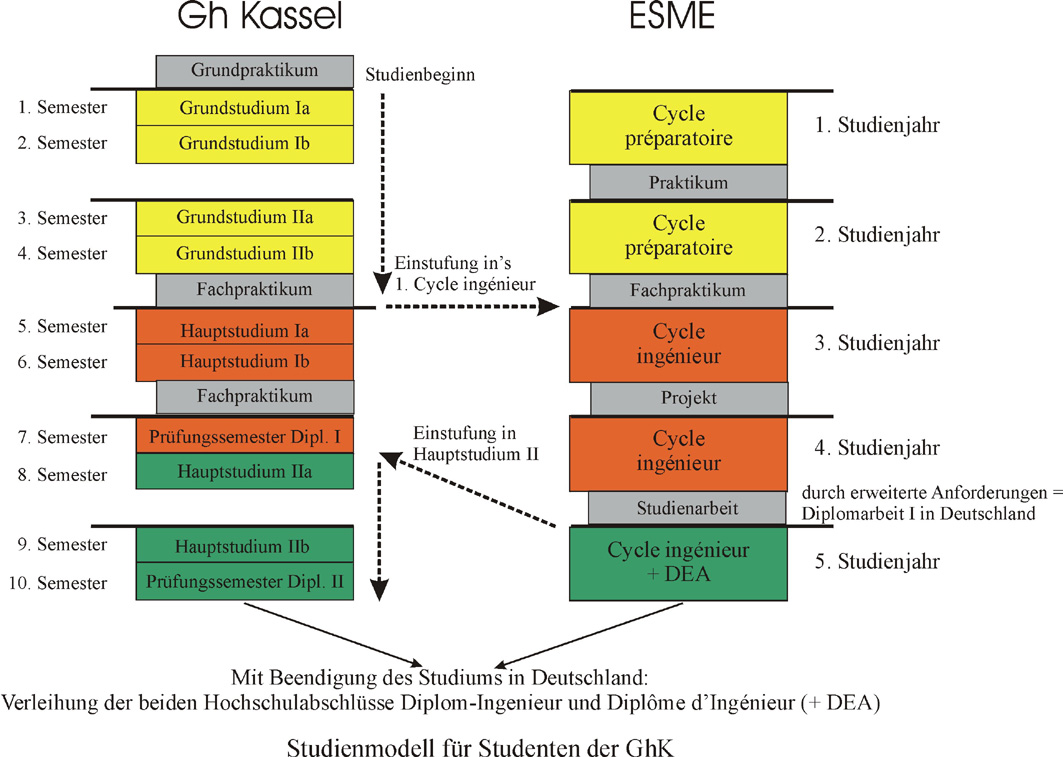
| 10. | Study course |
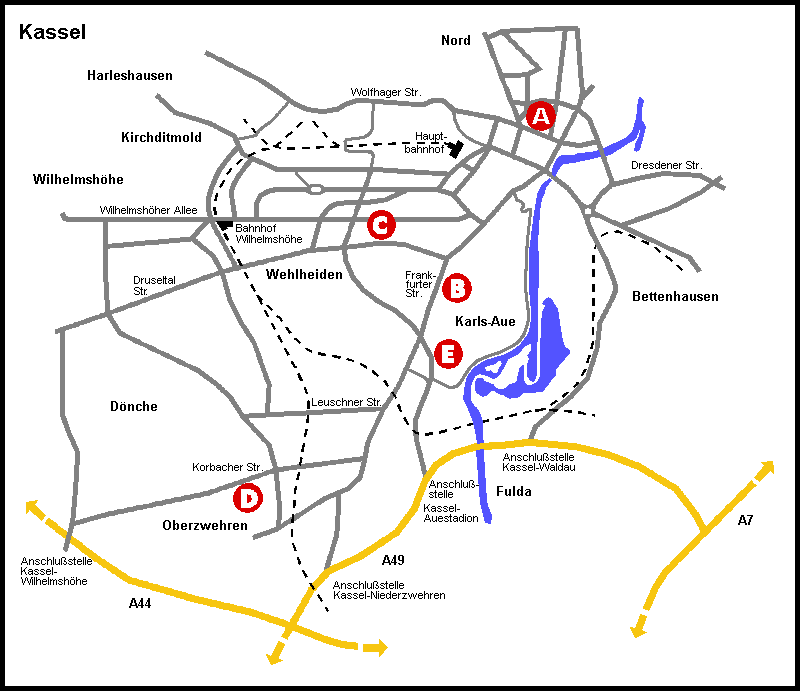
| 11. | Kassel: city map |
Welcome and Preface
Welcome to the University of Kassel. To make your experience at the university the most rewarding experience of your life and to avoid confusion, we like to provide you with some information beforehand. This brochure contains information about the university and the faculty of Electrical Engineering.
The University of Kassel and ESME Sudria in Paris belong to the first universities in France and Germany offering the chance to achieve two diplomas within one field of study. On the basis of adjusted models, students attend the exchange university for one to two years. After graduation they achieve the diplomas of two countries – without adding any extra time. High motivation and additional language abilities are the keys to participate in this programme.
The exchange programme is focussing on the following aims - besides the academic advantages:
Especially the industrial training that is integrated in the exchange programme gives the students a good inside view of the other countries work environment.
In April 2000 the first French-German diploma was given away: a 23-year-old student from Paris graduated in Kassel. The double diploma can be seen as the preparation for a future European diploma. To get more experience with different countries, the University of Kassel is maintaining a comparable international model of study to the University of Reading, Great Britain. Students, attending the University of Kassel, have the chance to study in three European countries to achieve a three-country-certificate. The university accepts all credits students get at the exchange universities.
| Kassel, May 2000 | Prof. Dr. Ing. S. Hentschke - representative of foreign affairs at the faculty of Electrical Engineering - |
you must fulfill to study at the University of Kassel.
French students must fulfill the following requirements to participate in the Master programme (the second study phase) in Kassel:
You must give proof of your admittance to a university in France or to ESME.
Also you must have completed a two-year fundamental education (preparatoire) at ESME or any other university in France. This is an equivalent to the German Vordiplom or the English bachelor degree. This has to be proven by certificates.
Further, you must be a registered full-time student at ESME. While studying in Kassel, you will be registered at both universities, at ESME and at the University of Kassel.
You must have completed a two-year education at ESME. You have received a minimum of 120 ECTS credits for four semesters. Also, you can give proof of all exams you have passed.
You’ll continue your chosen subject of study in Kassel (which is either Power Supply Systems or Power System Engineering).
You must have sufficient knowledge of the German language. To prove this, you have participated in a language test for students who plan to study at a German university.
You must have completed an industrial training of at least 20 weeks during the study period (usually in France). You can give proof of a training in an industrial company in France or a research institute in form of a certificate and a written report.
You must have completed an individual laboratory work, which is documented by a written thesis and has a time value of at least 12 hours per week. You must have finished an academic paper (can be written in French), which has to be presented as Bachelor Thesis. A French professor has to accept and valuate the diploma thesis.
The language center in Kassel offers a language training as preparation for your studies. It takes place in September and you must separately pay for these four weeks. You must apply at least eight weeks in advance.
For those who will stay in Kassel to finish their degree with the Master of Science, this section and the section about the diploma examinations in section 8 offer important information about the exam and some regulations. Read carefully and in case of questions contact your advisor or other staff members of the Electrical Engineering faculty.
To participate in the exams you have to register for each one before the announced date. Application forms (colored white) are available in front of the students‘ office (room #1326). You have to fill in the form and leave it with the staff in the students‘ office or leave it in the mail box. Later, check for your successful registration on the Notice Board, since all registered students are listed there.
There is a chance to withdraw, in case you decide to not participate in an exam. If you do withdraw, you must fill an official form (colored red and available in front of the students’ office) and give this to the students‘ office (room 1326) or leave it in the mail box in front of it. The staff will amend your records. Last chance to withdraw is a complete week before the exam, but may vary from class to class. So, make sure you know the last day of withdrawal for each exam.
The reliable source to find out about the dates of your exams is the Notice Board. Also changes at short notice will be announced here.
The results of the exams are either published on the Notice Board or in front of the office of the professor. Please, have your student I.D. number with you to check on your results.
This is a special examination board. Any timetable changes, exam dates etc. will be posted here as well as office hours of professors and other useful information. We assume you check this regularly, since this is the place where you can reliably check on examinations, on your addmittance to an exam, and on your results. So, make sure that you check this board frequently.
Where to find it:
The Notice Board is situated in front of the students‘ office (Room 1326) on the right side of the building, on the first floor.
Computer with internet access are available for all students of the University of Kassel with an extra mark in the student I.D. and a payment of 10,- marks per semester.
You can find a computer room at the university location IV (Wilhelmshöher Allee). More computers are available on the main campus of the university (Georg Forster Strasse).
The main library is situated on the main campus of the University of Kassel (Diagonale 10). Check the main course guide for opening hours. A minor library for the students of Electrical Engineering can be found in the university location IV (Wilhelmshöher Allee).
6. Option 1:Power Supply Systems
6.1. Course Guide for the 8th semester
| Subject of Study | Hours per Week | ECTS | |
|---|---|---|---|
| 1 | Special Topics: Higher Mathematics | 2 | 3 |
| 2 | Electromagnetic Field Theory I | 3 | 4,5 |
| 3 | Electromagnetic Field Theory II or Theory and Methods of Design of Electromagnetic Fields |
3 | 4,5 |
| 4 | Class of your choice that deals with social, economic, or law topics | 2 | 3 |
| 5 | Controlling of Electrical Power Supply Units | 3 | 4,5 |
| 6 | Energy Management | 3 | 4,5 |
| 7 | Automatic Control Engineering I* | 4 | 6 |
| 8 | Sampling Control*/** | 2 | 2** |
| TOTAL | 22 | 32 |
*Classes listed in section 6.3 may be substituted for classes above marked with an asterisk (*). These classes are either offered in the winter semester or in the summer semester. Please check the current course guide.
**See course guide for the 9th semester.
Note : before you start the new semester in Germany, you are supposed to discuss your personal schedule with an advisor. He/she has to give his/her approval of the classes you want to take. Your advisor will be the head of the board of examiners.
6.2. Course Guide for the 9th semester
| Subject of Study | Hours per Week | ECTS | |
|---|---|---|---|
| 1 | Lecture in the faculty of Electrical Engineering | 2 | 3 |
| 2 | Fundamentals of Computer Science Engineering or Fundamentals of Communication Engineering |
4 | 6 |
| 3 | Control Engineering** | 4 | 4** |
| 4 | Practical: Energy Engineering II | 2 | 3 |
| 5 | Class of your choice that deals with social, economic, or law topics | 2 | 3 |
| 6 | Diploma Thesis | 2 months | 10 |
| TOTAL | 14 | 29 |
*You must register for your Diploma examinations in the 9th semester and you’ll start working on your diploma thesis the remaining two months of the semester. Accordingly, you receive 10 ECTS points. Results of examinations you haven’t taken at this time must be handed in later.
**You must chose classes of a minimum of six hours per week for your diploma examinations, which take place in the 10th semester. Therefore, you don’t receive the full amount of ECTS points. Also see class marked with a double asterisk (**) in the 8th semester.
| Subject of Study | Hours per Week | ECTS | |
|---|---|---|---|
| 1 | Electrical Industrial and High Voltage Engineering II | 3 | 4,5 |
| 2 | Drive Engineering II | 3 | 4,5 |
| 3 | Thermodynamics of Fluidic Machines | 2 | 3 |
| 4 | Electronic Power Converter in the Power Supply | 3 | 4,5 |
| 5 | Simulation of Technical Systems | 2 | 3 |
| 6 | Use of Solar Radiant Energy I, II | 4 | 6 |
| 7 | Aspects of Power Economics I, II | 4 | 6 |
| 8 | Dynamic Behavior of Electrical Engines | 3 | 4,5 |
| 9 | Linear Optimal Control | 3 | 4,5 |
| 10 | Electrochemical Energy Storage Mechanisms | 2 | 3 |
| 11 | Use of Wind Energy | 2 | 3 |
| 12 | Controlling and Integration of Networks of Wind Power Stations | 2 | 3 |
| 13 | Electromagnetic Compatibility | 2 | 3 |
| 14 | Digital Engineering II | 2 | 3 |
| 15 | Analogue and Digital Methods of Measurement | 4 | 6 |
| 16 | Measuring of physical (non-electric) Units | 4 | 6 |
| 17 | Electromagnetic Field Theory II | 3 | 4,5 |
| 18 | Other classes supporting the study of Electrical Engineering | 4 | 6 |
You must take a total of, at least, 36 hours per week in the 8 th and 9th semester, from which 30 hours are considered as part of your diploma examinations beforehand and six hours are part of the examinations.
7. Option 2:Power System Engineering
7.1. Course Guide for the 8th semester
| Subject of Study | Hours per Week | ECTS | |
|---|---|---|---|
| 1 | Special Topics: Higher Mathematics | 2 | 3 |
| 2 | Electromagnetic Field Theory I | 3 | 4,5 |
| 3 | Electromagnetic Field Theory II or Theory and Methods of Design of Electromagnetic Fields |
3 | 4,5 |
| 4 | Class of your choice that deals with social, economic, or law topics | 2 | 3 |
| 5 | Drive Engineering II | 3 | 4,5 |
| 6 | The Dynamic Behavior of Electrical Engines | 3 | 4,5 |
| 7 | Thermodynamics of Fluidic Machines* | 2 | 3 |
| 6 | Sampling Control* | 2 | 3 |
| 8 | Use of Wind Energy*/** | 2 | 2** |
| TOTAL | 22 | 32 |
*Classes listed in section 7.3 may be substituted for classes above marked with an asterisk (*). These classes are either offered in the winter semester or in the summer semester. Please check the current course guide.
**See course guide for the 9th semester.
Note: before you start the new semester in Germany, you are supposed to discuss your personal schedule with an advisor. He/she has to give his/her approval of the classes you want to take. Your advisor will be the head of the board of examiners.
7.2. Course Guide for the 9th semester
| Subject of Study | Hours per Week | ECTS | |
|---|---|---|---|
| 1 | Lecture in the faculty of Electrical Engineering** | 2 | 3 |
| 2 | Fundamentals of Computer Science Engineering or Fundamentals of Communication Engineering |
4 | 6 |
| 3 | Control Engineering** | 4 | 4** |
| 4 | Practical: Energy Engineering II | 2 | 3 |
| 5 | Class of your choice that deals with social, economic, or law topics | 2 | 3 |
| 6 | Diploma Thesis* | 2 months | 10 |
| TOTAL | 14 | 29 |
*You must register for your Diploma examinations in the 9th semester and you’ll start working on your diploma thesis the remaining two months of the semester. Accordingly, you receive 10 ECTS points. Results of examinations you haven’t taken at this time must be handed in later.
**You must chose classes of a minimum of six hour per week for your diploma examinations, which take place in the 10th semester. Therefore, you don’t receive the full amount of ECTS points for those classes. Also see class marked with a double asterisk (**) in the 8th semester.
| Subject of Study | Hours per Week | ECTS | |
|---|---|---|---|
| 1 | Electrical Industrial and High Voltage Engineering II | 3 | 4,5 |
| 2 | Controlling of Electrical Power Supply Units | 3 | 4,5 |
| 3 | Electric Power Converter in the Power Supply | 3 | 4,5 |
| 4 | Aspects of Power Economics I, II | 4 | 6 |
| 5 | Automatic Control Engineering I | 4 | 6 |
| 6 | Linear Optimal Control | 3 | 4,5 |
| 7 | Electrochemical Energy Storage Mechanisms | 2 | 3 |
| 8 | Use of Solar Radiant Energy I, II | 4 | 6 |
| 9 | Controlling and Integration of Networks of Wind Power Stations | 2 | 3 |
| 10 | Electromagnetic Compatibility | 2 | 3 |
| 11 | Digital Engineering II | 2 | 3 |
| 12 | Analogue and Digital Methods of Measurement | 4 | 6 |
| 13 | Measuring of Physical (non-electric) Units | 4 | 6 |
| 14 | Electromagnetic Field Theory II | 3 | 4,5 |
| 15 | Theory and Methods of Design of Electromagnetic Fields | 3 | 4,5 |
| 16 | Energy Management | 3 | 4,5 |
| 17 | Other classes supporting the study of Electrical Engineering | 4 | 6 |
You must take a total of, at least, 36 hours per week in the 8 th and 9th semester, from which 30 hours are considered as part of your diploma examinations beforehand and six hours are part of the examinations.
8. Diploma Examinations (Master of Science)
The diploma examinations include the following points that must be considered:
1. You must attend classes of a minimum of 36 hours per week in the 8th and 9th semester, the second phase of your studies. Of course, you are not limited to this number of classes. You may chose additional classes. You can take exams during the 8th and 9th semester, but you must select classes of six hours per week for your final diploma examinations. In other words: you can take exams connected to classes of 30 hours per week, but you have to keep 6 for your final examinations in the 10th semester.
You can find a list of chosen classes in section 6 and 7 which will give you an idea about your personal schedule.
2. You must take your final examination in the field of your study (Electrical Energy Engineering) and the subject of your choice (Power Supply Systems or Power System Engineering). These examinations have to take place in subjects you haven’t been tested in during the 8th and 9 th semester. This examination is based on, at least, two classes with a minimum of six hours per week.
3. The board of examiners is supposed to set the exact dates for all examinations you have to take.
4. Further, the diploma thesis is part of the examination. See the following pages about the diploma thesis.
8.1. Diploma Thesis (Master Thesis)
The diploma thesis has to be based on individual academic work as you learn in the second phase of your studies. You have five months to work on the diploma thesis. There is a chance to extend this time for a maximum of four months. Furthermore, the following rules are valid:
1. The diploma thesis has to prove that the candidate is able to individually work on a problem in the field of Electrical Engineering with academic methods within a limited period of time.
2. A professor of the faculty of Electrical Engineering has to be in charge of the diploma thesis and has to approve the exact topic. If you want to work in an institution outside the university, you must have the approval of the board of examiners. In this case, a professor of the faculty of Electrical Engineering still has to be in charge of the diploma thesis.
3. You may chose the subject area of Electrical Engineering in which you want to work on your diploma thesis. Further, you can declare the date when the topic of your thesis is ready for publication on the Notice Board. The professor choses the topic of your diploma thesis.
4. You can work on your diploma thesis in a group. However, make sure that your part of the exam is recognizable as the part you individually worked on. This may be done in form of marked chapters, pages, or any other objective way that allows to clearly distinguish between the part you worked on and the parts other students worked on. Your part of the diploma thesis has to meet the requirements of point (1) at any time and the professor must be able to distinguish and valuate your individual work.
5. You can only receive the topic for your diploma thesis after having been officially admitted to the diploma examinations. You receive the topic of your diploma thesis from a member of the board of examiners and you have to sign a form as proof of receipt.
6. You have five months to work on your diploma thesis. The topic has to fit in this limited time period. There is a chance to refuse the topic once, and within the first eight weeks of the time you have to work on it. In exceptional cases there is a chance to extend the time for the thesis for a maximum of four months.
7. When you hand in the diploma thesis you must certify that you worked on it all by yourself and that you didn’t use any other sources outside the ones you mentioned in your thesis. The same applies to your part of a group project.
8.2. Acceptance and Valuation of the Diploma Thesis
1. You must hand in your diploma thesis in two copies within the time period. If you miss this date, your diploma thesis will be graded "failed".
2. Two examiners must judge your diploma thesis within six weeks after handing it in. In case of group work, or in case of handling several subject areas in your diploma thesis, you or the examiners can ask the board of examiners to allow up to two additional professors to take care of and examine the diploma thesis. Also, the professor can replace an already chosen examiner. If there is a group of examiners, they must chose a head to be in charge.
9. Curriculum of the academic year
| Date | |
|---|---|
| 01.10. | Winter Term begins |
| mid October | Teaching begins |
| 22.12. - 03.01. |
Christmas Holidays |
| mid February | Teaching ends |
| March | Official examination month some examinations may take place some time earlier or later |
| 31.03. | Winter Term ends |
| 01.04. | Summer Term begins |
| mid April | Teaching begins |
| mid July | Teaching ends |
| September | Official examination month – some examinations may take place some time earlier or later |
| 30.09. | Summer Term ends |
Impressum
Herausgeber: Fachbereich Elektrotechnik
Verantwortlich: Prof. Dr.-Ing. Siegbert Hentschke
- Auslandsbeauftragter des Fachbereichs –
Gestaltung und Übersetzung: Margit Middendorf
Web-Design : Dipl.-Ing. K. Sindelar
Fachliche Beratung: Dipl.-Ing. Markus Andiel
Genehmigung: Dekan des Fachbereichs, Prof. Dr.-Ing. Bernd Weidemann
Programmverantwortung an ESME:
Akademisch: Professeur H. Laborne
Verwaltung: Directeur Général Adjoint Bernard Culot
Förderung: Durch das hessische Sonderprogramm zur Förderung der Lehre
Anschriften
Fachbereich Elektrotechnik: Wilhelmshöher Allee 71-73, 34121 Kassel,
Internet: http://www.uni-kassel.de/fb16/
Prof. Hentschke: Tel.: 0561-804-6348, Fax: 0561-804-6004,
Email: he@digi.e-technik.uni-kassel.de
Dekanat: Tel.: 0561-804-6572/6328/6401, Fax: 0561-804-6520
Dipl.-Ing. Markus Andiel: Tel.: 0561-804-6316,
Email: andi@digi.e-technik.uni-kassel.de
Akademisches Auslandsamt der GhK: Mönchebergstraße 19, 34109 Kassel,
Tel: 0561-804-2103, Fax: 0561-804-3513, Email: aaa@hrz.uni-kassel.de,
Internet: http://www.uni-kassel.de/aaa
Sprachenzentrum der GhK: Mönchebergstraße 7 (Technik I/II), 34109 Kassel,
Tel.: 0561-804-2020; Email: sz@hrz.uni-kassel.de
Partnerhochschule in Paris: ESME SUDRIA, Ecole D`Ingénieurs Généraliste,
4 Rue Blaise Desgoffe, 75006 Paris, Tel.: 0149540750, Fax: 0149540740,
Email: contact@esme.fr, Internet: http://www.esme.fr