"Is Self-Employment a Career Trap?" - read the new article by I. Asanov & M. Mavlikeeva in "Entrepreneurship Theory and Practice"
Asanov, Igor; Mavlikeeva, Maria (2026): Is Self-Employment a Career Trap? A Large-Scale Field Experiment in the Labor Market. Entrepreneurship Theory and Practice [Online First]. DOI: 10.1177/10422587261440312.
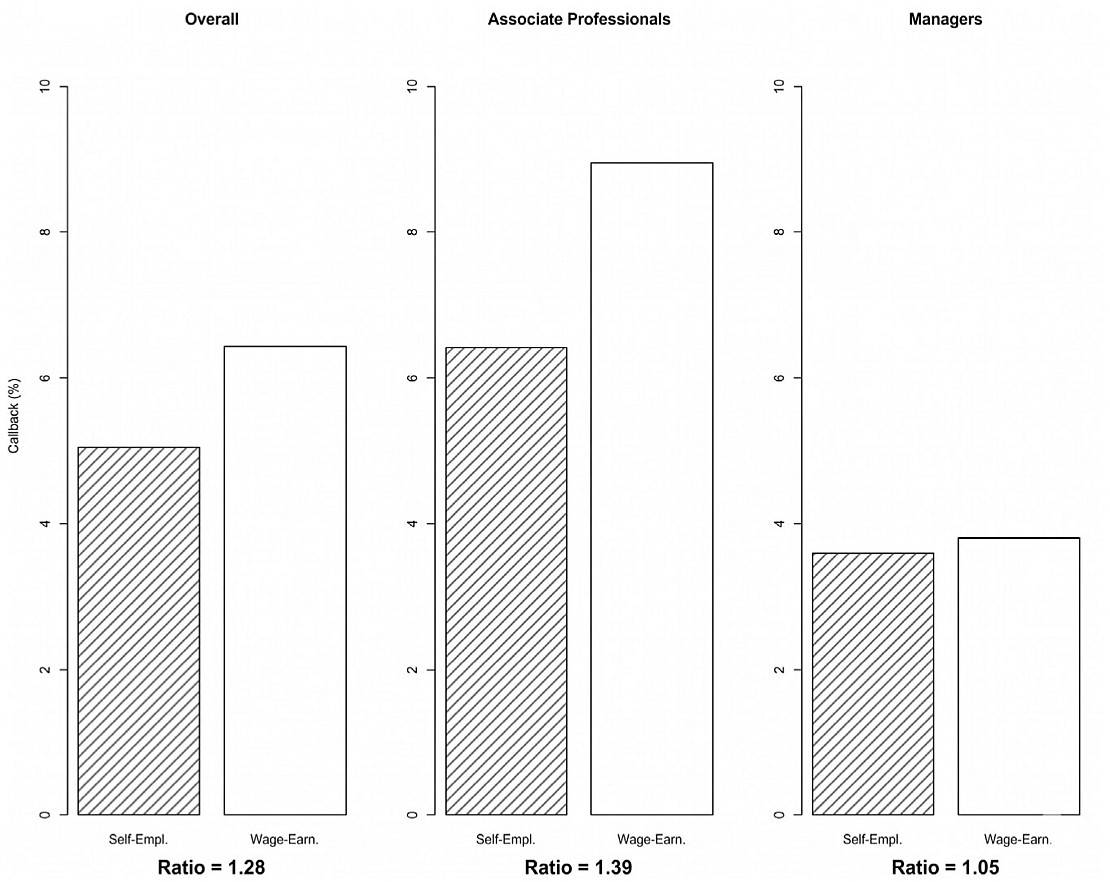
The study by Igor Asanov and Maria Mavlikeeva contributes to ongoing policy debates about the promotion of self-employment as a labor market policy instrument. Governments rely on self-employment programs to address unemployment, and growing AI-driven displacement of entry-level workers may intensify this trend. The recent findings urge caution: for workers at the associate professional level, a period of self-employment can reduce their chances of re-entering wage employment.
Highlights of the study:
- it is one of the largest correspondence experiments in the entrepreneurship literature, with over 8,000 resumes sent to real vacancies;
- it covers three industries: Finance, IT, and Public Relations/Marketing;
- the correspondence experiment simultaneously tests vertical heterogeneity across skill levels (including managerial positions) and horizontal generalizability across distinct industries in an entrepreneurial context;
- an O*NET-based index of required managerial skills per occupation provides a more granular, continuous validation of the main finding at the occupation level, beyond the aggregate ISCO classification.
Figure 1. Callback rate by group (based on International Standard Classification of Occupations[ISCO] standards)