
Lecture series
The content on this page was translated automatically.
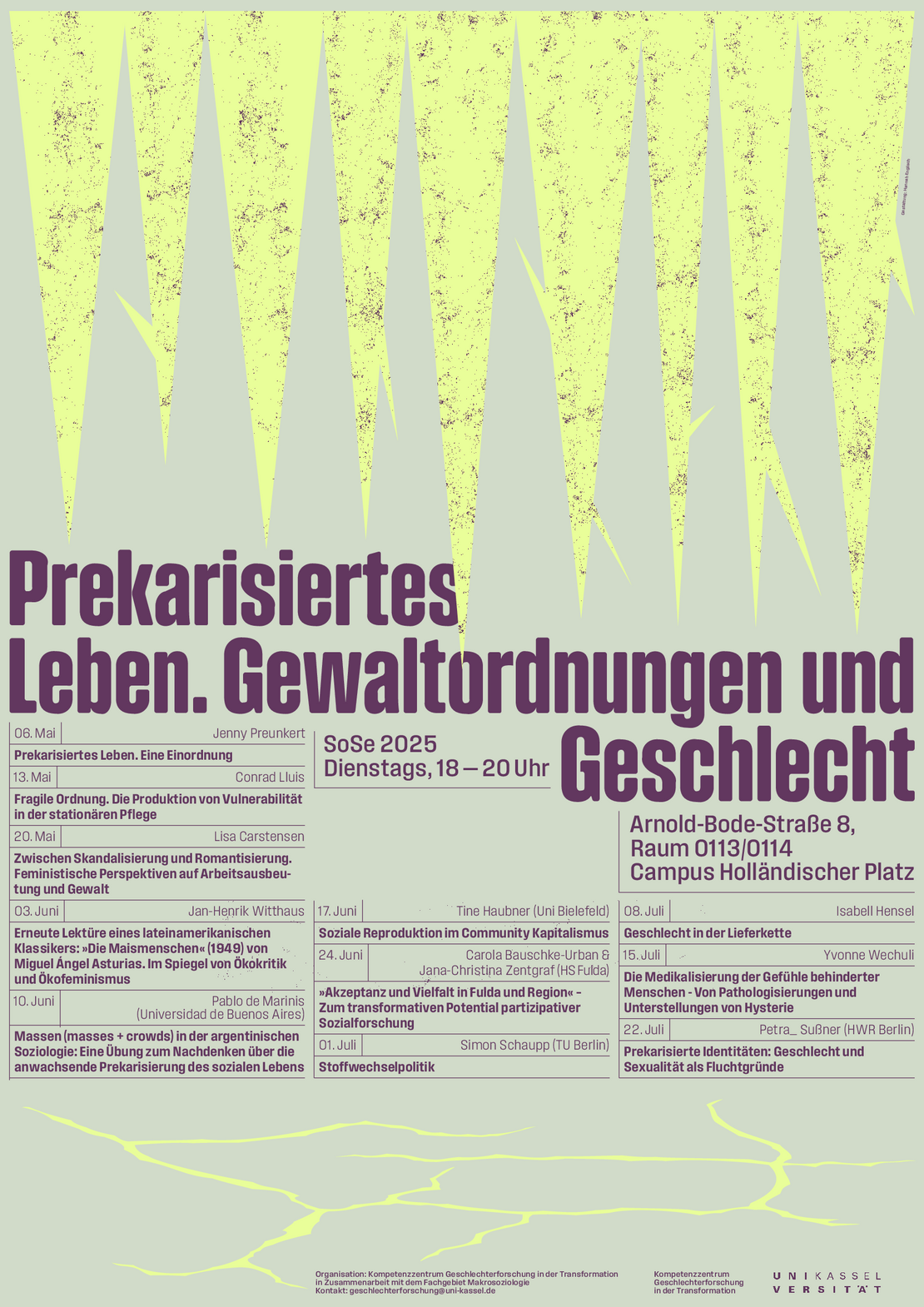
From an interdisciplinary and international perspective, the lecture series deals with the multidimensional and intersectional entanglements between different forms of orders of violence and gender that make life precarious. What kind of life is worth living - on the border between recognition and non-recognition? We ask how social, economic and cultural practices contribute to the precarization of work and housing, or more generally, life practices, and thereby (re-)produce gendered and gendering orders. For example, the question of whether and to what extent certain working conditions, lifestyles or bodies are particularly vulnerable or systematically marginalized through exploitation, discrimination, violence, marginalization, categorization or exclusion will be explored. The lecture series will address various aspects of precarious and precarious living realities and conditions that are (re-)produced and materialized by global, national or socially overlapping orders of violence. In the areas of work, care work, body, space, nature-technology and nature-human relations, refugee and migration regimes and housing, among others.
06 May Jenny Preunkert: Precarized life. A classification
May 13 Conrad Lluis: Fragile order. The production of vulnerability in residential care
20 May Lisa Carstensen: Between scandalization and romanticization. Feminist perspectives on labor exploitation and violence
June 03 Jan-Henrik Witthaus: Rereading a Latin American classic: "The Corn People" (1949) by Miguel Ángel Asturias. In the mirror of ecocriticism and ecofeminism
June 10 Pablo de Marinis (Universidad de Buenos Aires): Masses (masses + crowds) in Argentine sociology: an exercise in reflecting on the growing precarization of social life
June 17 Tine Haubner (University of Bielefeld): Social reproduction in community capitalism
June 24 Carola Bauschke-Urban & Jana-Christina Zentgraf (HS Fulda): "Acceptance and diversity in Fulda and the region" - On the transformative potential of participatory social research
July 01 Simon Schaupp (TU Berlin): Metabolic Politics
July 08 Isabell Hensel: Gender in the supply chain
15 July Yvonne Wechuli: The medicalization of the feelings of disabled people - Of pathologizations and insinuations of hysteria
22 July Petra_ Sußner (HWR Berlin): Precarized Identities: Gender and sexuality as reasons for flight
Tuesdays 6-8 pm, Arnold-Bode 8, Room 0113/0114, University of Kassel
Enquiries and registration at geschlechterforschung@uni-kassel.de
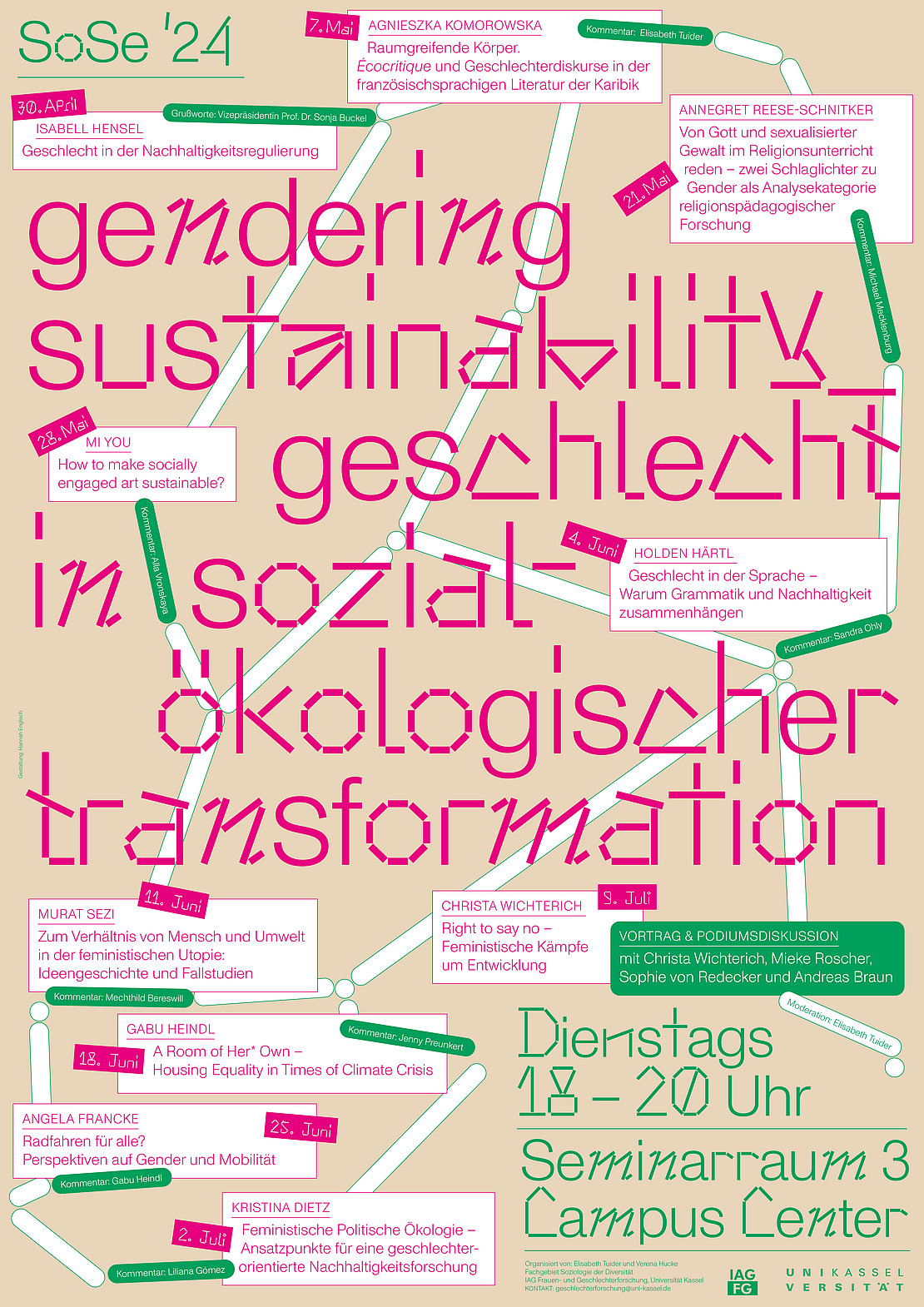
The lecture series takes a look at the context of sustainability debates and the gender constructions and gender relations embedded in them on the basis of various specialist perspectives. Among other things, we will look at the relationship between production and reproduction and the relationship between gender and work. We will also look at the starting points for gender-oriented sustainability research, ecofeminism and environmental intersectional justice as well as what characterizes the "grammar of sustainability". The series will conclude with a panel discussion and a keynote speech by Christa Wichterich.
30.04. Isabell Hensel: Gender in sustainability regulation (welcome address: Vice President Prof. Dr. Sonja Buckel)
07.05. Agnieszka Komorowska: Spatial bodies: Écocritique and gender discourses in French-language Caribbean literature. (Commentary: Elisabeth Tuider)
21.05. Annegret Reese-Schnitker: Talking about God and sexualized violence in religious education two highlights on gender as an analytical category of religious education research (commentary: Michael Mecklenburg)
28.05. Wed You: How to make socially engaged art sustainable? (Commentary: Alla Vronskaya)
04.06. Holden Härtl: Gender in language - Why grammar and sustainability are connected (commentary: Sandra Ohly)
11.06. Murat Sezi: On the relationship between humans and the environment in feminist utopia: history of ideas and case studies (commentary: Mechthild Bereswill)
18.06. Gabu Heindl: A Room of Her* Own - Housing Equality in Times of Climate Crisis (commentary: Jenny Preunkert)
25.06. Angela Francke: Cycling for all? Perspectives on gender and mobility (Comment: Gabu Heindl)
02.07. Kristina Dietz: Feminist Political Ecology - Starting Points for Gender-Oriented Sustainability Research (Comment: Liliana Gómez)
09.07. Lecture and panel discussion: Christa Wichterich, Mieke Roscher, Sophie von Redecker, Andreas Braun (Moderation: Elisabeth Tuider)
Tuesdays 6-8 p.m., Campus Center, Seminar Room 3/Room 1112, Moritzstr. 18, University of Kassel
Enquiries and registration at geschlechterforschung@uni-kassel.de
The IAG lecture series of the summer semester 2022 focuses on the nexus of kinship/family, queer* and trans* studies and feminist-posthumanist ecology and deals with questions on the (re)conceptualization of kinship beyond and in the context of heteronormative gender and reproductive relations.
Approaches from feminist and queer perspectives have taken a critical look at heteronormative orders of family, kinship and gender, made complex forms and practices of "doing family" and "doing kinship" visible and examined them in their diversity, dynamics and intersectionality. Scholars from these fields have argued, for example, that with the progress of bio- and reproductive technologies and the increasing legal and social recognition of family forms beyond the traditional heterosexual nuclear family, such as LGBTIQ families or three-parent families, definitions of kinship are (or must be) constantly renegotiated.
The denaturalization of the concept of kinship has proven to be central to queer and feminist approaches - not least through the critique of its fundamental premises of gender, reproduction and power relations. What constitutes kinship - or 'kinship' - is therefore not determined by a supposed 'nature', but rather depends on a variety of biological, social, legal, political and ecological factors that are always in negotiation with each other. With the subsequent rethinking of the relationship between 'nature' and 'culture', approaches from the field of feminist posthumanism and posthumanist ecology also open up a view of cross-species kinship relationships beyond the 'merely' human. Against the backdrop of the destruction of nature and the climate crisis, new questions of communitization, bonding and connectedness with a variety of life and hybrid forms as well as ecological processes arise.
The lecture series "Queer Kinship and Ecologies of Bonding" is interdisciplinary and enables students of the IAG certificate to approach methodological, theoretical-conceptual and disciplinary approaches.
Procedure
- May 17, 2022: Christine M. Klapeer and Jennifer Stoll in conversation: Queering Kinship, Queering Family: current debates, struggles and developments (moderation: Inga Nüthen)
- May 31, 2022: Fadi Saleh: Queer Humanitarianism, Syrian LGBTIQ Refugees, and the Transformation of Queer/Trans* Kinship
- June 07, 2022: Victoria Hegner: Queer Galaxies: Kinship in Science Fiction
- June 21, 2022: Ballroom Culture: Kinship, Community and Empowerment (film and discussion)
- June 28, 2022: Ute Kalender: Only Kin instead of Kids? On the problematic normativity of social parenthood from an international perspective
- July 05, 2022: Sophie von Redecker: In kin with nature - postcolonial and queer perspectives on agriculture
- July 12, 2022: Yv E. Nay: Politics of belonging of 'rainbow families' - between emancipatory change and homonormative-nationalist change
- July 13, 2022, 9-12 am: Subsequent, in-depth workshop with Yv E. Nay on the topic of "Heteronormativity, homonormativity and homonationalism in the context of queer families"

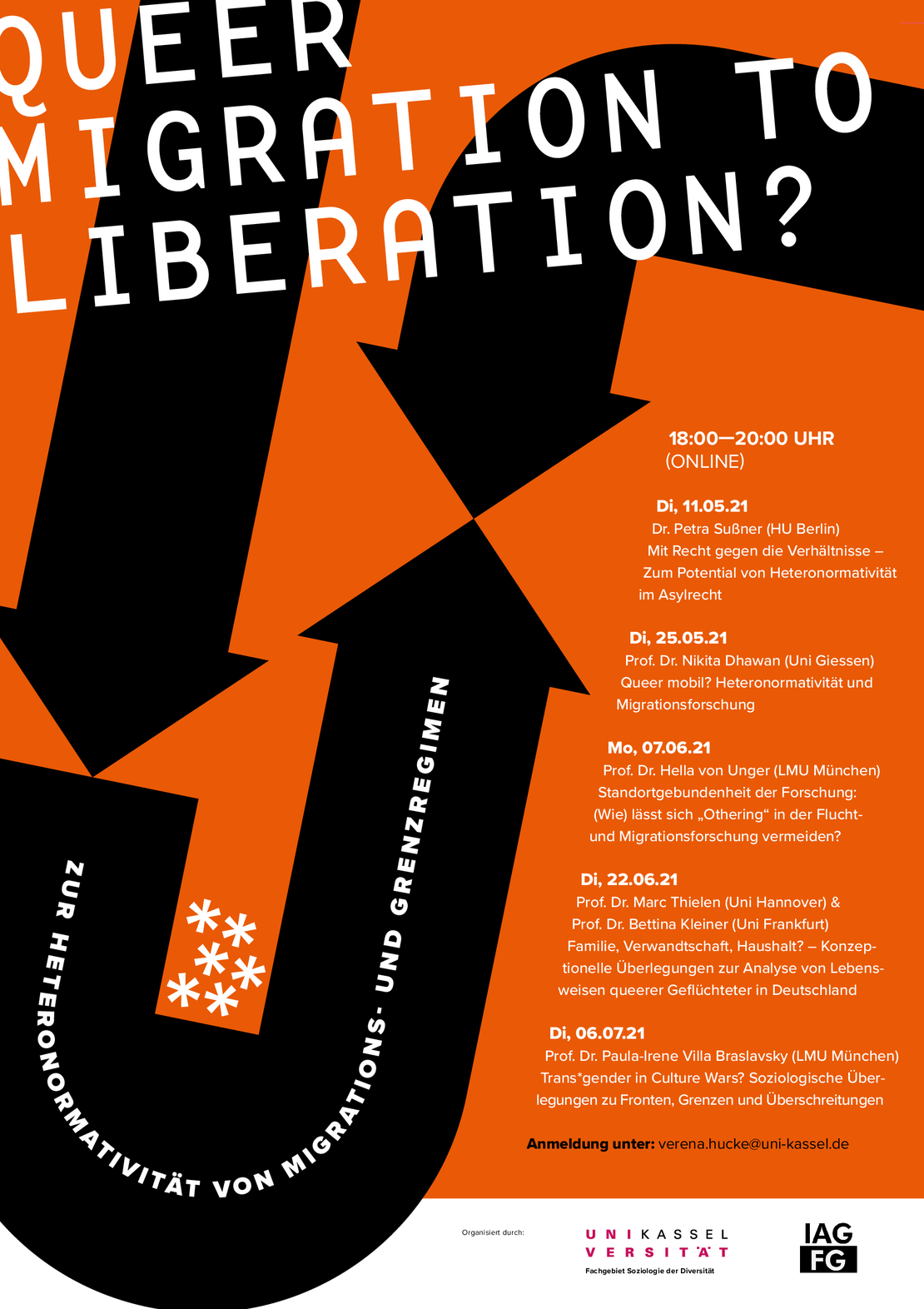
Migrations and borders are not only gendered, implicit and explicit heteronormative framings also structure all aspects of migration. Sexuality functions as a category of power and social organization that locates individuals at the center or in the periphery, positioning them in a certain way in terms of rights and protection, resources and opportunities, as well as violence. Sexuality serves as a means of demarcation and sets migrations and borders in motion. In this lecture series, we focus on sexualities and genders from a migration studies perspective and ask about their (historical) role in the production, reproduction and maintenance of migration and border regimes as well as about moments of transgression and the production of possibilities for action.
Course of events
- 18:00-20:00 (online)
- Tue, 11.05.21 Dr. Petra Sußner (HU Berlin): With law against the conditions - On the potential of heteronormativity in asylum law
- Tue, 25.05.21 Prof. Dr. Nikita Dhawan (University of Giessen): Queer mobile? Heteronormativity and migration research
- Mon, 07.06.21 Prof. Dr. Hella von Unger (LMU Munich): Location-bound research: (How) can "othering" be avoided in flight and migration research?
- Tue, 22.06.21 Prof. Dr. Marc Thielen (Uni Hannover) & Prof. Dr. Bettina Kleiner (Uni Frankfurt): Family, kinship, household? - Conceptual considerations for analyzing the lifestyles of queer refugees in Germany
- Tue, 06.07.21 Prof. Dr. Paula-Irene Villa Braslavsky (LMU Munich): Trans*gender in Culture Wars? Sociological reflections on fronts, borders and transgressions Registration at: verena.hucke@uni-kassel.de
Naked people, available bodies, negated boundaries of shame, eroticized fetishes - the list of associations that are usually linked to the phenomenon of objectified sexuality is long. Love and sexuality become projections that suggest availability in a dehumanized and passive way. Mainstream media in particular like to take up this topic because of its high entertainment value. Due to technological progress and digitalization, however, scenarios are also becoming conceivable - in films and intimate relationships, for example - that make interpersonal love relationships with things conceivable and practicable. Societal, social and technological developments contribute to renegotiating the boundaries between norm/abnormality, thing/human, arousal, intimacy and objectification.
The well-known films The Stepford Wives, Lars and the Women and Her are all ideally suited to illustrate these issues, while at the same time problematizing and critically questioning them.
In the film series of the IAG FG study program, the format is as follows: After a brief framing by the responsible lecturers (Prof. Dr. Susanne Bach/Anglistics, Raphaela Becker/Sociology and Prof. Dr. Elisabeth Tuider/Sociology), three films will first be watched together with the audience on the dates listed below. Afterwards, there will be an interdisciplinary discussion round with staff from the University of Kassel and the audience will have the opportunity to participate in the discussion and ask questions.
Schedule
- 18:15 - 21:45
- 1st date: 24.04.2018 "The Stepford Wives"
- 2nd date: 22.05.2018 "Lars and the Wives"
- 3rd date: 29.05.2018 "Her"

The term total institution was popularized in the 1960s by the American sociologist Erving Goffman. In his book Asyle, Goffman sets out what he considers to be the characteristic features of such institutions: people's lives and daily routines take place under one roof and under one authority - e.g. in prison, in the military, in a monastery, in a boarding school or in a reformatory. The rules and social interactions that structure the relationships between people in such institutions are aimed at enforcing certain goals to which people are expected to submit (e.g. resocialization, discipline, asceticism, performance).
It is not uncommon for total institutions to have a homosocial structure in which women/girls and men/boys are housed separately. In addition to this apparent significance of gender as an organizing feature of total institutions, there are also more implicit references to constructions of bisexuality, combined with embodiments of binary-coded versions of gender difference.
The film series of the IAG FG study program continues the series of the summer semester 2017. This semester, we will again examine feature films that shed light on different total institutions. The format will be as follows: After a brief framing by the responsible lecturers (Prof. Dr. Mechthild Bereswill/Sociology, Dr. Anke Neuber/Sociology and Murat Sezi/Anglophone Literary Studies), three films will first be watched together with the audience on the dates listed below. Afterwards, there will be an interdisciplinary discussion round with staff from the University of Kassel and the audience will have the opportunity to participate in the discussion and ask questions.
Schedule
- 18:15 - 21:45
- 1st date: 14.11.2017
- 2nd date: 21.11.2017
- 3rd date: 28.11.2017
We would like to invite you to the lecture series "Erkenntnisprojekt Geschlecht: Inter/Disziplinäre Perspektiven" on the following dates:
- 27.10.16 - Welcome and introduction by the Presidents of the Universities (Prof. Dr. Birgit Riegraf and Prof. Dr. Andreas Hänlein) and lecture "Vom Antifeminismus zum 'Anti-Genderismus'" (Andrea Maihofer, moderated by Mechthild Bereswill).
- 17.11.16 - Lecture "Die 'abgehängten Jungen' und der 'männliche Überlegenheitsimperativ' - Erziehungsqissenschaften und Psychoanalyse im Gespräch" (Rolf Pohl and Barbara Rendtorff, moderated by Antje Langer)
- 08.12.16 - Lecture "Gender in the Humanities: A Dialogue on the Development and Relevance of Gender Knowledge" (Rita Casale and Silke Wenk, moderated by Birgit Riegraf)
- 19.01.17 - Lecture "The category of gender and literary studies" (Toni Tholen and Claudia Öhlschläger, moderated by Britt-Marie Schuster)
The lectures will take place from 16:00-18:00 in lecture hall 4 of the Campuscenter.

In the summer semester 2016 and winter semester 2016/17, the IAG Women's and Gender Studies is organizing a lecture series on the topic of "Gender and Essentialism in Film".
The aim of this film series is to contribute to conveying the academic potential of gender-theoretical perspectives through the discussion of various films and to critically examine essentialist ideas.
The format is as follows: After a brief framing by the responsible lecturers (Prof. Dr. Mechthild Bereswill/Sociology and Murat Sezi/Anglophone Literary Studies), the films to be discussed will first be watched together with the audience. Afterwards, there will be an interdisciplinary discussion round with other lecturers from the University of Kassel, as well as the opportunity for the audience to participate in the discussion and ask questions.
Program
- Tuesdays, 6 - 10 p.m. in Moritzstraße 18, Room 1101
- Tuesday, 03.05.2016 "Introduction and Ex Machina"
- Tuesday, 07.06.2016 "On the other side"
- Tuesday, 05.07.2016 "Gran Torino"
- Tuesday, 01.11.2016 "Introduction and Billy Elliot"
- Tuesday, 15.11.2016 "All about my mother"
- Tuesday, 29.11.2016 "Monster"
In the winter semester 2015/16, the Sociology of Diversity Department 05 is organizing the gender and diversity research lab "GENDER Upfront", to which all interested parties are cordially invited. The lab takes place on Tuesdays from 6 - 8 p.m. in the Campus Center at Moritzsstraße 18 in room 1110, seminar room 1.
Preparatory texts for all sessions are available from mart.busche[at]uni-kassel[dot]de

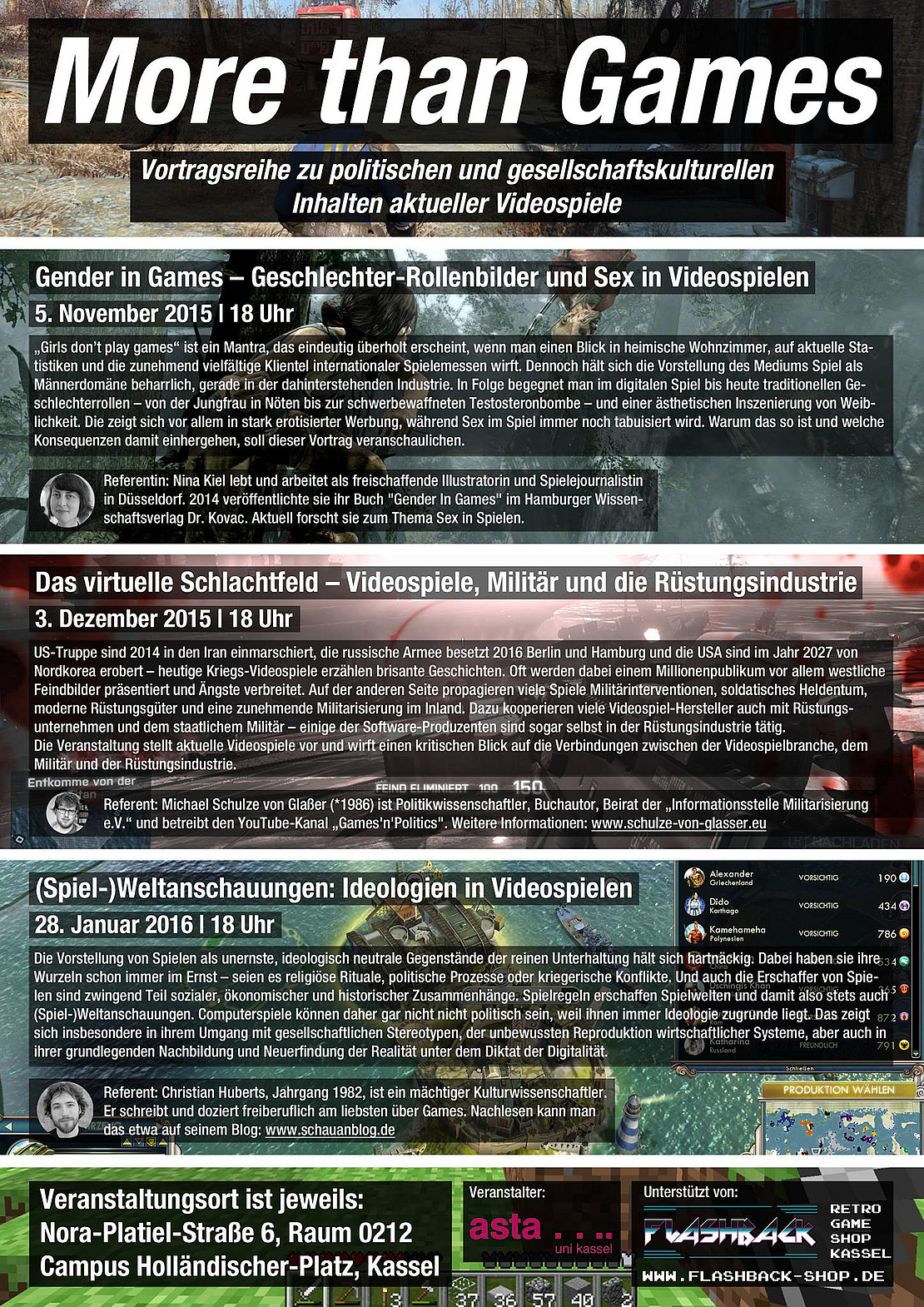
When: Thursday, November 5, 2015 - from 6:00 p.m.
Where: Nora-Platiel-Straße 6, Room 0212, Nora-Platiel-Straße 6, 34127 Kassel
Organizer: AStA Uni Kassel, Flashback - Retro-Gaming-Shop Kassel
"Girls don't play games" is a mantra that seems clearly outdated when you take a look at living rooms at home, current statistics and the increasingly diverse clientele at international games fairs. Nevertheless, the idea of games as a male-dominated medium persists, especially in the industry behind them. As a result, traditional gender roles - from the damsel in distress to the heavily armed testosterone bomb - and an aesthetic staging of femininity can still be found in digital games today. This is particularly evident in highly eroticized advertising, while sex in games is still taboo. This lecture will illustrate why this is the case and what the consequences are.
Speaker: Nina Kiel lives and works as a freelance illustrator and games journalist in Düsseldorf. In 2014, she published her book "Gender In Games" with the Hamburg science publisher Dr. Kovac. She is currently researching the topic of sex in games. Further information:www.ninakiel.de
Further dates in the "More than Games" event series:
For the event series "Watch out: Antifimenism - Practice and Critique of Queer and Feminist Research" on the following dates:
- 03.11.2015, 6 p.m.: On the social production of biological sex: DNA and 'genes' do not predict the development of the genital tract by Heinz-Jürgen Voß
- 10.11.2015, 8 pm: Let's talk about freedom of speech, baby!1!! by Anne Wizorek
- 08.12.2015, 6 pm: On the interaction of anti-feminist, anti-scientific and homo/trans*hostile arguments by Andreas Kemper
- 15.12.2015, 8 pm: Hate Poetry
Venue: Campus Center, Room 1110, Seminar Room 1

Feminist violence research can look back on 20 years of expertise in addressing and researching sexual/sexualized violence. In particular, sexualized violence in the workplace, in the family or in home education has been analysed and politicized. After the incidents at the Odenwaldschule and other educational institutions became known in 2010, the BMBF established a new research focus on the topic of sexualized violence in educational contexts. The lecture series will take stock of these new research projects and at the same time look at new aspects from the fields of sociology, education, youth and queer research. The lecture series will provide an insight into various aspects of sexualized violence that are relevant to educational contexts. To this end, the German discourse on 'sexualized violence' will be examined against the background of international debates. In addition, the transfer of theoretical pedagogical debates - especially with regard to the development of new contexts or ethical aspects - into practice will be reflected upon.
Program
- Tuesdays from 6 - 8 p.m. in Georg-Forster-Straße 4, room 0005. The lecture "Quantitative insights into research on sexualized violence" by Dr. Monika Schröttle will take place on Wednesday (not Tuesday!), 24.06.2015 from 6 - 8 p.m. in Georg-Forster-Straße 4, room 1004!
- Tuesday, 21.04.2015 "Sexualized violence and professional ethics" Inaugural lecture by Junior Professor Dr. Alexandra Retkowksi University of Kassel
- Tuesday, 19.05.2015 "Silence and speaking after sexualized violence in childhood and adolescence: Results of a new interview study with women and men" Prof. Dr. Barbara Kavemann Catholic University of Applied Sciences Berlin
- Tuesday, 09.06.2015 "Gender-historical perspectives on violence, sexuality and education" Prof. Dr. Meike Sophia Baader University of Hildesheim
- Tuesday, 16.06.2015 "Sexualized violence meets hate culture" Prof. Dr. Heinz-Jürgen Voß Merseburg University of Applied Sciences followed by a panel discussion on the topic of media shitstorms.
- Wednesday, 24.06.2015 "Quantitative insights into research on the topic of sexualized violence" Dr. Monika Schröttle TU Dortmund University
- Tuesday, 30.06.2015 "Sexualized violence from the perspective of queer research" Dr. Constance Ohms Broken Rainbow e. V. Frankfurt
- Tuesday, 07.07.2015 "Sexualized violence in pedagogical contexts and qualification requirements - demands on and challenges for pedagogical professionals" Jun.-Prof. Dr. Anja Henningsen, University of Kiel Jun.-Prof. Dr. Martin Wazlawik, University of Münster

Lecture series organized by the Women's and Gender Equality Office of the University of Kassel and the Interdisciplinary Working Group on Women's and Gender Studies (IAG FG) in cooperation with the Women's Representatives at the University of Kassel.
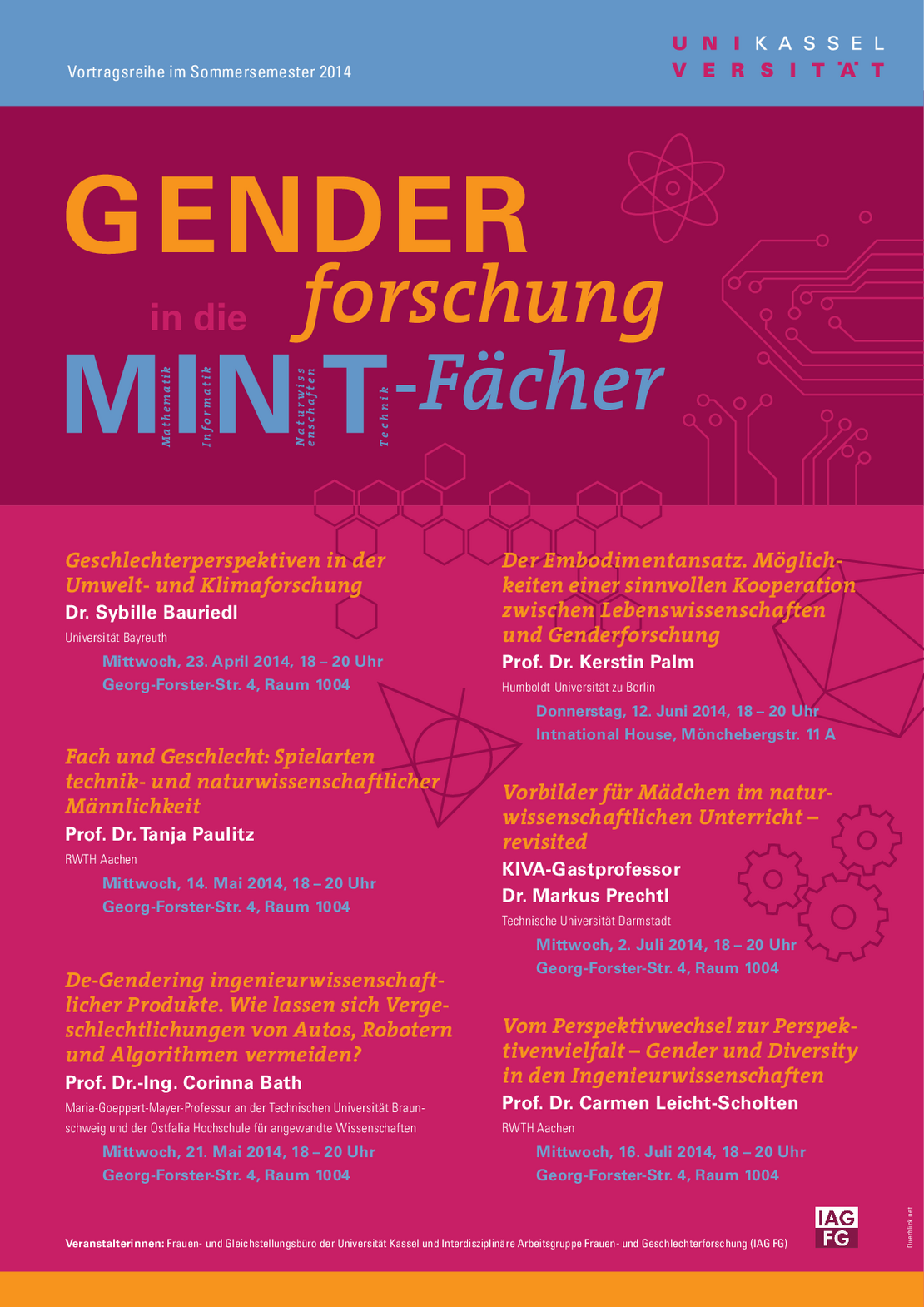
The number of women in the MINT subjects (mathematics, computer science, natural sciences and technology) has been increasing only slowly for years. Against the backdrop of demographic change, industry and universities are facing the challenge of accelerating this trend. Gender equality has become a quality feature of research and teaching. For scientific organizations such as the German Research Foundation (DFG), both the equitable participation of the sexes and the consideration of gender aspects in research are essential elements of high-quality research.
How can gender aspects be taken into account in the STEM subjects? This question will guide us through the lecture series. The invited gender researchers will examine the question in the various STEM subjects and explore the potential that arises from the combination of gender research for the STEM subjects. Focusing on the "gender question" in the subject cultures and in the bodies of knowledge will contribute in the long term to cultural change in the engineering and scientific disciplines and increase the innovative power of STEM research.
The lecture series is intended to publicize existing approaches to gender and science research in natural and technical science disciplines at the University of Kassel and to stimulate an interdisciplinary discussion on the integration of gender aspects in the STEM subjects.
Program
- The lectures take place (with one exception - see below) on Wednesdays from 6 - 8 pm in Georg-Forster-Straße 4 in room 1004. The lecture by Prof. Dr. Kerstin Palm will take place on Thursday, 12.06.2014 from 6 - 8 p.m. in the International House at Mönchebergstraße 11 A. Wednesday, 23.04.2014 "Gender perspectives in environmental and climate research" Dr. Sybille Bauriedl University of Bayreuth
- Wednesday, 14.05.2014 "Subject and gender: Varieties of technical and scientific masculinity" Prof. Dr. Tanja Paulitz RWTH Aachen University
- Wednesday, 21.05.2014 "De-gendering engineering products. How can the gendering of authors, robots and algorithms be avoided?" Prof. Dr.-Ing. Corinna Bath Maria Goeppert Mayer Professorship at the Technical University of Braunschweig and Ostfalia University of Applied Sciences
- Thursday, 12.06.2014 International House, Mönchebergstraße 11 "The embodiment approach. Possibilities for meaningful cooperation between the life sciences and gender research" Prof. Dr. Kerstin Palm Humboldt-Universität zu Berlin
- Wednesday, 02.07.2014 "Role models for girls in science lessons - revistited" Dr. Markus Prechtl Technical University of Darmstadt
- Wednesday, 16.07.2014 "From a change of perspective to a diversity of perspectives - gender and diversity in engineering" Prof. Dr. Carmen Leicht-Scholten RWTH Aachen University
Queer politics and theories question any natural, pre-discursive nature of bisexuality and heterosexuality and reconstruct the socio-historical processes of their emergence, normativization and normalization. Queer, which originally emerged in the USA as a discomfort against essentialist identity politics in the context of AIDS, heteronormativity, racism and homosexual renormalization, has undergone its very own translation in German-speaking countries.
What experiences do people have who locate themselves between or beyond masculinity and femininity? What role does the body play - as an artifact, as a stage, as a space of experience? How can political approaches such as feminism, postcolonial critique and queer be combined and what can (still) be learned from the last 20 years of engagement with the concept of "queer"?
In the lecture series queerfeldein, various aspects of queer life will be addressed from different perspectives. Sexuality, gainful employment, cultural production, aesthetics and politics as thematic fields, but also que(e)r related experiences such as discrimination, desire or recognition will be addressed in various lectures.
Schedule
- The lectures always take place on Wednesdays from 6 - 8 pm in room 3004 in Georg-Forster-Straße 4.
- 22.05.2013: "Qualverwandtschaften? BDSM as queer practice" by Volker Woltersdorff (Berlin): Podcast lecture part I, podcast lecture part II, podcast discussion
- 05.06.2013: "... Not so tangible and yet real" Presentation of a study on experiences of violence and multiple discrimination of lesbian, bisexual women and trans* 2010-2012" by Saideh Saadat-Lendle (les migras / Lesbenberatung Berlin e. V.): Podcast lecture part I, Podcast lecture part II, Podcast discussion part I, Podcast discussion part II
- 19.06.2013: "Intersexualität - Intersex: Eine Intervention" by Heinz-Jürgen Voß (Berlin): Podcast Lecture Part I, Podcast Lecture Part II, Podcast DiscussionPart II
- 26.06.2013: "Queer in the job?! Heteronormative dynamics in employment contexts" by Karen Wagels (Kassel): Podcast lecture part I, podcast lecture part II
- 03.07.2013: "HIV/Aids as (another) form of governmentality" by Ivan Jurica / Miltiadis Geronthanassis (Vienna): Podcast lecture part I, Podcast lecture part II

- 24.4.2013: Prof. Dr. Helen Schwenken, Political Science: How strawberry harvesting and intersectionality are connected: Migration & Gender in Spanish Agriculture - commented by Prof. Dr. Susanne Bach, English Studies
- 15.5.2013: Dr. Folkert Degenring, English Studies: Travelling Concepts and Working Identities - commented by Dr. des. Mareike Böth, History
- 12.6.2013: Dr. Kerstin Wolff, History: The Prostitute around 1900 - between Abolitionism and Neoreglementarism - commented by Dr. Susanne Schul, Medieval Studies
- 10.7.2013: Prof. Dr. Mechthild Bereswill, Sociology: Gender orders and social control - commented by Dr. Karen Wagels, Cultural Studies
Wednesdays from 6 - 8 p.m. in Mönchebergstraße 7, Room 0614
In the winter semester 2012/13, the ZFF research focus "Inequalities in gender relations" is organizing the lecture series "Intersectional research - but how?". The lectures take place on Wednesdays from 6 - 8 p.m. in Arnold-Bode-Straße 2 in room 0404.
- 24.10.2012: Dr. Stefan Wellgraf, Frankfurt/Oder: The boxer style - entanglements of class and aggressive masculinity
- 21.11.2012: Dr. Nicole Schröder, Paderborn / Koblenz: Intersectionality and Literature: Race, Gender and Space in Harriet Jacobs' Incidents in the Life of a Slave Girl and Frederick Douglass' Narrative of the Life of Frederick Douglass
- 16.01.2013: Prof. Birte Siim, Aalborg, Denmark: Framings of Gender and Ethno-national Diversity across Europe
- 06.02.2013: Prof. Dr. Christian Koller, Bangor, Wales: Intersectionality in the Tension between Social and Cultural History

Procedure
- 6 - 8 p.m. in Nora-Platiel-Straße 6, R, 0212
- 25.04.2012: "Art, Gender and Violence in American Literature" by Dr. Lars Heiler (Literary Studies English / American Studies, University of Kassel)
- 09.05.2012: "Gender in the Art of Orientalism" by Dr. Silke Förschler (Research Training Group "Dynamics of Space and Gender", University of Kassel)
- 23.05.2012: "Maria_queer - An exhibition provokes gender images" by Diana Dickel - Frauenstudien- und -bildungszentrum in der EKD, Hofgeismar and Doris Baum - artist, Marburg
- 06.06.2012: "The discomfort at the edge of beauty" by Juliane Gallo, Kassel
- 13.06.2012: "Abuse of Power Comes as No Surprise' - Non-hierarchical Structures and Community Projects in the Visual Arts" by Prof. Dr. Mathilde ter Heijne (Fine Arts, University of Kassel - Kunsthochschule)
- 27.06.2012: "Superimpositions of images, de- and reconstructions of gender in the age of technical reproducibility" by Prof. Dr. Silke Wenk (Art and Visual Culture, University of Oldenburg)
- 04.07.2012: "Hagar - a biblical figure in text and image" by Prof. Dr. Ilse Müllner - Catholic Theology, University of Kassel and Prof. Dr. Martina Sitt - University of Kassel - Art Academy

Procedure
- 6-8 p.m. in Nora-Platiel-Str. 4, R, 1213
- 20.04.2011: (Ge)Schlecht fühlen: Emotion and Cognition in Middle High German Gender Swap Narratives by PD Dr. Michael Mecklenburg, University of Kassel
- 04.05.2011: Fort - Da: "Intersectional Invisibility" from a cognitive-psychological and psychoanalytical perspective by Prof. Dr. Gudrun-Axeli Knapp, University of Hanover
- 18.05.2011: Does language influence our world view? Reflections on a seemingly obvious connection by Prof. Dr. Holden Härtl, University of Kassel
- 01.06.2011: The narrative processing of emotion and cognition in contemporary Anglo-American drama by Dr. Lars Heiler, University of Kassel
- 15.06.2011: Desire in language. The contribution of psychoanalytic discourse to a culture of difference by Prof. Dr. Rolf-Peter Warsitz, University of Kassel
- 29.06.2011: "Life can only be lived" - Youth movement and pedagogy in first-person documents by Prof. Dr. Edith Glaser, University of Kassel
Procedure
- 28.04.2010: 'New' Feminism, Liberal Feminism, Critical Feminism - Gender Discourses in the Context of Social Change Processes by Prof. Dr. Irene Dölling, University of Potsdam
- 05.05.2010: Gender hierarchies in group discussions of young people on the show Germany's Next Topmodel by Dr. Anna Stach, University of Kassel
- 19.05.2010: Writing about body and gender as a subjective processing of inequality(ies) using the example of the letters of Liselotte von der Pfalz (1652-1722) by Mareike Kohls, M.A., University of Kassel
- 02.06.2010: Violent Futures: Discourses of violence, inequality and gender in the work of the Canadian author Margret Atwood by Prof. Dr. Susanne Bach and Dr. Folkert Degenring, University of Kassel
- 16.06.2010: We are world champions! - Persistence and change in gender relations by Prof. Dr. Mechthild Bereswill and Dr. Anke Neuber, University of Kassel
- 30.06.2010: Black and white: Inequalities of masculinity constructions in Fritz Lang's Nibelungenfilm by Susanne Schul, M.A., University of Kassel
Procedure
- 28.10.2009: Crisis scenarios in US-American history since the end of the 19th century by Prof. Dr. Jürgen Martschukat, Erfurt
- 11.11.2009: Masculinity crises around "respect", anger and shame by Prof. Dr. Joachim Kersten, Münster
- 25.11.2009: Crisis or structural change of hegemonic masculinity? by Prof. Dr. Michael Meuser and Dr. Phil. Habil. Sylka Scholz, Dortmund, Dresden
- 09.12.2009: Restructuring masculinity? State and gender in the context of globalization and internationalization by Prof. Dr. Birgit Sauer, Vienna
- 13.01.2010: Subjectivity - Crisis - Utopia. Imaginations of masculinity in contemporary thought and writing by Prof. Dr. Toni Tholen, Hildesheim
- 27.01.2010: Men - the disadvantaged sex? Defenses of femininity and anti-feminism in the discourse on the crisis of masculinity by Prof. Dr. Rolf Pohl, Hanover
Proceedings
- 22.04.2009: Co-constitution of space and gender: Perspectives of geographical gender studies by Dr. Sybille Bauriedl, University of Kassel
- 06.05.2009: Hermetic spaces - rigid gender constructions. Concepts of masculinity in prison by Prof. Dr. Mechthild Bereswill and Dr. Anke Neuber, University of Kassel
- 27.05.2009: "Women and persons under the age of 18 are prohibited from entering". Spatial-social control strategies of prostitution and the gender order by Dr. Renate Ruhne, University of Kassel
- 10.06.2009: Scholarly women and the public sphere in Arab-Islamic society from the 11th to the 13th century by Prof. Dr. Irene Schneider, Georg-August-Universität Göttingen
- 24.06.2009: From the "risk" in the head and the "future" under the skin - reflections on the "self-determined" administrative body by Prof. Dr. Barbara Duden, Leibniz University Hanover
- Lecture series: In "good company?"Unconventional ways of life
SS 2006 at the University of Kassel
Organization: Susanne Heyn et al.
The lecture series took place as part of the university's "Year of Society". - Lecture series: Mother - Myth - Masculinity. Christian-Jewish traditions of care
WS 2002/03, in cooperation with the Society for Christian-Jewish Cooperation
Organization: Claudia Bruns, Christel Eckart, Urte Helduser, Eva Schulz-Jander - Violence and gender. Causes and manifestations of gender-specific violence
SS 2001 - WS 2001/2002
Organization: Katharina Pühl, Frauke Koher, in cooperation with the Women's Office of the City of Kassel, Kassel Women's Projects, Filmladen Kassel/Bali Kinos, Evangelisches Forum Kassel, Hessische Landeszentrale für politische Bildung, Referat VII. - Film series for the lecture series: troubles in paradise
29 November to 6 December 2001 in Kassel
Organization: Katharina Pühl, Frauke Koher
Curators: Katja Wiederspahn (feminist film theorist, Vienna), Marie-Hélène Gutberlet (film scholar, filmmaker, projectionist and co-editor of the magazine Frauen und Film, Frankfurt/M.) In cooperation with Filmladen Kassel e.V.