. This angle
depends on the pitch
. This angle
depends on the pitch  of the lenticular lenses, the focal
depth point
of the lenticular lenses, the focal
depth point  ; and the light index of glass N (e.g. N=1.5). The
horizontal pitch
; and the light index of glass N (e.g. N=1.5). The
horizontal pitch  on the focal plane is a little bit
larger than that of the lenses itself.
on the focal plane is a little bit
larger than that of the lenses itself.
 m. Each
black/white sub-pixel at focal layer has got a size of 5m x 5m.
Hence 100 different views can be written horizontally side by side
being emitted over the full angle 2, cf. Fig. 1.
m. Each
black/white sub-pixel at focal layer has got a size of 5m x 5m.
Hence 100 different views can be written horizontally side by side
being emitted over the full angle 2, cf. Fig. 1.
The focus of the lenses of the lenticular glass meets the plane, in
which the digitally written black-white film or the liquid crystal
layer is situated. Due to the high writing resolution of 5080 dpi, up
to 100 different views of objects can be emitted over 100 neighbored
ray angles. Geometrically, for each pixel a fan projection has to be
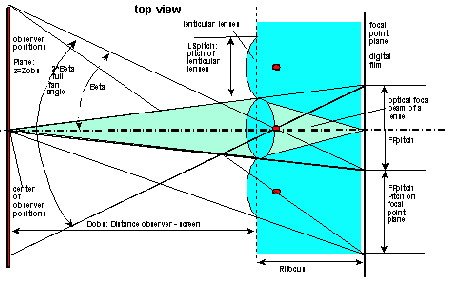
calculated over a full fan angle of 2 . This angle
depends on the pitch of the lenticular lenses, the focal
depth point ; and the light index of glass N (e.g. N=1.5). The
horizontal pitch on the focal plane is a little bit
larger than that of the lenses itself.
 denotes the optimal distance of the display screen from
the observer's eyes, being equal to the distance between the
z-position of lenticular plane and the z-position of the observer.
The half fan angle is given by the following function:
denotes the optimal distance of the display screen from
the observer's eyes, being equal to the distance between the
z-position of lenticular plane and the z-position of the observer.
The half fan angle is given by the following function:
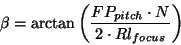 |
(2) |
For the system presented the following full fan angle is realized:
 . The number of views
  is distributed
over the fan angle
is distributed
over the fan angle  . Therefore the following view density
at the observer distance from the screen is achieved:
. Therefore the following view density
at the observer distance from the screen is achieved:
 this density step is
 per view.
For each view point the image can be represented by a fan projection
on the focal plane of the screen. Alltogether a number of
per view.
For each view point the image can be represented by a fan projection
on the focal plane of the screen. Alltogether a number of
 fan projections have to be carried out.
Fig.1 shows the relationship of fan angle, lense focus, pitches
and optimal planned observer distance from the screen.
fan projections have to be carried out.
Fig.1 shows the relationship of fan angle, lense focus, pitches
and optimal planned observer distance from the screen.
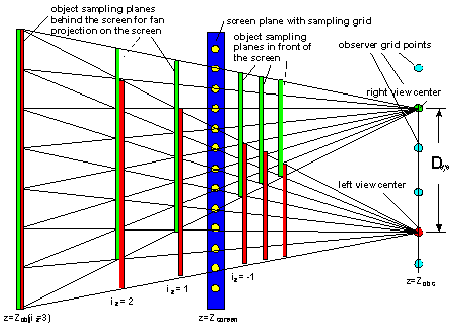
Fig.2 shows the fan projection for two special eye positions: the
right view center and the left view center, being situated in the
z-plane of the observer  . The screen is placed in the z-plane
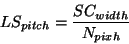
 . The pixels on the screen, on which the objects are
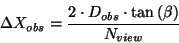
projected, have the distance . This pitch is given by the
width of the screen
. The pixels on the screen, on which the objects are
projected, have the distance . This pitch is given by the
width of the screen  divided by the number of horizontal
pixels per view:
divided by the number of horizontal
pixels per view: 
 |
(4) |