Next: The static object resolution Up: 3dprojtn Previous: Image projection and object

Sampling distances

The z-sampling distance for objects $\Delta Z_{obj}$ is given by the difference:
\begin{displaymath}

\Delta Z_{obj}\left( i,k\right) =Z_{obj}\left( i+1,k\right) -Z_{obj}

\left( i,k\right)

\end{displaymath} (10)

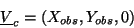
For simplicity let us use now a coordinate system for which the observer's z-position is zero: $Z_{obs}=0$. With respect to the fan projection the viewing center of the observer might be:
\begin{displaymath}

\underline{V}_{c}=\left( X_{obs},Y_{obs},0\right)

\end{displaymath} (11)

The sampling positions of the screen are given by

\begin{displaymath}

\underline{S}\left( i_{x},i_{y}\right) =\left( i_{x}\cdot \D...

...creen},i_{y}\cdot \Delta Y_{screen},Z_{screen}\right)

\mbox{,}

\end{displaymath} (12)

with normally $\Delta X_{screen}=\Delta Y_{screen}=LS_{pitch}$. The sampling z-planes for objects are derived from % latex2html id marker 532

$\left(

\ref{Eq_Zobs2} \right)$ by
\begin{displaymath}

Z_{obj}\left( i_{z}\right) =\frac{Z_{screen}\cdot D_{eye}}

{D_{eye}-i_{z}\cdot \Delta X_{screen}}

\mbox{,}

\end{displaymath} (13)

with
\begin{displaymath}

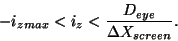
-i_{zmax}<i_{z}<\frac{D_{eye}}{\Delta X_{screen}}

\mbox{.}

\end{displaymath} (14)

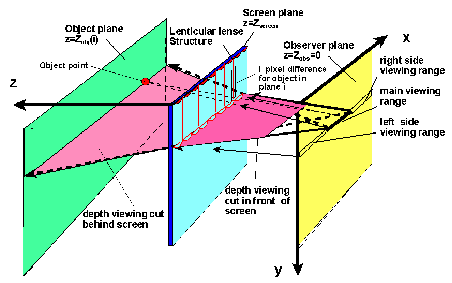
Figure 3: Coordinate system, with viewing planes and representation planes
\begin{figure}

\centering\epsfig {figure=coordinate_system.eps,width=10cm}\end{figure}

The sampling coordinates for the objects to be projected on the screen pixels are given by

\begin{displaymath}

\frac{X_{obj}-X_{obs}}{Z_{obj}\left( i_{z}\right) }

=\frac{i_{x}\cdot \Delta X_{screen}-X_{obs}}{Z_{screen}}

\end{displaymath} (15)

or
\begin{displaymath}

X_{obj}\left( i_{z},i_{x}\right) =X_{obs}+\frac{Z_{obj}\left...

...eft( i_{x}\cdot \Delta X_{screen}-X_{obs}\right) }{Z_{screen}}

\end{displaymath} (16)

The equivalent equation holds for $Y_{obj}$:
\begin{displaymath}

Y_{obj}\left( i_{z},i_{y}\right) =Y_{obs}+\frac{Z_{obj}\left...

...ft( i_{xy}\cdot \Delta Y_{screen}-Y_{obs}\right) }{Z_{screen}}

\end{displaymath} (17)

The sampling distances $\Delta X_{obj}$, $\Delta Y_{obj}$, $\Delta Z_{obj}$ are given as follows:
\begin{displaymath}

\Delta X_{obj}\left( i_{z}\right) =\frac{\Delta X_{screen}\cdot Z_{obj}

\left( i_{z}\right) }{Z_{screen}}

\end{displaymath} (18)

resp.
\begin{displaymath}

\Delta Y_{obj}\left( i_{z}\right) =\frac{\Delta Y_{screen}\cdot Z_{obj}

\left( i_{z}\right) }{Z_{screen}}

\end{displaymath} (19)


$\displaystyle \Delta Z_{obj}\left( i_{z}\right)$ $\textstyle =$ $\displaystyle Z_{obj}\left( i_{z}+1\right)

-Z_{obj} \left( i_{z}+1\right)$  
  $\textstyle =$ $\displaystyle Z_{screen}\cdot \frac{\Delta D}{\left( 1-\left(

i_{z}+1\right) \cdot \Delta D\right) \cdot \left( 1+i_{z}\cdot \Delta

D\right) }\mbox{,}$ (20)

with
\begin{displaymath}

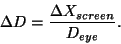
\Delta D=\frac{\Delta X_{screen}}{D_{eye}}

\mbox{.}

\end{displaymath} (21)


Next: The static object resolution Up: 3dprojtn Previous: Image projection and object

2000-08-21