Next: The dynamic object resolution
Up: 3dprojtn
Previous: Sampling distances
This three equations show that the allowed sampling distances of all
three directions are depth dependent. The depth sampling index is
given by iz. If three-dimensional objects or their surfaces are given
with respect to a equidistant sampling coordinates or constant
Nyquist frequencies. These object information datas must be filtered
and resampled. Therefore the necessary filtering operations will be
derived below.
The sampling resolutions given by equations
 ,
,
 ,
,
 can be achieved as long as the lenticular focus line is
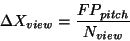
smaller than the horizontal sub-pixel width of one image view on the
focal point plane (cf. fig. 1). This view-pixel
width is given by
(cf. equ.
can be achieved as long as the lenticular focus line is
smaller than the horizontal sub-pixel width of one image view on the
focal point plane (cf. fig. 1). This view-pixel
width is given by
(cf. equ.
 )
)
 |
(22) |
This highest depth dependent 3D resolution is valid for a fixed
observer position. Therefore the resolution of objects given
by equ.
 to
to
 is called the static resolution. In case the observer
makes a horizontal movement there has to be taken into account
another resolution scale which is described in the following.
is called the static resolution. In case the observer
makes a horizontal movement there has to be taken into account
another resolution scale which is described in the following.
The observer sampling point distance shown in fig.
2 is given by
 (equ.
(equ.
 ). The
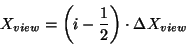
x-positions of the viewing point might be given by
). The
x-positions of the viewing point might be given by
 |
(23) |
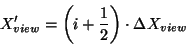
Let now the viewing position move
 |
(24) |
 |
(25) |
In the ideal case of a highest matching optical focus no changing
of views happens. But crossing the point
 the neighbored
view appears. Consequently the objects structure jumps into the
z-plane to the correct position. This jumping step is given by
the neighbored
view appears. Consequently the objects structure jumps into the
z-plane to the correct position. This jumping step is given by
![\begin{displaymath}
\Delta X_{objjump}\left( i_{z}\right) =\left[ Z_{obj}\left( ...
...ft( 0\right) \right] \cdot \frac{\Delta X_{view}}
{Z_{screen}}
\end{displaymath}](img71.gif) |
(26) |
if
 then no jump takes place.
In the other cases the jump is quantized by
then no jump takes place.
In the other cases the jump is quantized by
 .
.
Next: The dynamic object resolution
Up: 3dprojtn
Previous: Sampling distances
2000-08-21