

CINSaT presents itself at the Hessentag 2017 in Rüsselsheim
The content on this page was translated automatically.
CINSaT will be exhibiting at Hessentag 2017 in Rüsselsheim
With sunny weather and summer-like temperatures, Hessentag offered visitors the perfect opportunity to learn about current research topics in the world of nanostructures and to get an overview of the degree programs related to nanotechnology offered by the University of Kassel.
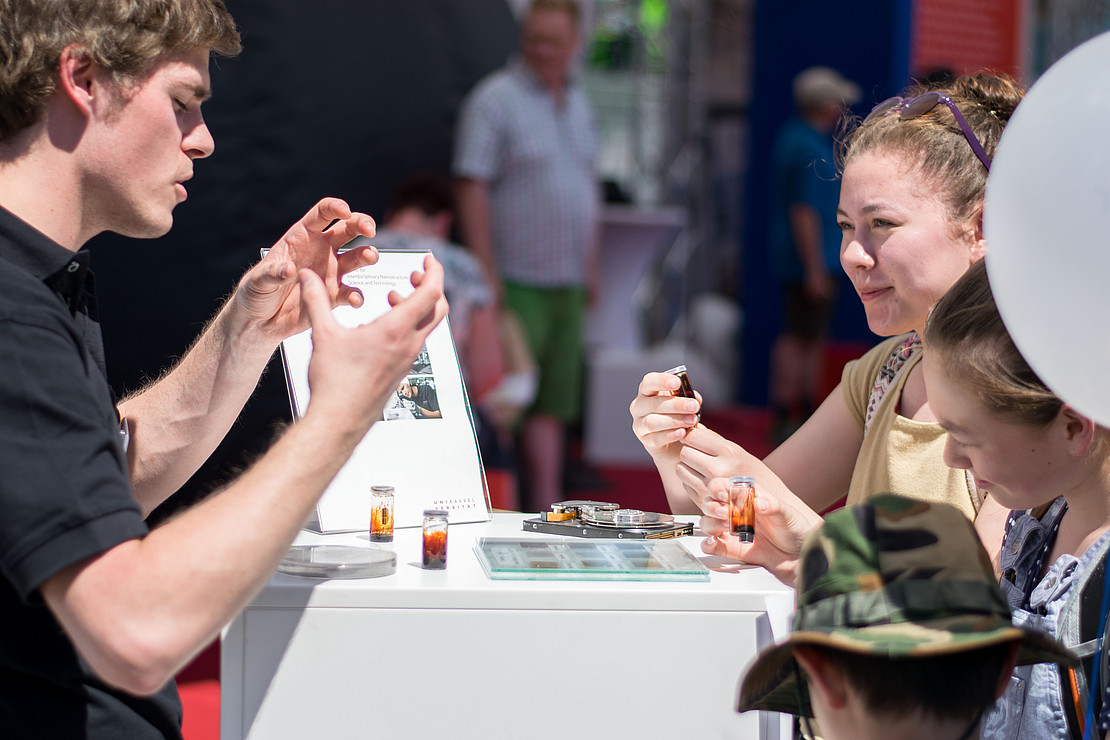
Once again this year, CINSaT joined forces with the numerous research projects of ProLOEWE—the State Initiative for the Development of Scientific and Economic Excellence—to present itself at the “Hessen Creates Knowledge” science initiative booth during Hessentag. Hessentag is a unique initiative organized by the State of Hesse to make science accessible to the general public and communicate it in understandable language. To this end, a wide variety of experiments and exhibits were prepared to evoke a “eureka moment” among visitors and thus impressively demonstrate that science is anything but boring and that many of its concepts can often be found in everyday life. Among the visitors to the booths was Hesse’s Minister of Science, Boris Rhein, who had invited attendees in advance to see Hesse’s outstanding research achievements firsthand and engage in dialogue with the scientists.
In addition to exciting experiments, the tour of CINSaT also offered the opportunity to gain insights into the bachelor’s and master’s programs of the internationally unique degree program in Nanostructure Sciences at the University of Kassel, which is significantly supported by CINSaT’s established research priorities. The close interconnection of interdisciplinary collaboration is particularly evident in the example of the LOEWE-funded ELCH project—Electron Dynamics of Chiral Systems—which is now firmly established as a separate research focus, “Chiral Systems,” within CINSaT. The ELCH research project was also represented once again at Hessentag and illustrated the topic of chirality, among other things, using the varying odor properties of molecules with the same chemical composition, which are attributable to the precise spatial arrangement of the components, i.e., their “handedness.”
Visitors found the experiments with liquid nitrogen, the manipulation of magnetic fluids, and the replica of an atomic force microscope built with LEGO Mindstorms to investigate nanostructures particularly impressive and engaging. The latter also sparked enthusiasm among numerous children and teenagers who had already gained some initial experience programming such systems.