Next: Conclusion
Up: 3dprojtn
Previous: The dynamic object resolution
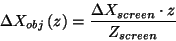
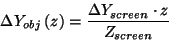
Within each z-plane  an equidistant sampling is defined by the
pixel difference of the screen:
an equidistant sampling is defined by the
pixel difference of the screen:
 ,
,
 according to the
fan projection for the static resolution:
according to the
fan projection for the static resolution:
 |
(28) |
and
 |
(29) |
with  .
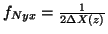
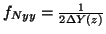
According to this distances the local Nyquist frequencies for low
pass filtering are given by
.
According to this distances the local Nyquist frequencies for low
pass filtering are given by
 resp.
resp.
 . Then the low pass
filtering for the z-plane can be done at the point
. Then the low pass
filtering for the z-plane can be done at the point  ,
,  by the functions
![\begin{displaymath}
si\left[ \frac{x-x_{0}}{2\cdot \Delta X}\right] =\frac{\sin ...
...Delta X}\right] }{2\pi \cdot \frac{x-x_{0}}
{2\cdot \Delta X}}
\end{displaymath}](img84.gif) |
(30) |
and
![\begin{displaymath}
si\left[ \frac{y-y_{0}}{2\cdot \Delta Y}\right] =\frac{\sin ...
...Delta Y}\right] }{2\pi \cdot \frac{y-y_{0}}
{2\cdot \Delta Y}}
\end{displaymath}](img85.gif) |
(31) |
Let be
 the picture in z-plane
  and
and  resp.
resp.  very
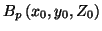
small sampling distances. The x-y-filtering then is carried out
for the point , by the sum
very
small sampling distances. The x-y-filtering then is carried out
for the point , by the sum
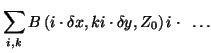
In case a dynamic resolution is wanted
 has
to be substituted by
has
to be substituted by
 .
.
The not equidistant z-Planes
 for sampling are
given by equation
for sampling are
given by equation
 . The filtering function for the z-coordinate at the
point
. The filtering function for the z-coordinate at the
point
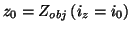 is derived as follows:
![\begin{displaymath}
f\left( z,z_{0}\right) =si\left[ \frac{1-\frac{Z_{screen}}{z}}{2\Delta D}-i_{0}\right]
\mbox{,}
\end{displaymath}](img99.gif) |
(33) |
with
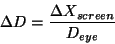 |
(34) |
Thus the filtering sum for the smaller sampling distances  will be
 |
(35) |
according

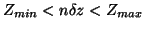 .
This completes the description of the three dimensional filtering
operations.
.
This completes the description of the three dimensional filtering
operations.
Normally the object image data are given also sampled. Then the
analogue function or re-sampling function is achieved by the known
sum using si-functions.
Next: Conclusion
Up: 3dprojtn
Previous: The dynamic object resolution
2000-08-21


![$\displaystyle si\left[ \frac{i\cdot \delta x-x_{0}}
{2\cdot \Delta X_{obj}\left...
... \frac{k\cdot
\delta y-y_{0}}{2\cdot \Delta Y_{obj}\left( Z_{0}\right) }\right]$](img93.gif)