

Research
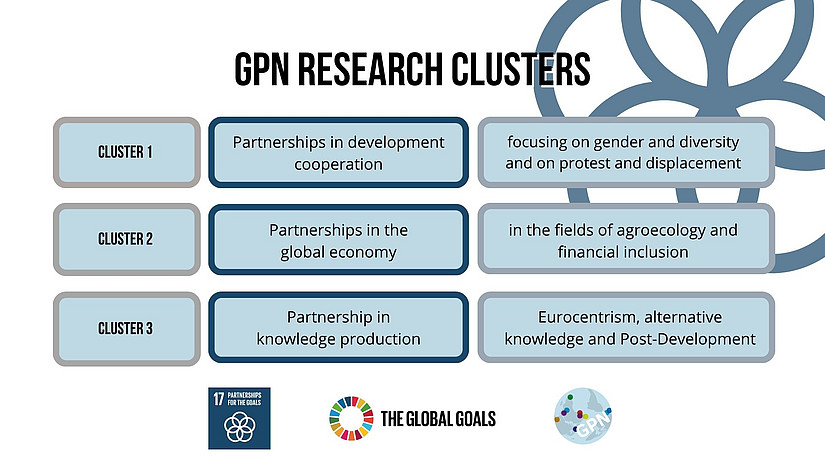
Cluster 1: Partnerships in development cooperation (focusing on gender and diversity and on protest and displacement)
In cluster 1, the research will focus on the one hand on the role of gender and diversity in development cooperation and on the other hand on protests against displacement through development projects.
In the first focus, we assume that development policy and practice, social structures and institutions as well as daily life are permeated by patriarchal, racializing, ableist and colonial power relations. In the projects, we search for inclusive, participatory and collaborative forms of storytelling, ecofeminist practices producing and consuming in order to give weight to voices, stories and communities that are unheard, denied and erased by power structures (Harcourt 2016, Narayanaswamy et al. 2023).
The second focus arises on the work in the first phase on accountability mechanisms in development cooperation like the World Bank Inspection Panel (Schäfer 2023) and engages with protests against displacement as a consequence of development projects (e.g. Aboda 2019, Ziai 2019, for an overview see Tan 2020). Further the research in this cluster will also take into account the results of the Center for Global Cooperation Research regarding the role of imagination and reflexivity in development cooperation (Freistein et al. 2022).
Cluster 2: Partnerships in the global economy (in the fields of agroecology and financial inclusion)
In cluster 2 our focus will be on agroecology as well as on financial inclusion. Both topics will continue the work of the past five years on agriculture and finance, albeit with a narrower focus.
In the light of the deleterious consequences of the hegemonic agricultural practices for rural livelihoods and ecology demonstrated by recent research, agroecology has emerged as a sustainability oriented paradigm (e.g. Foster and Clark, 2018; Jha et al, 2022; Burkett, 2005; Levin, 2020; Redcliff, 1993; Shiva, 2016). It recognizes that farm-level practices are conditioned by the multi-level social-ecological system context into which they are embedded. Opposing further intensification and industrialization of agricultural practices it advocates attention to local context, traditional knowledge and ecological principles in farming as well as maintaining autonomy of farmers. As the 2022 Report of the Intergovernmental Panel on Climate Change (IPCC 2022) documents, millions of people have been exposed to acute food and water insecurity or scarcity in Africa, Asia, Central and South America, and other parts of the world, also pointing to agroecology as pathway to food systems ensuring survival.
The other focus is on financial inclusion, also a topic of increasing relevance which is included in eight of the 17 SDGs. Yet recent research shows the problematic aspects of microfinance as the strategy to reduce poverty through financialization (Prabhakar 2021, Bateman 2021), which is why the GPN will explore its critique and alternatives.
Cluster 3: Partnership in knowledge production: Eurocentrism, alternative knowledge and Post-Development
In Cluster 3, we will focus on Eurocentrism, Post-Development and non-anthropocentric sustainability. Regarding Post-Development, we will build on current research (Dunlap/Tornel 2024, Ziai 2023a, Agostino/Schöneberg 2023) to explore the political, economic and epistemic aspects of local ‘alternatives to development’, also in the use of agroecology (see above in Cluster 2).
Further, we will explore the links between sustainability and coloniality, going beyond the confines of green capitalism and the imperial mode of living (Brand/Wissen 2013) to explore non-anthropocentric knowledge about ecologies and interrelations, extending the relational approach of communal philsophies like Ubuntu to other parts of nature as well (Kimmerer 2013, Gibson et al. 2015, Krenak 2020). Researching non-Western cosmologies and ontologies of soil (Bellacasa 2015) with our partners in rural areas of the Global South again promises synergies with the research on agroecology.
Overarching themes: Sustainability, coloniality, intersectionality
In the first phase, three overarching themes emerged in the research clusters: Sustainability, Coloniality and Intersectionality.
Sustainability became an overarching theme in response to the climate crisis and the need to find alternatives to the resource-intensive imperial modes of production and consumption of modern industrial societies (Brand/Wissen 2013). Without a strong sense of sustainability, global partnerships would reproduce growth models that exacerbate the problems of this mode of production and consumption. The topic is also closely related to the new Kassel Institute for Sustainability at the University of Kassel, which is associated with a number of new chairs and BA and MA programs such as Agriculture, Ecology and Society (AGES) or Critical Sustainability and Postcolonial Studies (CSPS).
Coloniality refers to the significant role that five centuries of colonialism have played in shaping relations between the global North and the global South, leading to asymmetries that still exist today (Quijano 2000). Without a reflection on coloniality, global partnerships would forget the historical debts incurred during these centuries, including the climate debt of the early industrialized countries. This theme intersects with the foci of the Chair of Development and Postcolonial Studies, the Chair of Modern History, the Chair of Sociology of Diversity and the aforementioned MA CSPS.
Intersectionality makes it clear that there is not just one type of power relation that acts as a universal key to explaining social and economic inequality at the global, national or local level (including colonial relations), but that the intertwined oppression of (at least) capitalism, racism, heteronormativity and patriarchy must be taken into account. Without intersectionality, global partnerships would bypass these power relations and possibly produce solutions that reproduce them. This topic is reflected in the new research center "Gender Studies in Transition" at the University of Kassel.
Apffel-Marglin, Frédérique/Marglin, Stephen (eds) (1990): Dominating Knowledge. Development, Culture, and Resistance. Oxford: Clarendon Press.
Apffel-Marglin, Frédérique/Marglin, Stephen (eds) (1996): Decolonizing Knowledge. From Development to Dialogue. Oxford: Clarendon Press.
Aslanbeigui, Nahid/Oakes, Guy/Uddin, Nancy (2010): 'Assessing Microcredit in Bangladesh: A Critique of the Concept of Empowerment', Review of Political Economy, 22: 2, 181-204.
Attridge, Samantha (2018): Can blended finance work for the poorest countries? ODI Insights https:// www.odi.org/blogs/10650-can-blended-finance-work-poorest-countries (Aug 1, 2019)
Ashoff, Guido (2005): Enhancing policy coherence for development : justification, recognition and approaches to achievement. Bonn: DIE.
Barthel, Bettina (2019): Renewable and decentralized energies from a postcolonial perspective. Ethnographic analyses of German-Tanzanian partnerships. Baden-Baden: Nomos.
Bendix, Daniel/Müller, Franziska/Ziai, Aram (eds) (2020): Beyond the Master's Tools? Decolonizing Knowledge Orders, Resarch and Teaching. Lanham: Rowman & Littlefield.
Bhambra, Gurminder (2014): Knowledge production in global context: Power and coloniality. Current Sociology 62 (4), 451-456.
BMZ (2017): Africa and Europe - New partnership for development, peace and the future.
Key points for a Marshall Plan with Africa. Berlin: BMZ.
Browne, Stephen (1999): Beyond Aid. From Patronage to Partnership. Aldershot: Ashgate.
Caliari, Aldo (2014) Analysis of Millennium Development Goal 8: A Global Partnership for Development, Journal of Human Development and Capabilities, 15:2-3, 275-287.
Clark, Dana/Fox, Jonathan/Treakle, Kay (eds) (2003): Demanding Accountability. Civil-Society Claims and the World Bank Inspection Panel. Lanham: Rowman & Littlefield.
Clark, Robyn/Reed, James/Sunderland, Terry (2018): Bridging funding gaps for climate and sustainable development: Pitfalls, progress and potential of private finance, in: Land Use Policy, Volume 71, 335-346
Comaroff, J., & Comaroff, J. L. (2015). Theory from the South: Or, how Euro-America is evolving toward Africa. Routledge.
Connell, Raewyn (2007): Southern Theory. The global dynamics of knowledge in social science.Cambridge: Polity Press.
Cooke, Bill/Kothari, Uma (2001): Participation: The New Tyranny? London: Zed Books.
Cowen, M.P./Shenton, R.W. (1996): Doctrines Of Development. 1st ed. London: Routledge.
De Wet, Chris (ed.) (2006): Development-Induced Displacement. Problems, Policies, and People. New York: Berghahn.
Duflo, Esther/Banerjee, Abhijit/Glennerster, Rachel/Kinnan, Cynthia G. (2013): The miracle of microfinance? National Bureau of Economic Research, Working Paper 18950.
Easterly, William (2013): The Tyranny of Experts. Economists, Dictators, and the Forgotten Rights of the Poor. New York: Basic Books.
Eriksson Baaz, Maria (2005): The Paternalism of Partnership. A Postcolonial Reading of Identity in Development Aid. London: Zed books.
Escobar, Arturo (2012): Encountering Development. The Making and Unmaking of the Third World. 2nd ed. Princeton: Princeton University Press.
Fam, Dena/Palmer, Jane/Riedy, Chris/Mitchell, Cynthia (eds) (2017): Transdisciplinary Resarch and Practice for Sustainability Outcomes. London: Routledge.
Ferguson, James (1994): The Anti-Politics Machine. 'Development', Depoliticization and Bureaucratic Power in Lesotho. Minneapolis: Minnesota University Press.
Fox, Jonathan/Brown, L. David (eds) (1998): The Struggle for Accountability. The World Bank, NGOs, and Grassroots Movements. Cambridge: MIT Press.
Gold, S., Trautrims, A., Trodd, Z. (2015) Modern slavery challenges to supply chain management. Supply Chain Management: An International Journal, 20 (5), 485-494.
Hirsch Hadorn, Gertrude/Hoffmann-Riem, Holger/Biber-Klemm, Susette/Grossenbacher-Mansuy, Walter/Joye, Dominique/Pohl, Christian/Wiesmann, Urs/Zemp, Elisabeth (eds) (2008): Handbook of Transdisciplinary Research. Springer.
Hickey, Samuel/Mohan, Giles (eds) (2004): Participation: from tyranny to transformation? Exploring new approaches to participation in development. London: Zed Books.
Kabeer, Naila (1994): Reversed Realities. Gender Hierarchies in Development Thought. London: Verso.
Kothari, Ashish/Salleh, Ariel/Escobar, Arturo/Demaria, Federico/Acosta, Alberto (eds) (2019): Pluriverse: A Post-Development Dictionary. New Delhi: Tulika Books.
Li, Tania Murray (2007): The Will to Improve. Governmentality, Development, and the Practice of Politics. Durham: Duke University Press.
Mader, Philip (2013) Explaining and Quantifying the Extractive Success of Financial Systems: Microfinance and the Financialization of Poverty, Economic Research, 26 (s1), 13-28.
Mauser, Wolfram/Klepper, Gernot/Rice, Martin/Schmalzbauer, Bettina Susanne/Hackmann, Heide/Leemans, Rik/Moore, Howard (2013): Transdisciplinary global change research: the co-creation of knowledge for sustainability, in: Current Opinion in Environmental Sustainability, Vol 5/3-4, pp. 420-431.
Mawdsley, Emma (2018): 'From billions to trillions': Financing the SDGs in a world 'beyond aid', in: Dialogues in Human Geography 8 (2), 191-195.
Melber, H. (2018). Knowledge Production and Decolonization-Not only African challenges. Strategic Review for Southern Africa, 40(1), 4-15.
Messner, Dirk/Maxwell, Simon/Nuscheler, Franz/Siegle, Joseph (2005): Governance Reform of the Bretton Woods Institutions and the UN Development System. Dialogue on Globalization, Occasional Papers No. 18. Washington: FES.
Mignolo, Walter (2007): Delinking: The rhetoric of modernity, the logic of coloniality and the grammar of decoloniality. Cultural Studies 21 (2-3), 449-514.
Mitchell, Timothy (2002): Rule of Experts. Egypt, Techno-Politics, Modernity. Berkeley, University of California Press.
Mkandawire, T. (2011). Running while others walk: Knowledge and the challenge of Africa's development. Africa Development, 36(2), 1-36.
Mosse, David (2005): Cultivating Development. An Ethnography of Aid Policy and Practice. London: Pluto Press.
Müller, Franziska (2017): IRENA as glocal actor: pathways towards energy governmentality. Innovation: The European Journal of Social Science Research. 30 (3), 306-322.
Nandy, Ashish (ed) (1988): Sciecne, Hegemony and Violence. A Reqiuem for Modernity. Delhi: Oxford University Press.
Ndlovu, Morgan (2014): Why indigenous knowledge in the 21st century? A decolonial turn. Yesterday and Today 11, 84-98.
Ndhlovu, F (2017), 'Southern development discourse for Southern Africa: linguistic and cultural imperatives', Journal of Multicultural Discourses. (Available at: DOI: 10.1080/17447143.2016.1277733.)
Parthan, Binu/Osterkorn, Marianne/Kennedy, Matthew/Hoskyns, St. John/Bazilian, Morgan/Monga, Pradeep (2010): Lessons for low-carbon energy transition: Experience from the Renewable Energy and Energy Efficiency Partnership (REEEP). Energy for Sustainable Development. (Available at: DOI: 10.1016/j.esd.2010.04.003)
Pereira, Javier (2017): Blended Finance: What it is, how it works and how it is used, Oxfam. https://oxfamilibrary.openrepository.com/handle/10546/620186 (Aug 1, 2019)
Radcliffe, Sarah (2015): Dilemmas of Difference. Indigenous Women and the Limits of Postcolonial Development Policy. Durham: Duke University Press.
Rahnema, Majid with Bawtree, Victoria (eds.) (1997): The Post-Development Reader. London: Zed Books.
Raynolds, Laura (2000): Re-embedding global agriculture: the international organic and fair trade movements, Agriculture and Human Values 17: 297-309.
Reiter, Bernd (ed.) (2018): Constructing the Pluriverse. The Geopolitics of Knowledge. Durham: Duke University Press.
Rist, Gilbert (2014): The History of Development. From Western Origins to Global Faith. 4th ed. London: Zed Books.
Sachs, Wolfgang (ed) (2010): The Development Dictionary. A Guide to Knowledge as Power. 2nd ed. London: Zed Books.
Santos, Boaventura de Sousa (ed.) (2007): Another Knowledge is Possible. Beyond Northern Epistemologies. London: Verso.
Santos, Boaventura de Sousa (2014): Epistemologies of the South. Justice against Epistemicide. Boulder: Paradigm.
Seabrook, Jeremy (1993): Victims of Development. Resistance and Alternatives. London: Verso.
Smith, L. T. (2013) Decolonizing methodologies: Research and indigenous peoples. Zed Books Ltd.
Townsend, Janet Gabriel (1995): Women's Voices from the Rainforest. London: Routledge.
Vaggi, Gianni/Prizzon, Annalisa (2014): On the sustainability of external debt: is debt relief enough? Cambridge Journal of Economics 38: 1155-1169.
Visvanathan, Nalini/Duggan, Lynn/Wiegersma, Nan/Nisonoff, Laurie (eds.) (2011): The Women, Gender and Development Reader. 2nd edition. London: Zed Books.
Wienold, Hanns (2012): Fair trade: Moral economy or exchange of equivalents? Periphery No. 128, 500-508.
Young, Elspeth (1995): Third World in the First. Development and Indigenous Peoples. London: Routledge.
Ziai, Aram (2007): Global structural policy? The North-South policy of the FRG and the dispositif of development. Münster: Westfälisches Dampfboot.
Ziai, Aram (2016): Development Discourse and Global History. London: Routledge.