

SCHIRM
Optical MEMS Microshutter Arrays for the Protection of the Eyes and Optical Components (SCHIRM)
An increasing number of laser attacks have been reported on bus and tram drivers, security personnel, or pilots of civil aviation during takeoff and landing. These attacks are based on irresponsible recklessness, gross mischief, or even a terrorist background. Existing laser safety goggles have at least one or more of the following disadvantages: low transmission, not color neutral, absorbing only a few wavelengths paired with insufficient attenuation, and not meeting existing norms. Our MEMS-based ultrafast microshutter arrays provide safety for all wavelengths, an optical density (OD) > 4, and hyperfast switching speed. Microshutter arrays utilize electrostatic actuation, applying a voltage between the transparent conductive oxide electrode and the metallic microshutter grid as the counter-electrode. The actuation speed and transmission need optimization of geometry and voltage levels. The closing is initiated if hazardous laser radiation is detected by a photodiode ring located around each goggle glass. In different samples, individual optimizations led to 1 µs closing time, blocking 10W of 532 nm for > 2 minutes, OD 4.5 in closed state, and 75% transmission in default state. This methodology is also able to protect security cameras and other optical components against laser attacks.
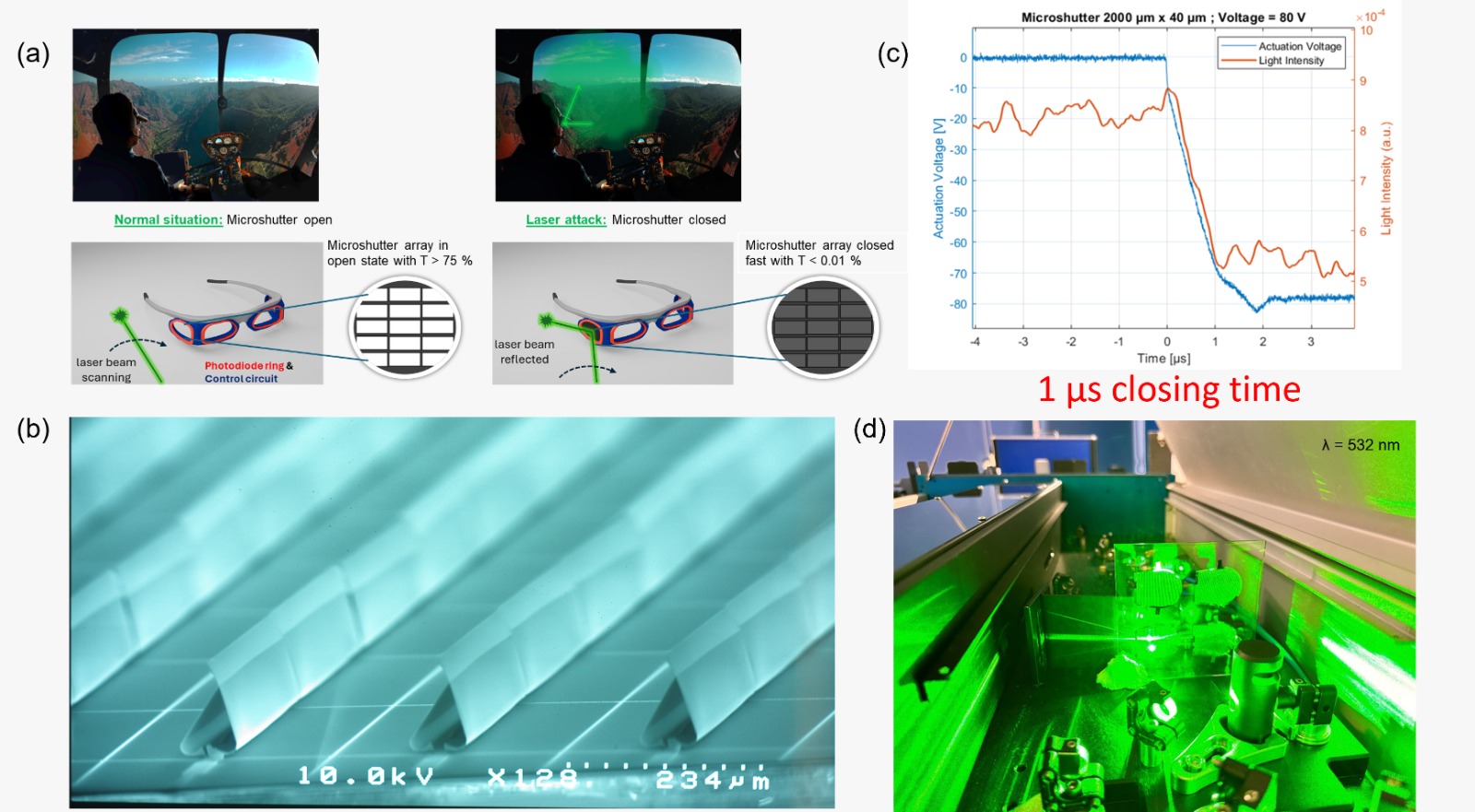
Recent research highlights of DFG SCHIRM; (a) Schematic illustration of the working principle of MEMS-based laser safety goggles with insets of corresponding micrographs, both open and closed state, (b) SEM micrograph of recently developed microshutter arrays in “Butterfly Orientation”, (c) Measured actuation voltage profiles and light intensity profiles as a function of time, (d) reliability experiment with laser exposure.
Publications
S. Liu, M. Smolarczyk, Md K. Hasan, X. Yang, P. Kästner and H. Hillmer, “Hyperfast MEMS-Based Microshutter Arrays for Laser Safety Goggles and Security Devices.” In Nanotechnological Advances in Environmental, Cyber and CBRN Security; Petkov, P., Achour, M.E., Popov, C., Eds.; NATO Science for Peace and Security Series B: Physics and Biophysics; Springer: Dordrecht, 2025; pp. 481–494. https://doi.org/10.1007/978-94-024-2316-7_28
S. Liu, P. Kästner, R. Donatiello, A. Shrivastava, M. Smolarczyk, M.S.Q. Iskhandar, M.K. Hasan, G. Caruso, J. Chen, B. Elsaka, S. Baby, D. Löber, T. Kusserow, J. Adam and H. Hillmer, "State-of-the-art materials used in MEMS micromirror arrays for photonic applications". Photonics2024, 11, 253. https://doi.org/10.3390/photonics11030253
X. Yang, P. Kästner, E. Käkel, M. Smolarczyk, S. Liu, Q. Li, and H. Hillmer, "Study of Dynamics in Metallic MEMS Cantilevers - Pull-in Voltage and Actuation Speed." Appl. Sci.2023, 13, 1118. https://doi.org/10.3390/app13021118