

Lamosafe
Microshutter Arrays for laser safety goggles
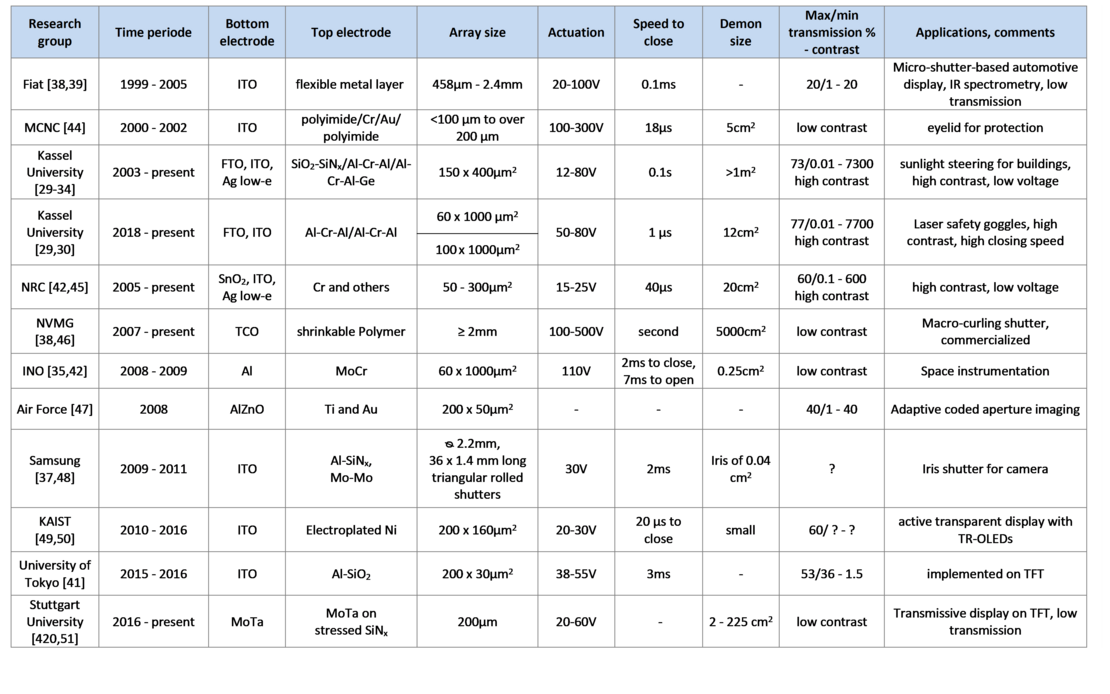
There are many investigations from various groups which have been working on micro-shutter arrays for decades. After working a long time on MEMS micromirror array for smart windows in building, the team of Kassel University also entered the field of microshutter arrays, with a concept for an effective fast eye protection, especially an active laser safety goggle. For our MEMS microshutter arrays presented in this section, a mini mum transmissivity Tmin of 0.01% and, recently a maximum transmissivity Tmax of 77%, including the glass substrate with the transparent conductive oxide (TCO) layer. This provides a modulation contrast of Tmax/Tmin= 7700 between open and closed states.
Table 1. Comparison of different MEMS shutter technologies: materials, size of a single shutter elements, experimental characterization results, and potential applications.
The active laser goggles are designed to protect for terroristic laser attacks against pilots, tram and bus drivers, police, and security personal. An important application is protecting the health of the human eye against laser strikes during traffic use. It is very important to help solving this still increasing problem, which is more than a decade existing and still not solved, satisfactorily. The goal is to solve this problem by active laser goggles, via achieving ultrafast closing of the MEMS shutters after photodiodes have identified laser radiation.
Passive laser safety goggles are delivering much less than active ones. A first type are photochromic glasses on the market, which do not meet the speed requirements and are not sufficient concerning transmission. A second type are conventional passive laser safety goggles on the market, which are based on optical filter technology. Each type of goggle can only absorb one or few designed wavelength ranges. The transmitted spectra are passively selected by the filter itself, which is leading to a coloring effect when it is designed for visible laser wavelengths, since some wavelength ranges are subtracted from the white spectrum. Another weak point of passive laser goggles, all having coatings, is that a single scratch going through the coating stack, destroy the protection.
Important is which application is considered. E.g., for any traffic use (pilots in the cockpit, bus-and tram-drivers), passive laser protection is not allowed to be applied. The reasons are that passive laser goggles have (i) unacceptable low transmission during night use when attacks mostly happened and (ii) the pilot cannot see the correct color of displays or indication LEDs or does not see important details at all. Each single frequency range to be blocked by the passive laser goggle makes the multilayer coating more complex and less transmissive. Layer attacks to pilots have been reported for the green (532 nm), red (640 and 650 nm), blue (405 nm) and others. Starting from the green and adding all these colors to be suppressed, the overall transmission significantly decreases (down to 35%) and changes the color recognition, very negatively. Therefore, the passive laser goggle is not allowed to be used for any traffic and even less at night use. This has motivated us to develop MEMS microshutter arrays for laser safety goggles with adequate sensing and control technology, which is able to block laser light of any wavelength exceeding defined eye safety levels. The active laser technology enables to solve not only the two problems mentioned above, but keep safety, security and health high without penalizing them. In summary, the MEMS microshutter array goggle is colour neutral, has much higher transmission and reveals much higher optical, density (OD) in the closed status compared to most passive laser goggles.
Our metallic MEMS microshutter arrays in the laser safety goggle are normally in a totally open state and should close on request with a high switching speed. The arrangement of these shutters in an array connected via a grid enable the shutters to move synchronously with the neighboring ones. The microshutter arrays in laser safety goggles enable the light transmitting the glasses and reach the human eyes in normal open conditions. In case of a laser attack, they close fast and block incoming light of all wavelengths totally in the closing state, since laser light can cause serious damage to eyes. The shutters reopen after the laser radiation passed and enable free sight of the eyes.
In the default state, microshutters are open and vertically standing on the substrate, as shown in Figure 1, captured from three viewpoints. The red arrow in Figure 12 (b) is pointing in the long direction of the anchor of a shutter, which represents the contacting grid at the same time.
Figure 2 depicts the applied electrostatic actuation voltage (blue) and the light intensity transmitted through the microshutter array (orange) as a function of time. The measurement presents the highest closing speed of our microshutter arrays, measured up to now. In this case, the dimensions of a single microshutter are 2000 µm × 40 µm (Lx and Ly) and the step voltage profile switches from 0 V to 80 V. Our simulations have shown that reducing the microshutter dimensions (Ly) perpendicular to the hinge, the switching time will decrease. However, the height of the actuation voltage also impacts the closing time of the microshutter arrays. Very low actuation voltages and fast closing at the same time cannot be obtained at the same time. A compromise must be found, the shutters could be either optimized towards ultra-fast closing accepting high voltages only, or optimized towards low actuation voltages tolerating slower closing.
Different dimensions have been explored for our microshutter arrays for laser safety goggles to investigate the compromise between switching time and actuation voltage – to identify the best solution is yet under investigation.
Microshutter arrays consist of thousands of microshutters in a specialized format. With high contrast and high closing speed, microshutter arrays provides a promising solution for safety usage. Depending on the detecting photodiode, microshutter arrays can be used for all wavelengths or the required spectrum as laser safety goggles. The most significant benefit of microshutter arrays for laser safety goggles is that the metallic blades reflect lasers of all wavelengths and are color neutral.

Figure 1. SEM micrographs of (a) a perspective top view of microshutter array in opening state after lift-off and drying process, (b) perspective side view of standing flat shutters, the red arrow indicates the anchor (supporting post) i.e. the connecting grid. The arrow directs in the long direction of the anchors. (c) Perspective top view of microshutter focusing on the blade and grid.

Figure 2. Light intensity transmitted through the microshutter array as a function of time (orange profile and right ordinate). The applied electrostatic actuation voltage is also displayed as a function of time (blue profile and left ordinate). A closing time below 1µs is measured for of a microshutter arrays with the dimension of 2000 µm × 40 µm of a single mirror.