Single News
Does generative AI in schools and universities kill independent thinking? Not necessarily, say Kassel researchers!
As part of an interdisciplinary collaboration between the Centre for Empirical Teaching and Learning Research (ZELL) and the International Centre for Higher Education Research (INCHER), Peer-Benedikt Degen and Dr. Igor Asanov conducted a study examining the effectiveness of an AI-based Socratic tutor. This AI tutor was designed, technically implemented and tested in a controlled study by Peer-Benedikt Degen as part of his doctoral thesis. The study by the two Kassel researchers shows that the use of AI can support critical, independent and reflective thinking rather than hinder it, provided that the AI tool is specifically designed for educational purposes.
The results are particularly significant in light of a recent study by MIT (https://www.media.mit.edu/publications/your-brain-on-chatgpt/), which showed that students exhibited lower cognitive activity when using uninstructed AI (in this case, Chat-GPT 4o from OpenAI). This finding underscores the importance of focusing on pedagogical framing in AI-supported learning
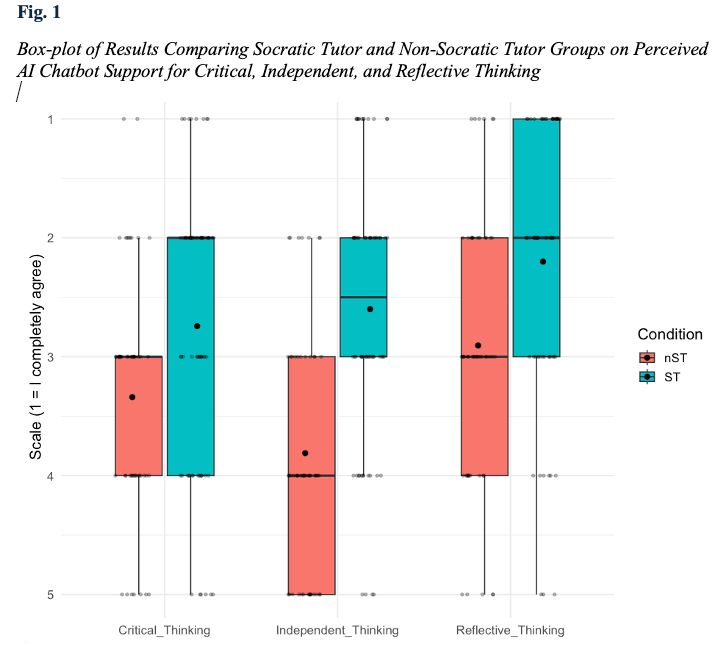
The study by ZELL and INCHER was conducted with 65 teacher training students in Germany and compares the students' interaction with a Socratic tutor with their interaction with an untrained AI chatbot. Students who used the Socratic tutor reported significantly greater promotion of critical, independent and reflective thinking, suggesting that dialogic AI can stimulate metacognitive engagement, thus contradicting recent narratives about the loss of skills due to the use of generative AI.
The preprint of the study has just been published on arXiv and can be accessed at https://arxiv.org/abs/2508.05116
Peer-Benedikt Degen, Igor Asanov (2025): “Beyond Automation: Socratic AI, Epistemic Agency, and the Implications of the Emergence of Orchestrated Multi-Agent Learning Architectures”. https://arxiv.org/abs/2508.05116
Contact:
Degen[at]uni-kassel[dot]de