

Design Methods

Selected Research Projects Over Time
Design Methods
The VENUS development method is an interdisciplinary approach to socio-technical software design. As part of the LOEWE VENUS research initiative, “Designing Technical-Social Networking in Situational Ubiquitous Systems,” experts from the fields of computer science, human-computer interaction, trust management, and law at the ITeG, developed a systematic, interdisciplinary development method for the design of ubiquitous systems.
The goal of this development was to create a socially responsible design method that, in addition to functional requirements, also meets requirements such as usability, protection of personal data, trust in technology, reliability and robustness, as well as economic and legal framework conditions.
The VENUS development method covers the entire development cycle, from requirements analysis to system evaluation. The individual phases of software development are supported by integrated methods (e.g., KORA) and techniques for the iterative, interdisciplinary development of socially acceptable ubiquitous systems.
- Link to the VENUS Research Focus
- Link to VENUS publications

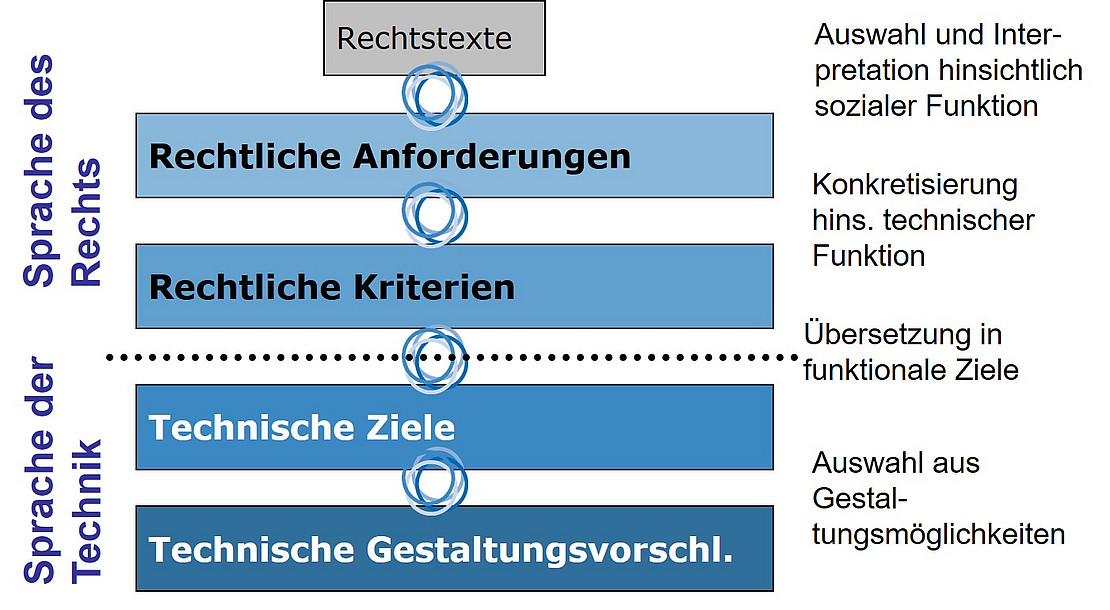
The KORA method for specifying legal requirements was developed to ensure that technology is designed in accordance with the Constitution and to bridge the gap between law and technology. Its creators are Alexander Roßnagel and the provet Research Group. KORA provides a set of tools for the step-by-step, systematic elaboration of constitutional principles, leading to implementable design proposals for information technology.
KORA is a method for legally compliant technology design. Technology increasingly determines the conditions under which the law can be realized. The law must therefore be incorporated into the technology development process itself. KORA makes it possible to systematically develop proposals for the legally compliant design of information technology.
GERD is a scientific model designed to integrate “gender and diversity” considerations into the practical development of technology. The model was originally developed in the “Sociotechnical System Design and Gender” working group within the Faculty of Computer Science at the University of Bremen and further refined at the ITeG in the GeDIS research group. GERD is designed for use in the tech industry and related research fields. It provides knowledge and guidelines for teams, addressing all phases of research and development.
The GERD model is designed to help teams consider, capture, and integrate the diversity of people, contexts, and knowledge at every stage of the research or development process. It maps core processes in computer science research and software development and assigns relevant gender and diversity considerations to each phase.
