

Newscast and events


Past events
Narrative literature informs us about historical and contemporary cultures and societies. The readings planned for the winter semester revolve around the social context of narcotráfico - the world of organized drug smuggling and trafficking. This addresses a social and political event horizon that has taken on extremely threatening proportions in certain Latin American countries such as Mexico or Colombia, but has also triggered an almost unmanageable production of novels, films and series on the subject.
The planned event will examine in particular the role of women who move in the milieu of organized crime. On the one hand, a high level of sexualized violence is observed in these social environments, on the other hand, recent field studies have drawn attention to the fact that (married) women play a stabilizing role in the social structure of organized crime. On the basis of literary and generally informative texts, we will reflect on the aforementioned connections, as well as on narrative literature as a medium of social observation and cultural reflection.
The novel: Pilar Quintana, Coleccionistas de polvos raros (El Aleph, 2010) is recommended for early purchase and reading
The lecture focuses on an almost forgotten topic in modern literature. Ever since the office was developed as a literary theme in the 19th century with the expansion of private and state administrative apparatuses - e.g. by Gogol, Balzac or Melville - a growing number of authors have been involved in the development of this theme. As a result, administrations were not only understood at the state level as the permanent establishment of state forms of rule (Max Weber), they were also perceived from a social-individual perspective as overpowering bureaucratic monsters, as some of Franz Kafka's narrative texts demonstrate (e.g. The Trial).
In Latin America, bureaucratic traditions go back to the colonial era. Not only soldiers and missionaries were involved in the conquista, but also lawyers and scribes. In the colonial cities and at the courts, legal literacy was soon discovered as an instrument of power that was used against a poorly literate population. In the twentieth century, Latin American authors drew on the collective colonial experience on the one hand, and on the impulses of European literature on the other. The Cuentos de la oficina (1925) by the Argentinean Roberto Mariani became a classic of the newly emerging genre. The literary texts following Mariani's cycle of stories are still in the process of being catalogued. The lecture follows on from this desideratum. A series of texts and authors will be presented and the office will be thematized primarily as a space of power and domination, in which not only the grey everyday life dominates, but also intrigue, affects or the negotiation of identities are at home.
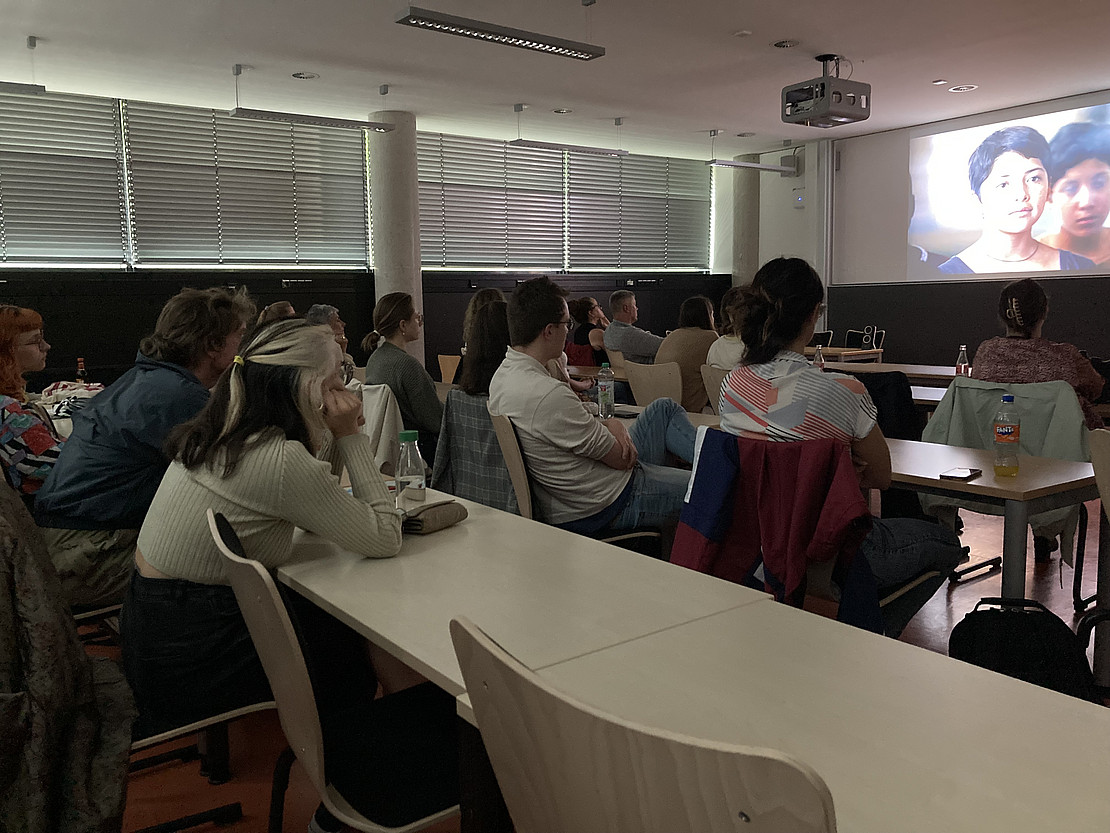
On 29.05.2024, "Noche de fuego" by Salvadoran-Mexican director Tatiana Huezo was shown as part of the three-part event series "Romance Film Evening" (organization: Dolores León Muñoz, Jacopo Romei & Karolin Schäfer). Based on Jennifer Clement's novel "Prayers for the stolen" (2014; Spanish title: "Ladydi"), this 2021 film deals with the dangers of drug and human trafficking faced by three girls during their childhood and adolescence in the Mexican state of Guerrero.
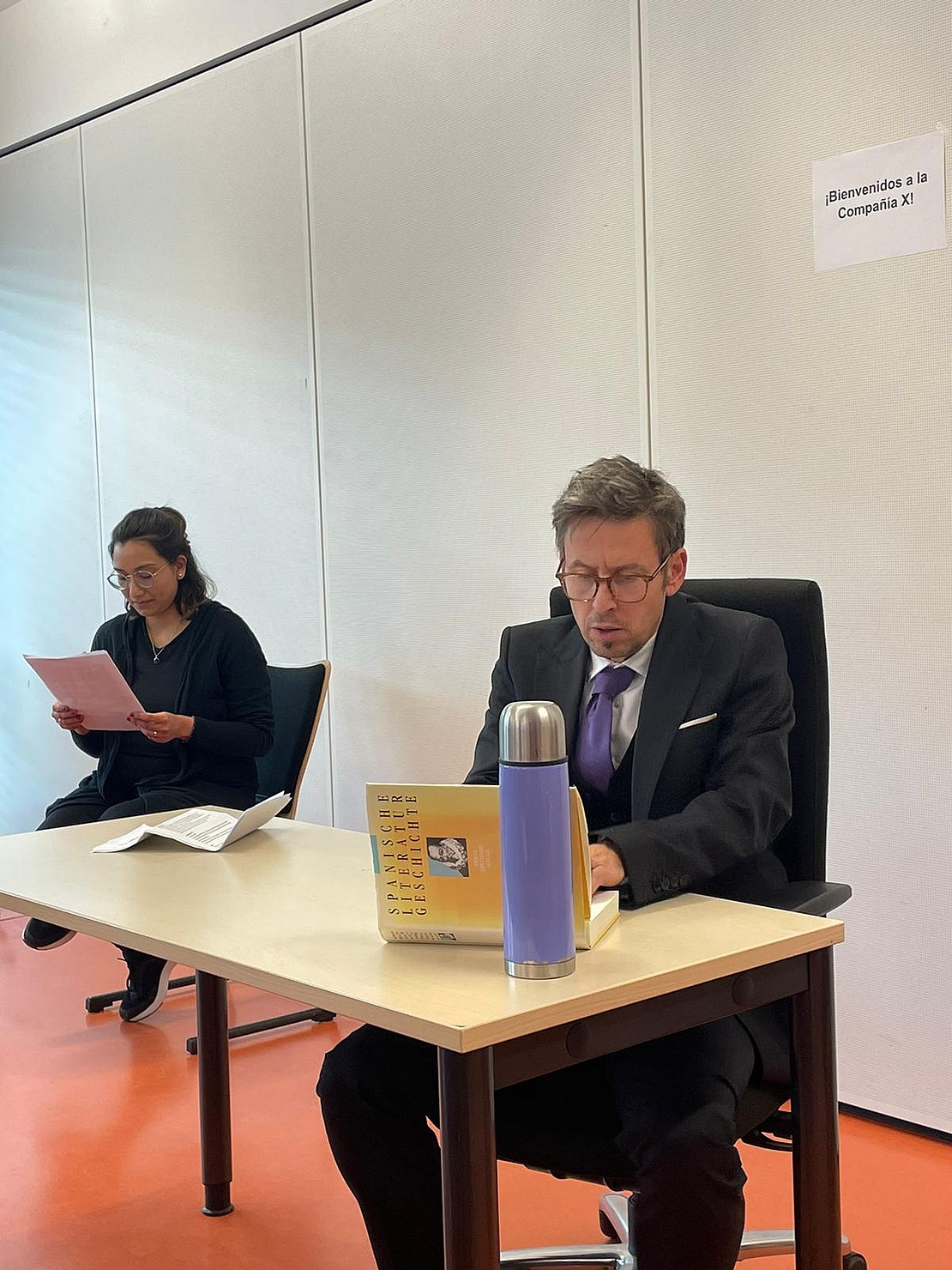
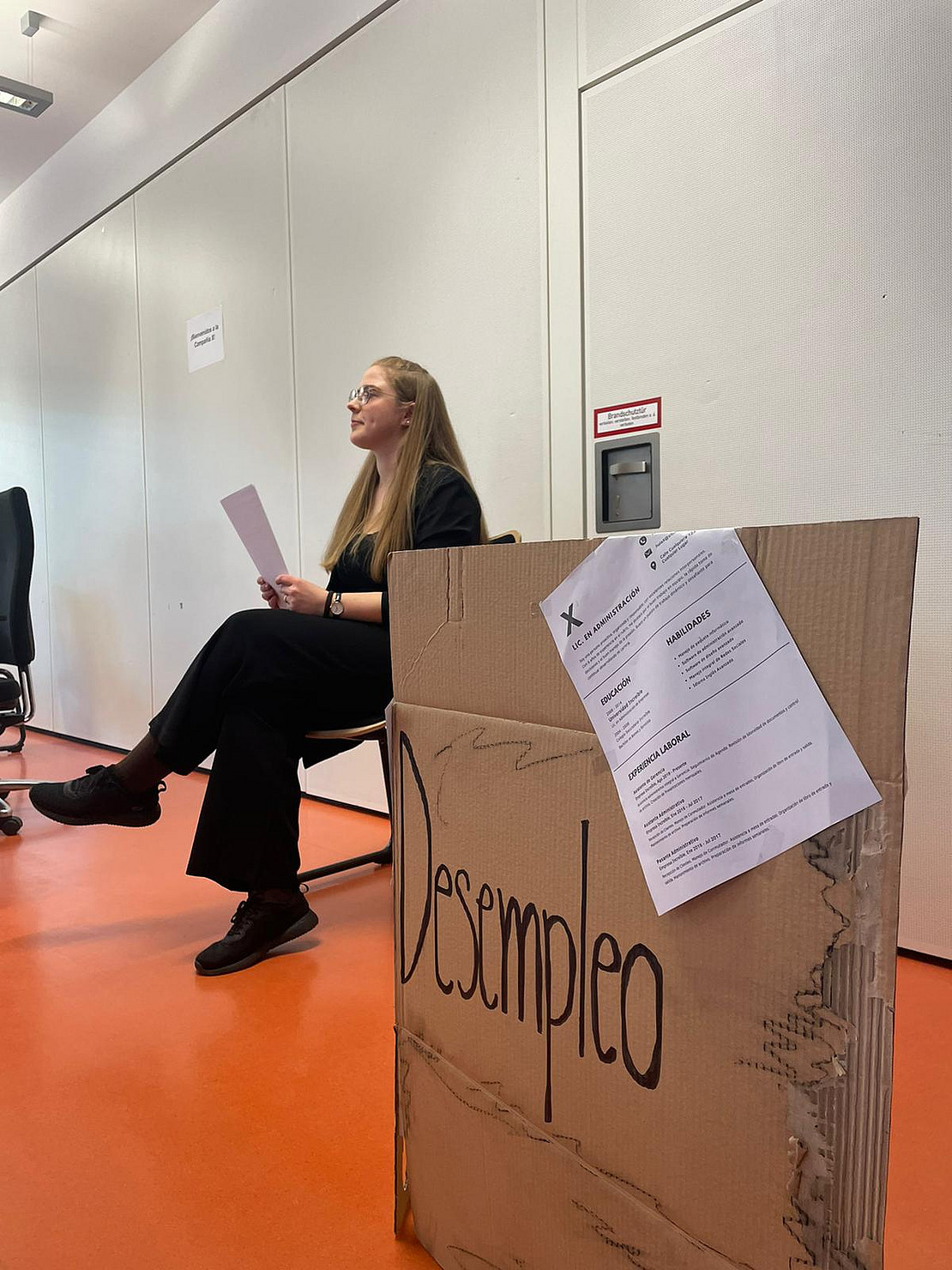
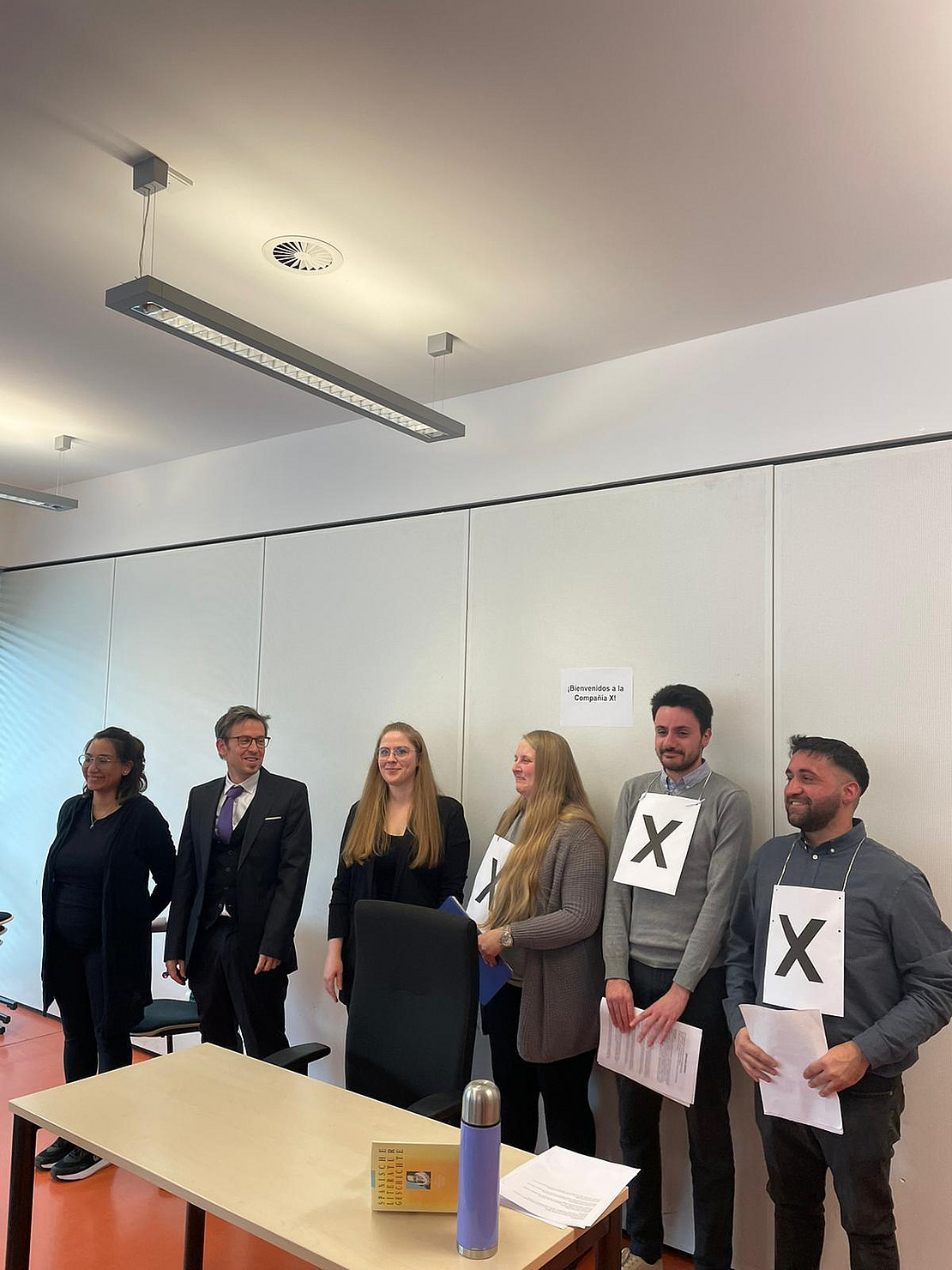
On 24.04.2024, another semester opening ("Institute Day") of Kassel Romance Studies took place. Prof. Dr. Jan-Henrik Witthaus and Karolin Schäfer organized a staged reading to give the faculty and students an insight into the findings from the project work. The subject of the reading were constellations of characters from everyday literary office life, which were presented together with students in the form of a collage. These contained fragments from the following texts from the corpus that has so far been developed as part of the project:
Rillo (Roberto Mariani, Argentina 1925)
Santana (Roberto Mariani, Argentina 1925)
Lacarreguy (Roberto Mariani, Argentina 1925)
44 horas semanales (Josefina Marpons, Argentina 1936)
Los perros no ladraron (Carmen Naranjo, Costa Rica 1966)
El gerente (Julio Ricci, Uruguay 1985)
La necesidad de ser esquizofrénico (Julio Ricci, Uruguay 1985)
Zafaron a tiempo (Jorge A. Vilches, Argentina 1985)
Llanto en el Proyecto Patagonia (Jorge A. Vilches, Argentina 1985)
Recursos Humanos (Antonio García Ángel, Colombia 2007)
Recursos Humanos (Antonio Ortuño, Mexico 2007)
El oficinista (Guillermo Saccomanno, Argentina 2010)

The rise and fall of Pablo Escobar's (1949-1993) drug empire has become known beyond the borders of Colombia thanks to the Netflix series Narcos. However, the perspective offered there is not only committed to a dependence on the Global North in terms of the format and the origin of the production. The presentation itself also marks this perspective. Within the framework of Colombian cultural production, however, the memory of Escobar is kept alive in literature, film and art - and this happens, depending on the respective media mediation, with an ambivalence that this topic deserves.
The planned event is dedicated to literary, cinematic and artistic testimonies that have been grouped around Pablo Escobar's memory, with a focus on Colombian cultural production. Conceptually and theoretically, we will be guided by the work of Maurice Halbwachs, Pierre Nora and Jan and Aleida Assmann.
Who would have thought that stories from the office could be much more exciting than the topic seems to suggest? Such stories not only tell of sometimes seemingly monotonous activities, but also of power, career, violence, love or affect. This is not so surprising, as working people spend a considerable part of their lives in the place where they work, in this case: the office. By reading a series of literary texts from Latin America that cover the range of topics mentioned, the aim is to reflect on the cultural and social significance of office work in the countries of that global region. A guiding question could be the relevance of income, positions, activities or modes of existence for identity processes, hierarchization or exclusion.
Literary texts by Josefina Marpons, Jorge A. Vilches and Julio Ricci, among others, will be read.
Over the last two decades, drug trafficking and smuggling has become a permanent theme of fiction literature in some Latin American countries, with a particular focus on the formation of organized groups and the social and political consequences. In Mexico in particular, thematically related novel production is experiencing an upswing, so much so that there is even talk of a new genre that has conquered the book markets. However, this literature is not entirely uncontroversial, as some commentators claim that it portrays an image of the country that is anything but favourable and plays a rather dubious role in the negotiation of collective identities - an argument that becomes understandable when you consider that the 'narcotráfico' has long since found its way into contemporary Netflix&Co worlds, in which US-American images of Latin America become recognizable.
The lecture will begin by looking at the social and political background before examining and explaining the literature itself. We will begin by taking a closer look at the concept of genre - with the aim of critically questioning whether the talk of a 'new genre' is justified at all. It will also address the question of how the different forms of writing depict social realities and reflect them critically. A number of examples will be used to address the above-mentioned aspects and others that arise during the course of the event.
On 13.07.2023, Prof. Dr. Agnieszka Komorowska and Prof. Dr. Jan-Henrik Witthaus organized a workshop entitled "Narrativas, Representaciones, (Re)construcciones: Perspectivas cruzadas sobre América Latina" on the occasion of the large CELA conference and were able to use this opportunity to talk to colleagues from Latin America about their respective research initiatives. In this context, new perspectives, suggestions and text proposals for our DFG project also emerged. Our heartfelt thanks go to our colleagues.