

Colloque de recherche INCHER - Semestre d'hiver 2026/2027
The content on this page was translated automatically.
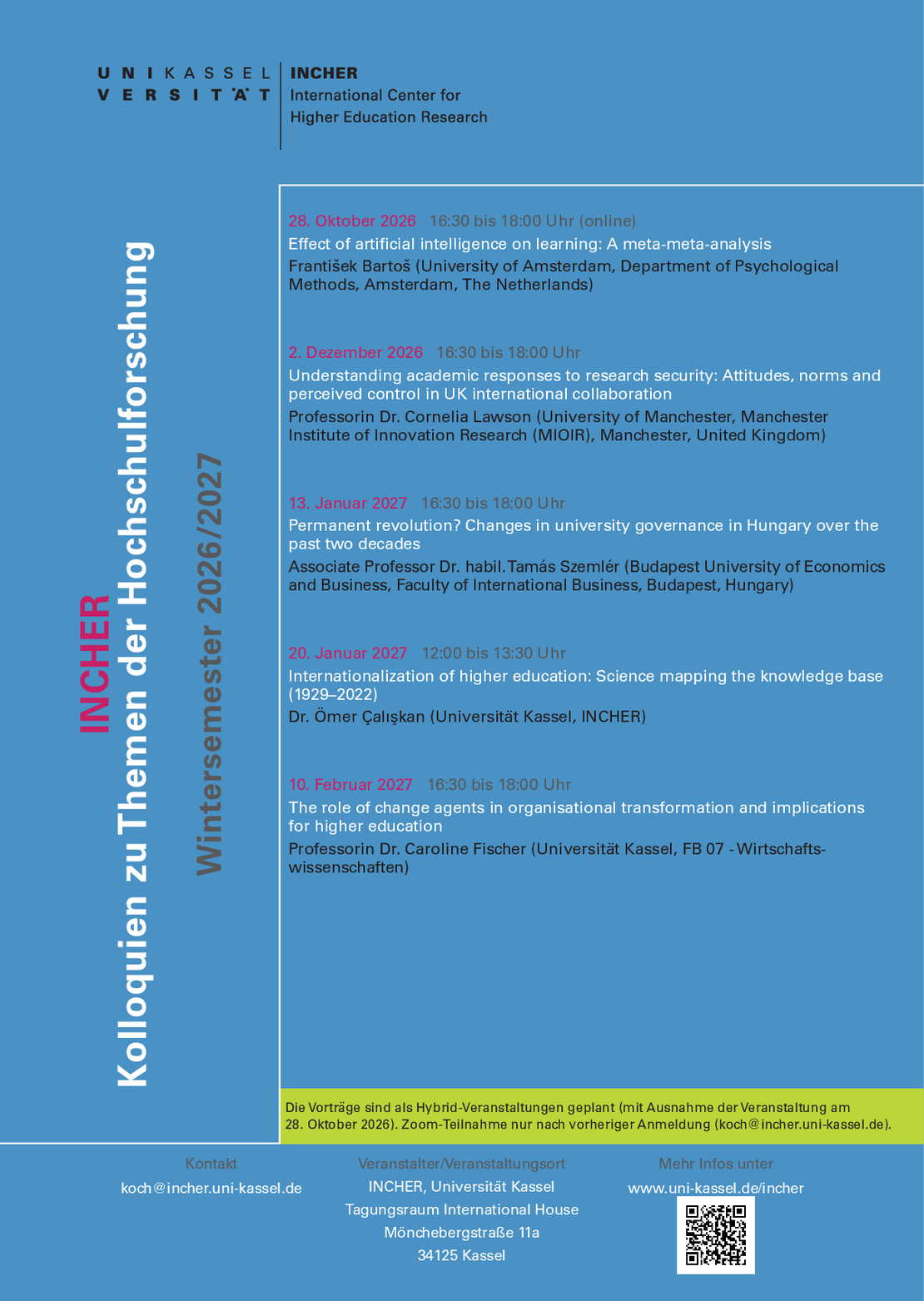
More information about the topics and guests:
Authors Abstract:
Artificial intelligence and large language models are believed to revolutionize education. This claim is seemingly supported by empirical evidence from dozens of meta-analyses reporting large and statistically significant average effects of AI/LLMs on learning outcomes. In this talk, I summarize evidence from 72 meta-analyses and challenge these findings.
František Bartoš is a postdoctoral researcher at the Department of Psychological Methods at the University of Amsterdam and cofounder and CFO of JASP Services. His goal is to improve statistical procedures and enable researchers to draw better inferences from data. He is interested in Bayesian statistics, meta-analyses, publication bias, and replicability.
Authors Abstract:
International research collaboration is central to modern science, yet an emerging “security turn” in science and technology policy is placing new obligations on academics as they pursue cross-border partnerships. Evidence on how these research security measures shape academic practice remains limited. Drawing on the Theory of Planned Behaviour, this paper examines the conditions under which UK academics use research security practices and adjust international collaboration behaviour in response to security concerns. We argue that compliance depends on normative pressure from close actors (peers and line managers) and distant actors (university leadership, funders, and government), perceived behavioural control (self-efficacy), and perceived benefits and costs of compliance. Using an original survey of 354 UK academics in science and engineering, we find that perceived benefits are consistently associated with greater use of research security practices and with both derisking and decoupling behaviours, whereas self-efficacy shows no independent effect. Perceived costs are associated with behavioural change only when normative pressure from close actors is high, indicating that immediate peer environments condition how researchers respond to securitised governance. The findings highlight awareness-building and peer-level engagement as key levers for embedding research security into academic practice.
Cornelia Lawson is Full Professor of Economics of Science and Innovation at the Manchester Institute of Innovation Research (MIOIR), University of Manchester. Her research focuses on the performance and career paths of researchers and inventors, including inter-organisational and inter-sectoral research collaboration. She has published on topics of knowledge transfer, AI in science, researcher mobility, and research funding decision making. Cornelia currently serves as Associate Editor at Research Policy. She is a Visiting Researcher at the University of Tokyo, and Adjunct Professor at Hitotsubashi University, Japan.
Authors Abstract:
Higher education in Hungary has gone through a series of major changes in the last two decades. These changes concern(ed) the structure and the content of education as well as university governance. The frequency of the changes did not help the creation of a stable long-term framework for the functioning of the sector. Right now, after a major political change in Hungary we witness new fundamental changes concerning university governance that can modify the picture once again.
Tamás Szemlér is an economist-teacher. He graduated at the Budapest University of Economics in 1993, majoring in economic theory and French language for specific purposes (economics). He obtained his PhD degree in the field of international studies at the Budapest University of Economics and Public Administration in 2001; his PhD thesis tackled French – German relations in the context of the European integration process. Between 1993 and 2010 he worked as a full-time researcher (in 2008–2009 as scientific deputy director) at the Institute for World Economics of the Hungarian Academy of Sciences. Since 2010, education has come to the foreground of his activities; he has taught economic and EU integration courses at Budapest Business School and at the National University of Public Service (Budapest); beyond other leading positions, he has been Dean of the College of International Management of Budapest Business School between 2012 and 2016. In 2018 he obtained his habilitated doctor title in public administration sciences (topic of thesis: EU budget – past and prospects). Currently he works as an Associate Professor at the Faculty of International Business of Budapest University of Economics and Business. His research interests include European integration, international economic issues, economic policy as well as current issues of the development of higher education.
Authors Abstract:
This study explores the internationalization of higher education (IHE) using science mapping techniques based on 5,253 articles and reviews published between 1929 and 2022. The findings reveal a substantial growth and diversification of IHE research, with China-based researchers increasingly contributing to the field alongside traditionally dominant English-speaking countries. The conceptual analysis identified seven major research clusters: teaching and learning, mobility and migration, language policy, study abroad, transnational higher education, international students and their experiences, and macro-level policies and practices. Overall, the findings highlight the growing and increasingly diverse knowledge base of IHE research.
Ömer Çalışkan, PhD, is a researcher and former Alexander von Humboldt Fellow at the International Center for Higher Education Research (INCHER), University of Kassel. He is currently the Principal Investigator at the University of Kassel for a European Union-funded Horizon Europe project (Visionary Roadmaps: Crafting an Inclusive and Participatory European Democracy with Youth and Communities). His research interests include the internationalization of higher education, international student mobility, and educational leadership. His work has been published in leading journals, including Educational Management Administration & Leadership, Journal of Educational Administration, International Journal of Educational Development, Journal of Studies in International Education, and Comparative Education.
Authors Abstract:
Organisational transformation is not merely a matter of structures, technologies, and strategic decisions; it also depends fundamentally on how employees perceive, interpret, and shape processes of change. This talk examines the role of change agents as actors at the interface between organisational change strategies and everyday organisational practice. Drawing on empirical studies in public sector organisations, it explores the conditions under which change agents can support and shape transformational processes. Building on these findings, the talk then turns to the implications for higher education teaching: What competencies do students need to become future change agents, and how can universities create learning environments and practical experiences that enable them to develop these competencies?
Prof. Dr. Caroline Fischer is Chair of Public Administration and Management at the University of Kassel. Her research focuses on the micro-level dynamics of public administration, with particular emphasis on the motivation, values, attitudes, and behavior of public servants and citizens. She is especially interested in topics such as error, risk, crisis management and learning, human resource management in the public sector, and technological developments in government.