

Eroding diversity and heritage: the case of the Mayan Milpa in Mexico
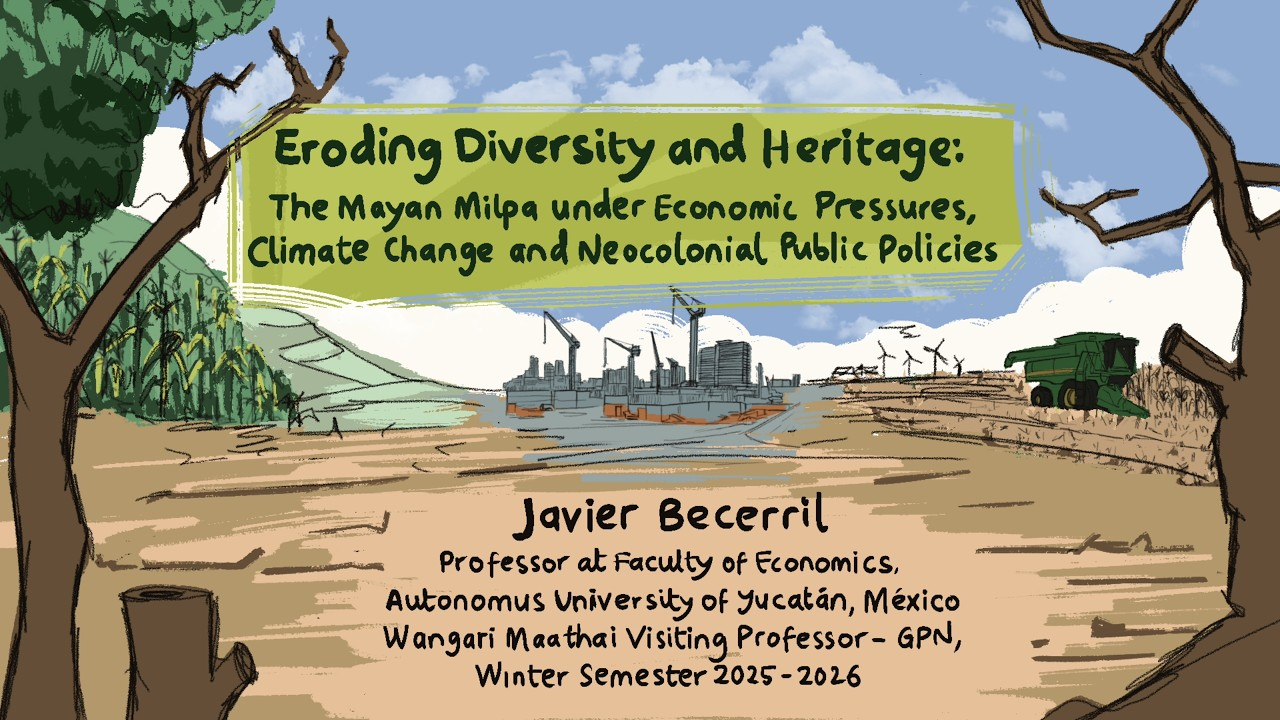
In diesem Video stellt Javier Becerril, Wangari-Maathai-Gastprofessor an der Universität Kassel im Rahmen des Global Partnership Network (Wintersemester 2025) und Professor an der Wirtschaftsfakultät der Autonomen Universität von Yucatán in Mexiko, die Maya-Milpa als einen Vorschlag für die Welt vor, der wirtschaftlichem Druck, neokolonialer Politik und den Herausforderungen des Klimawandels widersteht. Anhand historischer Beispiele und ökonometrischer Modelle der Region Yucatán argumentiert er, dass die Maya-Milpa dem Kolonialismus sowie dem neoliberalen und neokolonialen Druck standhalten konnte. Dieser Widerstand hat jedoch zu Veränderungen bei diesem epistemischen Thema und in den betroffenen Gemeinschaften geführt.
Begleiten Sie uns auf dieser Reise in die Maya-Tradition, die seit mehr als viertausend Jahren über Generationen hinweg fortbesteht.
Literaturempfehlungen für dieses E-Learning Video
Altieri, M. & Toledo, V.M. (2011). The agroecological revolution of Latin America: rescuing nature, securing food sovereignity and empowering peasants. The Journal of Peasant Studies Vol. 38, No. 3, July 2011, 587–612. Traducción de Pablo Alarcón-Chaires revisada por los autores. Retrieved from: https://www.semillas.org.co/apc-aa-files/5d99b14191c59782eab3da99d8f95126/AGROECOLOGIA_ALTIERTOLEDO.pdf
Escobar, A. (2025). Hilos del pensamiento crítico: cultura, ecología, posdesarrollo, pluriverso y transiciones / Arturo Escobar... [et al.]. - 1a ed. - Ciudad Autónoma de Buenos Aires: CLACSO, 2025. Retrieved from: https://www.clacso.org/wp-content/uploads/2025/05/Arturo-Escobar-Antologia.pdf
FAO (2023). Sistema Importante del Patrimonio Agrícola Mundial (SIPAM/GIAHS): Milpa Maya. Retrieved from: https://www.fao.org/mexico/noticias/detail-events/es/c/1616723/
Fenzi M, Jarvis DI, Arias Reyes LM, Latournerie Moreno L, Tuxill J. (2017). Longitudinal analysis of maize diversity in Yucatan, Mexico: influence of agro-ecological factors on landraces conservation and modern variety introduction. Plant Genetic Resources. 2017;15(1):51-63. doi:10.1017/S1479262115000374 Retrieved from: https://www.cambridge.org/core/services/aop-cambridge-core/content/view/CAB4EA86B65C7615436B4656F09E65BB/S1479262115000374a.pdf
Levy, S., & van Wijnbergen, S. (1992). Maize and the Free Trade Agreement between Mexico and the United States. The World Bank Economic Review. Retrieved from: https://documents1.worldbank.org/curated/en/124801468781794006/pdf/multi0page.pdf
Toledo, V. M., Barrera-Bassols, N. et al. (2008). Multiple use and biodiversity within the Mayan communities of Yucatán. Interciencia. Retrieved from: https://www.researchgate.net/publication/286939832_Multiple_use_and_biodiversity_within_the_Mayan_communities_of_Yucatan_Mexico
Yunez-Naude, A. & Serrano-Cote, V. (2009). "Liberalization of Staple Crops: Lessons from the Mexican Experience in Maize," 2009 Conference, August 16-22, 2009, Beijing, China 50827, International Association of Agricultural Economists. Retrieved from: https://ideas.repec.org/p/ags/iaae09/50827.html