

Eroding diversity and heritage: the case of the Mayan Milpa in Mexico
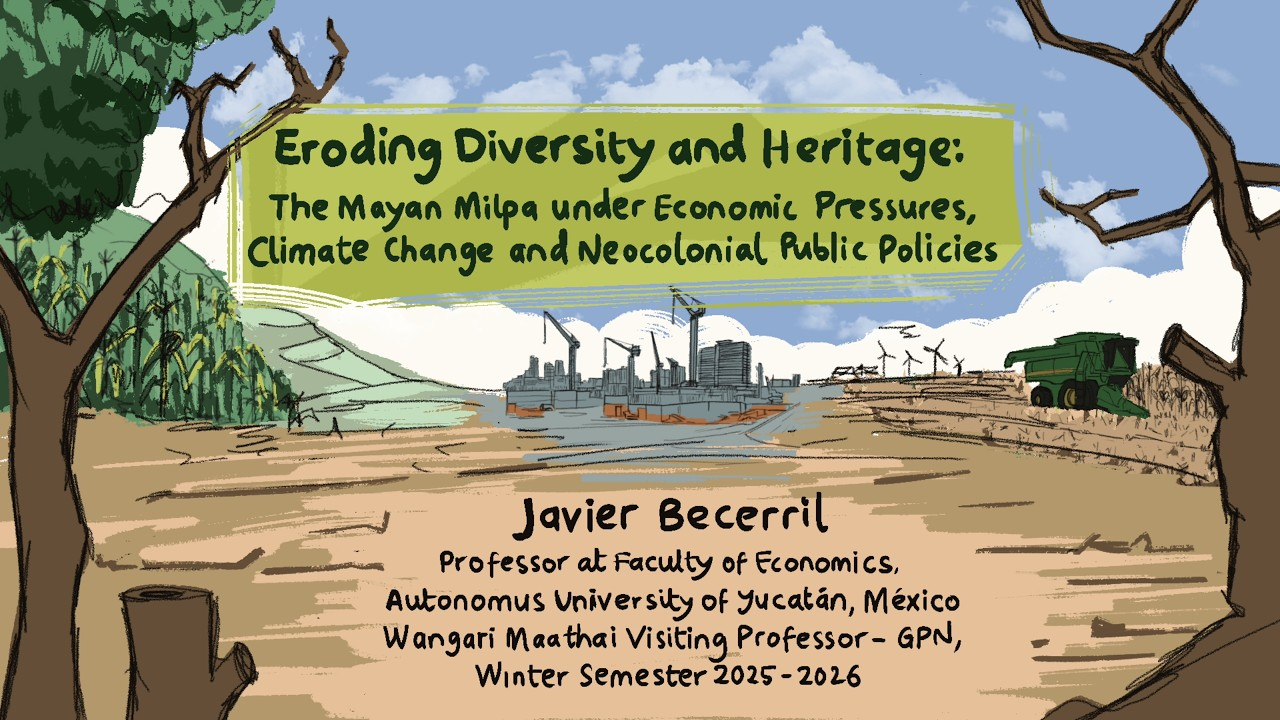
In this video, Javier Becerril, Wangari Maathai Visiting Professor at the University of Kassel for the Global Partnership Network (Winter semester 2025), and Professor at the Faculty of Economics in the Autonomus University of Yucatán Mexico, presents the Mayan Milpa as a proposal to the world that resists economic pressures, neocolonial public policies and the challenges of climate change. Supported by historical examples and econometric models of the Yucatan region, he claims that the Mayan Milpa has been able to resist colonialism and the neoliberal and neocolonial pressure. However, the resistance has brought transformations to this epistemic subject and to the communities involved.
Join us in this travel to the Mayan tradition that has survived through generations for more than four thousand years.
Recommended Reading for this E-Learning Video
Altieri, M. & Toledo, V.M. (2011). The agroecological revolution of Latin America: rescuing nature, securing food sovereignty, and empowering peasants. The Journal of Peasant Studies Vol. 38, No. 3, July 2011, 587–612. Translation by Pablo Alarcón-Chaires, revised by the authors. Retrieved from: https://www.semillas.org.co/apc-aa-files/5d99b14191c59782eab3da99d8f95126/AGROECOLOGIA_ALTIERTOLEDO.pdf
Escobar, A. (2025). Threads of Critical Thought: Culture, Ecology, Post-Development, Pluriverse, and Transitions / Arturo Escobar... [et al.]. - 1st ed. - Autonomous City of Buenos Aires: CLACSO, 2025. Retrieved from: https://www.clacso.org/wp-content/uploads/2025/05/Arturo-Escobar-Antologia.pdf
FAO (2023). Globally Important Agricultural Heritage Systems (GIAHS): Milpa Maya. Retrieved from: https://www.fao.org/mexico/noticias/detail-events/es/c/1616723/
Fenzi M, Jarvis DI, Arias Reyes LM, Latournerie Moreno L, Tuxill J. (2017). Longitudinal analysis of maize diversity in Yucatán, Mexico: influence of agroecological factors on landrace conservation and the introduction of modern varieties. Plant Genetic Resources. 2017;15(1):51-63. doi:10.1017/S1479262115000374 Retrieved from https://www.cambridge.org/core/services/aop-cambridge-core/content/view/CAB4EA86B65C7615436B4656F09E65BB/S1479262115000374a.pdf
Levy, S., & van Wijnbergen, S. (1992). Maize and the Free Trade Agreement between Mexico and the United States. The World Bank Economic Review. Retrieved from: documents1.worldbank.org/curated/en/124801468781794006/pdf/multi0page.pdf
Toledo, V. M., Barrera-Bassols, N., et al. (2008). Multiple use and biodiversity within the Mayan communities of Yucatán. Interciencia. Retrieved from: https://www.researchgate.net/publication/286939832_Multiple_use_and_biodiversity_within_the_Mayan_communities_of_Yucatan_Mexico
Yunez-Naude, A. & Serrano-Cote, V. (2009). "Liberalization of Staple Crops: Lessons from the Mexican Experience in Maize," 2009 Conference, August 16–22, 2009, Beijing, China 50827, International Association of Agricultural Economists. Retrieved from: https://ideas.repec.org/p/ags/iaae09/50827.html