MOSAIK
MEMS ring shutter for high-aperture sub-microscale interferometry with dynamic selective aperture illumination (MOSAIK)
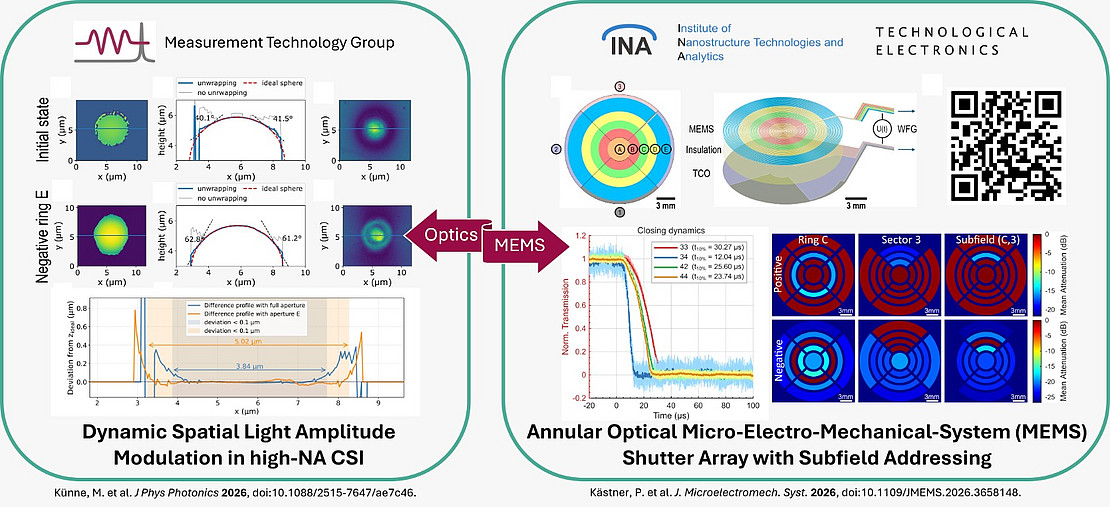
The project aims to optimize the simulation, design, and fabrication of a MEMS ring shutter for integration and application in a high-aperture (0.95 NA) Linnik interferometer to enable frequencyselective illumination. By imaging the ring shutter into the pupil plane of the microscope objectives, it can be partially illuminated, allowing light to reach the sample only at selected incidence angles in specified sectors, thereby altering the frequency composition of the measurable interferogram. Different spatial frequencies are crucial for the reconstruction of topography depending on the surface structure, and thus, the signal-to-noise ratio can be significantly improved through this method. This is particularly relevant for challenging structural features with steep surface slopes and small grating periods. In this setup, the ring shutter serves as a light manipulator and will be optimized for its optical properties, specifically transmission and contrast, through modifications in design, manufacturing process, and material choice. The project aims to find suitable/optimal parameters, particularly the number and width of ring sectors, to advantageously compose frequency distributions when analyzing selected reference samples. With switching speeds in the microsecond range, it allows for rapid dynamic control. To develop the methodology and ensure optimal results, the ring shutter must be integrated with high precision into the optical path of the interferometer. The electronic control must be synchronized with the measurement process, and the evaluation algorithms must be adjusted to the alterable signal spectra.