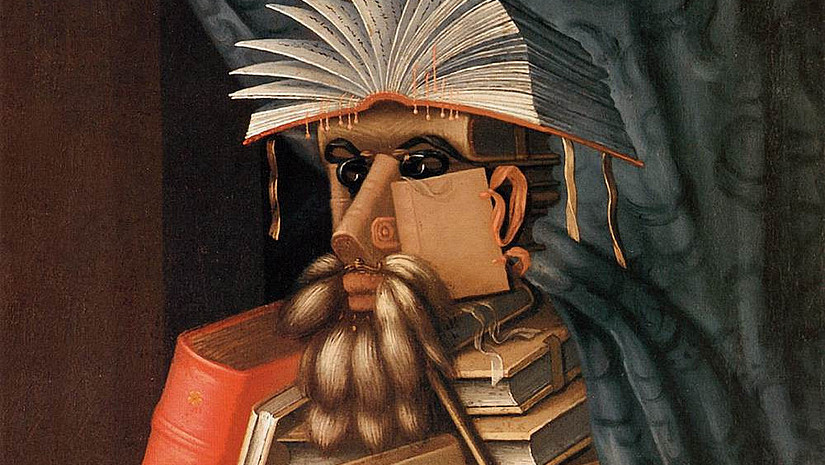
The bureaucratic foundations of Hispanoamerica's colonial past have been pointed out time and again (Siegert 2003; Brendecke 2009). Exemplary for an administrative sovereignty is King Philip II of Spain. The report (relación, noticia) and its forms of standardization become central elements of rule over the colonial empire, with official hierarchies playing a major role. Also, in this context, literacy and the use of writing lead to privilege and exclusion (Rama 1984).
Even a glance at this early period makes clear that bureaucracy can be perceived from the perspective of the rulers or the ruled: Two are equally the possible contexts of the bureau: on the one hand, the public administration, and on the other, the private enterprise whose director:s become absolute rulers in the wake of neoliberal policies and tight labor markets. The subject of the business enterprise forms a suitable starting point for further explorations in the thematic field of office work and for illuminating the scope of small-scale sovereignty. In this context, texts by Roberto Mariani, Roberto Arlt, Juan Carlos Onetti, Mario Benedetti and, more recently, Guillermo Saccomanno play a role. In them, we find references not only to Kafka, but also to narrative texts of the 19th century (Gogol, Dostoevsky, Balzac, Melville), in which the office is staged as a setting for literature and as a place of power (cf. Wolf 2017).
Against the background of this literary tradition, current narrative texts on the office and bureaucracy will be researched, compiled, and documented. The office becomes visible as a space of domination, exemplifying a spatial and organizational structure of small-scale sovereignty in which state power is withdrawn. Neoliberal policies (Svampa 2005), pursued in some Latin American countries beginning in the 1990s, provide an authoritative context, but not the only one.