

Plantations

Publications
Witthaus, Jan-Henrik: "Relecturas antropológicas y ecocríticas de Hombres de Máiz (1949) de Miguel Ángel Asturias", in: Pangeas. Revista Interdisciplinar de Ecocrítica 7 (2025), pp. 97-108. DOI: 10.14198/pangeas.29724
Schäfer, Karolin (ed.): "'[A] pesar de su carácter manso, puede ser [...] feroz.' Negotiations of masculinity in Guillermo Saccomanno's post-crisis novel El oficinista (2010)", in: Brinkmann, Lisa Marie et al. (eds.): Kritische Perspektiven in der Romanistik. Contributions to the XXXIX Forum Junge Romanistik in Hamburg (Series Forum Junge Romanistik 30).
Witthaus, Jan-Henrik: "Mapeando 'soberanías menores' en la narrativa sobre el narcotráfico. Entre México y Colombia", in: Mecila Working Paper Series 79 (2025), São Paulo. Open Access.
DOI: 10.46877/witthaus.2025.79. Online: mecila.net/wp-content/uploads/2025/03/WP-Witthaus-Online.pdf (09.05.2025).
Schäfer, Karolin (2024): "'Y te pago; te visto; te doy de comer.' Disciplinary mechanisms in Roberto Mariani's Cuentos de la oficina (1925) in the context of economic upheavals in the Cono Sur." apropos [Perspectives on Romania] 13, pp. 46-68. DOI: doi.org/10.15460/apropos.13.2166.
Witthaus, Jan-Henrik: "Pequeña soberanía y narcoliteratura. Reflexiones acerca de un tema recurrente en la literatura hispanoamericana", in: Writing the Post-Global in Latin America: Collapse and Conviviality, ed. Gesine Müller and Jan Knobloch. Ciudad Autónoma de Buenos Aires: CLACSO; São Paulo: Mecila, 2022.
Rink, Annika (planned): “Resources, Resistance, and Interspecies Relations in Francophone Caribbean Plantation Literature,” Frankoromanistiktag, University of Kassel, September 29–October 2, 2026.
Rink, Annika: “Écricultures: Sovereignty, Paternalism, and Agency in Autobiographical Plantation Novels of the Caribbean,” “Écritures du moi en contexte caraïbéen: regards croisés,” University of the Antilles (Martinique), June 23–24, 2026.
Research Log
(Kopie 3)
South of the capital, Fort-de-France, near Trois-Îlets, there is a museum commemorating a plantation as the birthplace of a French noblewoman: Empress Josephine, Napoleon’s first wife.
The exhibition explains that before her father acquired the plantation through marriage, it was known as “la Petite Guinée,” “in reference to the large number of slaves who were exploited.” Their French ancestors embarked on the “colonial adventure,” which would enrich the French Kingdom on a collective level and the “adventurers” on an individual level.
The de Tascher family lived on site most of the time; the plantation was managed by a “géreur,” “[w]here one usually also found a steward responsible for maintaining order and supervising the enslaved people, as well as keeping the plantation’s accounts.” The informational panels describe plantations as quasi-autonomous territories that divided the space into three parts: natural areas, cultivated for export or to supply the enslaved people, or as a source of timber or game; storage areas; and living quarters.
The texts and exhibits on Josephine form the centerpiece. The introduction takes an almost deconstructivist approach:
“Historical figures are often the subject of legends drawn from anecdotes, of which several versions circulate, having been more or less reworked over time. Josephine is no exception to the rule. As a child, it is said that it was foretold she would be more than a queen! This prediction has given rise to numerous depictions.”
This is followed by a retelling of the myth in which an elderly enslaved woman prophesied Josephine’s various marriages and her ascension to the throne. The museum’s founder, Dr. Robert Rose-Rosette, who holds a Ph.D. in veterinary medicine, concludes that Josephine herself spread the myths:
“She recounts with enthusiasm what life will bring her: she will marry a first time but will not be happy; she will marry a second time, and then the whole world will be at her feet—she will be more than a queen. ‘This is too much,’ said Madame de La Pagerie, exasperated, and put her daughter on a diet of dry bread for eight days in the lower gallery south of the purgerie” (Dr. Robert Rose-Rosette, *Empress Josephine and Her Island*, lecture of June 17, 1975)
Josephine’s childhood and youth are portrayed in a particularly idyllic light, marked by her fascination with tropical flora as well as roses. Furthermore, the hygiene practices of the de Tascher daughters—who bathed in a basin later renamed “le bassin de la reine”—are depicted in a sensationalist manner. In 1796, she married Napoleon Bonaparte; the divorce followed 13 years later, as they were unable to have children. Five years later, she died of pneumonia.
The exhibition features a vandalized bust to symbolize the criticism directed at Josephine. An information panel explains that, according to allegations, she was partly responsible for the reversal of the abolition of slavery in Martinique in 1802. The matter cannot be settled beyond a doubt; she was neither politically educated nor interested in politics. The context is provided as follows:
“It was primarily representatives of business circles linked to the colonies, advisors, and large plantation owners gravitating around the Minister of the Navy and Colonies who influenced this decision; a decision that, for Napoleon, was part of a broader desire to regain control over the island of Saint-Domingue (later Haiti) and to restore France’s finances through the productivity of the colonies—which, however, relied on slave labor. | Nevertheless, because of her unique fate, Joséphine still symbolizes today the people of her social circle—those known in Martinican Creole as the “békés”: Creole settlers whose economic interests took precedence over respect for human life, leading them to defend a system of slavery in order to preserve the colonial order that enabled their prosperity.”
In the museum’s outdoor area, the processes of sugarcane cultivation and sugar production are explained. The fact that the residence was destroyed by a bomb attack in 1986 is only briefly mentioned at the beginning. Mechanical and technical details are listed, and enslaved people are brought to the forefront, along with the cultivation, harvesting, and processing of sugarcane in ox-powered mills:
“During the sugarcane harvest, or ‘roulaison,’ the enslaved people worked day and night. The mill was a source of accidents. Sometimes, the slaves’ inattention or exhaustion would cause one of their hands to be caught along with the cane in the rollers. Since the mechanism was driven by animals, the machine could not be stopped quickly once it was in motion; there was then no alternative but to amputate the crushed limb of the unfortunate victim.”
Upon entering the kitchen house, a large-format inventory list from 1815 is on display. It lists the names, ages, and values of the 115 enslaved people; the next panel features inventory lists of kitchen utensils.
The social structure on the plantation is described in detail:
“Apart from the owners, the manager who replaced or assisted them in running the plantation, and the steward, responsible for bookkeeping and supervising the slaves, the rest of the people living on the plantation on a daily basis generally had the status of slaves. Several types can be distinguished.”
Enslaved people with artisanal skills (“esclaves à talents”) were trained, and “le commandeur” supervised the workers’ various activities. “The domestic servants”: “nursemaid, seamstress, and cook”—these lived closer to the ‘masters’ and not behind the manioc mill like the rest of the enslaved people. The nursemaid, or “Da,” was integrated into family life and enjoyed certain privileges. Josephine’s “Da,” for example, was one of the few who were freed in 1807 and received a pension certificate from Napoleon; both documents are on display. The emancipation of enslaved people, along with the tax to be paid, is described as a social safety valve. Various legally regulated dress codes reflected the plantation hierarchy, which was also differentiated among the enslaved people themselves. However, the exhibition also explains that finer cloth and jewelry served only to highlight the patron’s social superiority.
The slave trade itself is also addressed in terms of the commodification of Africans. “A market value was thus assigned to them; it varied according to gender, age, specific skills, and perceived ethno-racial categorization.” In addition to discussions of market value—which is also quantified—the text mentions inherited enslaved people who have no market value because they are too old or otherwise unable to work, yet are still transferred.
African ancestry is briefly mentioned, while considerably more space is devoted to the description of creolization. Under the common euphemism “colorism,” the exhibition explains cultural racist norms that persisted after the abolition of slavery. The value of enslaved people was also determined genetically; the exhibition highlights the strategic reproduction of enslaved people:
“References to interracial relationships reflect the relationships between white men and free or enslaved Black women. In the context of domination and oppression that characterized colonial societies, a few rare relationships may have been the result of love stories; relationships were also sometimes endured as a last resort by women seeking to improve their living conditions and the situation of their children. But more often than not, the women were raped.”
As archaeological findings—rather than the oral histories of enslaved people—have shown, living conditions were harsh. Even the decrees issued by the Crown indicated this, at least indirectly, when in 1786 they called for better living conditions, the moderation of punishments, and health care for enslaved people (Royal Ordinance of October 15, 1786). The Civil Code was ignored in Martinique. Starting in 1833, enslaved people were no longer considered property, yet they were by no means free. It was not until the lois Makaud (1845) that their situation improved.
“Despite laws prohibiting the most severe forms of abuse, few masters were punished for such acts before the 1830s. However, in 1824, Mr. Denouille, who had been employed as a steward and then very briefly as manager of the plantation, was dismissed because of the mistreatment he inflicted on the slaves.”
Forms of resistance are also listed on the panels: revolts, poisonings, and arson attacks, as well as working slowly, feigning illness, destroying production tools, suicide, and escape. The mistreatment of enslaved people was prohibited in a printed decree from 1784. Indictments point to “subaltern agencies.” Furthermore, the exhibition explains “major” and “minor” marronage, which are distinguished by the duration of the escape.
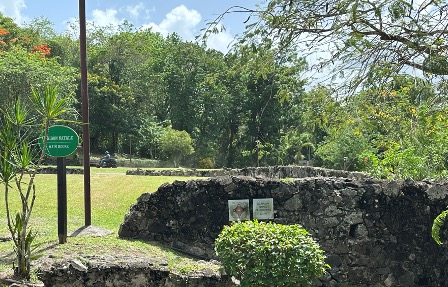 Image: privat
The banana is presented as the perfect fruit—reason enough to dedicate a museum to it: “It is certainly the planet’s favorite fruit, and our goal is to help you discover it—from its origins to your shopping basket—through this permanent exhibition.”
Illustrations depict interspecies “friendships” between plants and insects, while information panels highlight “the enemies of the banana tree”—namely fungi, weevils, and nematodes. Tools for banana cultivation and products made from banana leaf fibers—such as a dark-skinned doll dressed in a banana-leaf gown—are on display. The information panels, written in French and Creole, provide details on biological classification, biodiversity, plant smuggling and trade, as well as cultivation techniques. Terms from European and Afro-Caribbean languages are used and explained. The centerpiece of the exhibition inside the building and on the side of the washing facility outside is “La guerre de la banane: David contre Goliath.” Neo-imperialist aggression originated from the U.S., which put pressure on production within the EU—as well as in Central and South America—even though the EU produces bananas with lower pesticide use:
“This is the banana war, in which the goal for the ‘dollar banana’ is to control 100% of the European market—of which it already holds 80%—by eliminating, in particular, production from the French Antilles.”
The use of the pesticide chlordecone—which has caused cancer rates on the island to skyrocket since the 1990s and has contaminated rivers and springs—is mentioned only in passing in connection with pest control efforts aimed at “clean banana plantations.”
Several panels display cultural-historical representations of the banana as a crop—for example, on banknotes or as an exoticized garment worn by a scantily clad Josephine Backer on event posters. This sexualized depiction, the text rhetorically asks, may well have contributed to the fruit’s popularity in France. The section concludes with a piquant quip: “Offering a banana to a lady can therefore be very… suggestive!!!!”
Over the course of the exhibition, the banana is personified, and its colonial context is not explicitly addressed until late in the exhibition. An information panel refers to it as a “fruit voyageur”; the exhibits feature cargo ships, not ships used to transport enslaved people. Prominently featured, however, is the journey from Southeast Asia through Africa to Southern Europe and the Canary Islands, as represented by the frequently depicted protagonist Christopher Columbus, who had it “dans le sillage.”
With colonization came the transformation of nature through the cultivation and selection of “old” and “new” plants. Tobacco and sugarcane were grown for colonial export, while sweet potatoes, cassava, and bananas were grown to feed the local population. – Fun fact: “Did you know? | Slaves preferred to eat grilled plantains rather than boiled ones.” Home gardens were replaced by gardens modeled after the French style, which today turns out to have been a mistake, as the sustainability of “Native American” gardens has long been proven.
And then the paternalism is laid bare:
“These changes also reflected the desire of the colonists and the central government to impose a different conception of property, in which land was no longer a communal asset, as among the Native Americans; rather, it belonged to an individual who had demarcated and cleared it and who, consequently, had sole use and enjoyment of it.”
Following cultural-historical discussions of global centers, the “Beliefs and Superstitions” of the Antilles are also mentioned, and traditional healing knowledge about plants is presented.
Through the visibility of Creole cultural practices and the consistent use of the Creole language, it appears that long-standing postcolonial demands have been addressed. The omission of the environmental disaster surrounding Chloredecon—which activists classify as genocide— as well as the obscuring of existing neo-imperial practices in banana cultivation, give the impression that the marketing of “European” fruits in the plantation’s private museum—which belongs to the territorial collectivity of the French Republic—takes center stage.
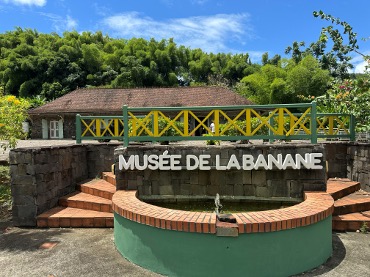 Image: privat
The Martinique Zoo is located in the ruins of a plantation and distillery and is thus marketed as a dual attraction. The analogy between dehumanized workers and so-called “restorative” animal husbandry of non-native species is not questioned—the logo bears the inscription “Since 1643.” Instead, the destruction caused by the devastating volcanic eruption of 1902 is lamented:
“The plantation and its treasures of life, engineering, and cultural and industrial heritage, accumulated over more than 200 years of history, were swept away in a matter of hours.”
The repurposing by botanist Jean-Philippe Thoze represents an awakening from a “sommeil centenaire.”
Sugarcane, indigo, cocoa, coconuts, and cassava have been cultivated on the estate since the time of Louis de Reynal. The production of indigo is depicted in detail within the ruins. Enslaved workers process the fermented raw material in the “diablotin.” The work processes at the cassava mill are also described on an information panel. The planting and processing of sugarcane are said to have been introduced to the island by Jewish Dutch settlers in 1654 and continued until the abolition of slavery. The ox-powered mill was largely replaced by a watermill. After the sugar crystallized through an evaporation process, the residues were distilled into the precursor to rum, known as “guildive” or “tafia.”
There is a prevailing romanticization of rum culture. The souvenir shop is teeming with black dolls and female figures dressed in “typical” Madras fabrics—and pirates! The painful labor of harvesting sugarcane, made difficult by the sharp leaves, is available in an idyllicized form as decorative aluminum signs.
The distillery, along with its art exhibition and the Fondation Clément’s grounds, is one of Martinique’s top tourist attractions and is widely promoted. Industrial romance meets rum of various quality grades. The project’s context is presented from a one-sided perspective: the settlers’ houses are preserved and maintained, framed by flowerbeds. For a visit by a U.S. president in 1991, a hut was erected, above which a U.S. flag flies alongside the flags of France, the EU, and the distillery. Traces of enslaved people and Black wage laborers are given less prominence. Although a guided tour of the grounds emphasizes that Henry Clément acquired the plantation only after the abolition of slavery, working conditions changed only very slowly. No workers’ settlement has survived, and the majority of the workers are scarcely remembered: the garden is adorned with various large-scale works of art. An unlabeled piece depicts unclothed, male-identified figures made of metal, carrying standard kitchen forks and running along the edge of a giant cooking pot. Passing the ornamental pond, one reads “BLOOD” in two-meter-tall red letters. Nor is the sugarcane depicted in any detail. Rum tastings and “high culture,” mostly from the global center—that has to suffice.
Following a conference trip to Martinique in June 2026, I went on an archival research trip, which I was able to supplement with visits to sites commemorating the plantations.
While the Archives Territoriales in Fort-de-France offered a traditional, albeit superbly digitized, collection, the archives of the Fondation Clément—one of the largest rum distilleries—were remarkable in many ways. Estates left by researchers provided insights into efforts at family history research in post-slavery Martinique. Furthermore, the collected references to historical documents and writings on the early history of plantations in Martinique will serve as a starting point for future studies.
 Image: privat
Jiménez Brais’s drama in five scenes (2023) is set on a futuristic plantation in the 20s of the 22nd century, which, at the cutting edge of technological advancements, produces the world’s finest pineapple plants. The play depicts the use of artificial intelligence and brilliant female scientists (!) as well as female administrators (!). The character designations are depersonalized and refer to the profession (“Ingeniera,” “Administradora”), a clearer, classificatory job title (“Patrón,” “Peón”), a collective (“Cuerpo de Peones,” “Grupo de Empresarios”), or vague essences (“Señora” or “Multiespecie,” a vibrant, ‘natural’ being). Beneath a massive domed structure, genetically “optimized” pineapple plants grow—the foundation of the Costa Rican economy, controlled by the Pinea Fruit Corporation’s monopoly. Despite the goal of becoming climate-neutral, the environment outside the domes is almost completely destroyed. Class differences are reflected in the living quarters, though it is surprising that, given the apparent degree of technological progress, workers are still needed at all. Piña plays with the readers’ expectations. The fact that the latest pineapple creation can be eaten raw (409) may come as a surprise, while narratives of “progress and development” in turn reproduce common neoliberal tropes and imply continuities.
The plot unfolds around a sabotage plan between “Señora” and “Patrón,” the heir to the plantation’s founder. The woman inexplicably gains access to the plantation’s secure control center and asks the manager about the patrón. It turns out that he prefers to be called “David,” which suggests a distancing from the paternalistic system in David’s self-identification. In her conversation with the administrator, the woman reveals that the workers are underpaid despite the company’s record profits and that both people and the land are being exploited (411). Administradora rejects the argument, initially responding with the catchphrase “¡Piña!” and continuing in neoliberal jargon: “We can’t stop for even an hour. We work for ourselves… For Costa Rica. We’re a model on the platform. There is no poverty… There is no strike. We are a community that operates without interruption. ¡La piña will never be in short supply!” (412).
When the woman implies the system’s dependence and fragility, the administrator wants to have her removed. That’s when Patrón enters the scene; the two speak in the shadow of the Multiespecie’s background noise so as not to be overheard. He and Loriana know each other through internet chats and are planning a reset: they want to program errors so that the plantation freezes up and then develop a new, (environmentally) sustainable, healthy system before the world collapses (413).
The plantation freezes; the engineer no longer understands the world—her calculations were perfect (414–416)—and it seems as though “el ecosistema ha despertado por si mismo” (416). While Patrón is still trying to prevent human sacrifices, the Peones are organizing the resistance. Amid toxic fumes and increasing cold, they demand the dismissal of the engineer, whom they accuse of lying to them with her descriptions of a prosperous future (418). They blame her for the many deaths. Yet the workforce is by no means united. Some want to return to work afterward—and certainly not a revolution—in order to “move the country forward” and rebuild the plantation. Patrón alludes to the ecological and social problems of pineapple cultivation, and some workers begin to parrot neoliberal slogans once again. During their conversation, the engineer realizes that the Patrón is behind the sabotage, and he tries to inspire her to help build an alternative system, but she resigns (420).
A time jump: 300 days into the strike, the Multiespecie becomes airier, and flowers grow on it. Señora must convince the Patrón to initiate the collapse (421–422). In the next scene, four literal “lords”—plantation owners from various countries—discuss the strike situation in Costa Rica, which has also inspired imitators in Argentina (422). The next steps are to be decided “independently” (423) by the “Gobierno del Tricentario,” to whom the entrepreneurs are sending a report. Patrón invited the group, but they do not want to abandon the pineapple (424). “PATRÓN: Nature itself is the measure! For on these lands, a crown will no longer be seen. A species different from our own will reign here” (424). The pineapple crown becomes a metaphor for sovereignty, which is taken up in the following sentence: Soon, a “different” multiple, more-than-human species will reign here without human intervention. A businessman threatens to override the territory’s external sovereignty: “If the engineer’s dismissal has not been communicated by [tonight], government units will breach the borders” (425).
Two days later, the workers storm the plantation’s control center. They mourn their dead and demand justice (425–426). Once again, the visions of the future are pitted against one another: back to work, or toward a new system? The engineer steps forward and proclaims technical solutions based on thepeones’ self-sacrificing labor; the peones agree among themselves and send her away. The scene cuts off; a government representative takes control of the dome, no technology works anymore, and almost everything freezes up (426).
In the next scene, the surviving patrón speaks with a government android. He first tries to convey a positive impression of the situation, but the android wants to negotiate with him about a fresh start, financed by the government (427). The representative tries to make it clear that the government has the upper hand: “That’s what I said. And if that’s not the case… I’ll take that as a given” (428). Technical support could make the relaunch possible. Patrón retorts: “Machines… against human beings! […] As long as I can speak and breathe! No more nonsense!” (428). He opens the cover of the Multiespecie, which unfolds. The representative stammers, his speech faltering: “I tried to talk… now I am forced to exercise my full authority. Because of the risk it poses to all of Costa Rica… the Government of the Republic is removing you from the leadership of Pinea Fruit Corp., and pineapple production will be carried out under state investment. We’ll begin the recovery immediately!” (428). Patrón and Señora die as the Multiespecie spreads. Their self-sacrifice is prefaced by reflections on the limits of development and a fresh start following the—ultimately anthropogenic—destruction. In Haraway’s style, Patrón speaks of the cyborg: “The only hope I see is this new species—a horizontal intersection between the machine, the organic, and consciousness” (428). The woman has the final—ecofeminist—word: “We are compost!” (428). The multispecies moves and finally begins to dance (428). Is there still a need for sovereigns after the apocalypse?
Jorge Amado wrote a book (1933)—possibly a novel (59 and 61)—to describe the cocoa plantations in southern Bahia. This note is based on the Spanish translation; the Portuguese quotations will be added once they are obtained. The autodiegetic narrator alternates, within short chapters, between “cuadros” of plantation society and biographical narratives that recount his journey to the plantation. He comes from the middle class, is well-educated, and was left penniless by a family feud; he therefore sees himself as a mediator between the classes (10) and repeatedly attempts to normalize class differences through his authenticated narrative role (20).
The work is characterized by contrasting comparisons between the living conditions of the patrones and the peones (6). The family of the overweight plantation owner (41) is described as decadent; the son is portrayed as dim-witted, and the daughter as arrogant, despite being educated. The female workers are abused by the father and son—the patrones—as early as childhood (30); they ignore the existing romantic relationships among thepeones (54). The narrator concludes that love is not for workers:
“And in our loveless lives (does love even exist on the cacao plantations…?) we had moments of nostalgia. Was love meant only for the rich? Honorio said aloud what we were all thinking: ‘What a shitty life’” (33).
The other characters on the plantation—as well as those in plantation society, which includes the town of Pirangi with its festivals and prostitution—are described in detail. The theme of paternalism runs throughout the work. Particular attention should be paid to the fact that in Brazil, the patrones are referred to as “coronel,” that is, a military rank (6). The police and judges are integrated into the paternalistic system. Order and clear hierarchies—the patrón’s daughter idealizes the plantation in her writing:
“…and they are happy in their honest work. They have fun, play the guitar, and love and cherish the patrones, who are their fathers and teachers. They adore the patrones, who, in return, treat them well, like parents treat their children. Perhaps that is why the exotic ideas of the indoctrinators who appear on the plantations hold no sway” (50).
This contrasts with the descriptions provided by the first-person narrator, who attempts to portray the subalterns as subjects—who, though subjugated, are by no means mere objects:
“[The children] smoked cigarettes made of chopped tobacco and drank large swigs of cachaça from the earliest childhood. They learned to fear the colonel or the foreman, and they absorbed that mixture of love and hate their parents felt toward the colonel. They rolled around in the mud with the pigs and accepted blessings from everyone. They had a vague idea of God—a being somewhat like the colonel, who rewarded the rich and punished the poor. They grew up full of superstitions and scars. Without religion, they saw the priest as an enemy. They hated him naturally, just as they hated poisonous cobras and the bosses’ young children. At age twelve, the workers took them to Pirangi, to the house of whores. When they caught that terrible disease, they became men. Instead of five hundred reis, they started earning one thousand five hundred. A bunch of kids with common names: Jodo, José, María, Pedro, María de Lourdes, Paulo—kids who never had toys or dolls. Some had rare, aristocratic names like those of novel heroes: Luis Carlos, Tito Livio, César, Augusto, Jorge, Gilca, Alda. Later I discovered that all of them were godchildren of María, the colonel’s daughter” (37).
The peones’ dialogue also gives them a voice of their own, one that reflects, for example, class differences based on dependence on the international stock market (as well as 62):
“—This place seems like a cursed land. Back in Ceará, they’d told me that money was flowing freely around here. | —There was money about two years ago. Cocoa reached forty thousand reis. The colonels really spent it. We were making five thousand reis a day. | “Did you save any money?” | “Hardly… Everything went up: dried meat, flour, beans. Nobody saved. For us, things are always the same, whether cocoa prices are high or low. For the colonels, it’s different. I’m actually glad when cocoa prices go down... | The old man turned to the man from Ceará. | -You came from Ceará just when they sent a lot of money there... Wages went up. I read about it. The government guaranteed that no one would starve. | “God only knows. They pocket the money and we starve. We never saw a dime. My wife died along the way and my daughter ended up on the street of the seven deadly sins” (18)
The normalization of poverty, justified by marginalization (see also 40), strikes as ironic a few pages later:
“No one complained. Everything was fine. We lived almost on the margins of the world, and no one cared about our misery. We lived just to live. Far off in the distance, we could glimpse the idea that things might change. How? We didn’t know. Not all of us could be bosses. Out of a thousand, barely one could get rich. At the Fraternidad plantation, only Algemiro had achieved anything. The boss had given him a plot of land worth about thirty cantos, which he would pay back with his harvests. So how were we going to escape that miserable situation? Sometimes we thought about those things. Mainly Colodino” (22).
The networks that enable the paternalistic plantation economy become clear. The priest’s sermons serve to stabilize the status quo:
“The priest, dressed in gold and silk, made us envious. Then he would deliver a fine sermon. He asserted that people should obey the plantation owners and the priests. That they should not lend an ear to egalitarian theories (people were eager to learn about these theories). He threatened the wicked who rebelled with hell. He offered heaven to those who accepted their lot (39)
In *Cacao*, too, there are extensive accounts of the plantation’s system of contracts and debt (6). The fact that the contract workers are referred to as *alquilados* strikes the first-person narrator as strange:
“The word struck me as strange: | —Machines, animals—everything—can be rented, but people aren’t rented out. | On the cur’s lands, people are rented out too. The word humiliated me. ‘Alquilado’… I was reduced to much less than a man” (14).
But *Cacao* also tells of the resistance strategies and agency of the *peones* and foremen, as well as the prostitutes, who largely succeed through solidarity within the lower class.
“—[…] I like killing colonels, but I don’t kill workers. I’m no traitor. | After a long time, I discovered that Honorio’s gesture wasn’t called generosity. It had a much more beautiful name: class consciousness” (58).
They migrate in search of better living conditions or talk back to the patrones (43ff). There is fraud in the calculation of debts and penalties for mistakes made by foremen and workers (34–35). The committed first-person narrator also attempts to debunk the patrones’ myths. For example, he quotes letters from prostitutes and peones that refute the notion that they are illiterate. Despite linguistic otherness—which at times veers into the picturesque—it becomes clear, however, that these individuals are capable of communicating in writing (59–69). Yet revolt, it seems, is not possible:
“Finally, one day he cut the daily wages down to three thousand reis. I led the revolt—we wouldn’t go back to the fields. We planned everything one night, at old Valentín’s house […] Joao Grilo was the last to arrive. He was coming from Pirangi, and when he heard our plan, he discouraged us. ‘Don’t even think about it… More than three hundred starving people have arrived who’ll work for any price… and we’re going to starve to death…’ “We’re defeated before we even start fighting.” “We’re born defeated…” Valentín declared. We hung our heads, and the next day we returned to work with five hundred reis less” (62).
The former laborer and current capataz killed for the patrón and is especially protected by him (21). Algemiro becomes part of the plantation owners’ circle; the following episode illustrates his mimicry:
“Algemiro also danced. […] The foreman loved those parties thrown by the rich and swelled with vanity because they treated him well. He had been a farmhand like us and could not read. He had been working for Mané Frajelo for fourteen years. He managed to buy a farm for thirty contos. The colonel had lent him the money, secured by a mortgage on the sugarcane harvests. His sole ambition was to get rich. We hated the colonel. But we despised Algemiro. We felt he wasn’t one of us. I, a descendant of a wealthy family, was closer to the farmhands than he was—he who came from generations and generations of slaves. A mulatto, with blond, curly hair, blue cashmere clothes—everything about him, his mannerisms and smiles—he laughed delightedly at the chatter of those bourgeois women. From the sidelines, we smiled with contempt” (27)
In the protagonist’s verbal exchange with the patrón’s daughter, topics such as education, hygiene, and race are addressed on the one hand, while on the other, the protagonist attempts to subvert or satirize the patrona’s stereotypes. Somewhere between flirtation and self-affirmation, the first-person narrator emphasizes his solidarity with his class (which is framed as proto-communist [44]) and his hatred of the paternalistic system (44ff). The romance leads to a hypothetical game about the future: who would switch classes—she certainly wouldn’t in the end! (61ff). The first-person narrator concludes with a poignant farewell to the plantation:
“LOVE | The next day I said goodbye to my comrades. The wind swept across the fields, and for the first time I felt the beauty of the place. I looked back longingly at the big house. My love for my class—for the peasants and workers—a great and human love—would overcome my petty love for the boss’s daughter. That’s what I thought, and I was right. At the bend in the road, I turned around. Honorio was waving goodbye to me with his enormous hand. In the courtyard of the big house, the wind was ruffling María’s blond hair. I set out for the struggle with a pure and happy heart” (64).
The short series of articles *Lo que son los yerbales* was written by the Spaniard Rafael Barrett and is dedicated to providing a realistic portrayal of the inhumane living conditions of the *mineros*. Using the textual strategies of factual texts, the narrative voice aims to take readers along to the yerbales: “y con vuestros ojos veréis la verdad” (157). In doing so, the narrator sheds light on the relationship between the state and “modern slavery,” the methods of recruitment through debt contracts (161–162), subjugation, punishment for rebellion or escape (174), and murders as well as child labor (163–164) in the yerba industry. The text also reports on the demographic consequences of the destruction of the forest workers, most of whom leave their families behind, while prostitution flourishes in the living quarters (170–171). In addition to documentary accounts—including figures on wages, the opaque financial system, and its speculations (177–178), quotations from legal texts, and retellings of conversations with harvest workers—the text takes on an appeal-driven character (164), capable of provoking outrage through shifts in perspective and ironic devices, and seeking to put an end to the narratives of progress promoted by industry and the state (178–179). The forest and the plants are attributed with monstrosity and subjectivity (166), in which some people find “gold,” but most find exploitation or their deaths.
With regard to representations of sovereignty, various actors are associated with it in *Lo que son los yerbales*. The state has forfeited its sovereignty; the lands were sold, and legislation is shaped by the interests of industry thanks to corrupt politicians and judges (157–158):
“It is well known that the state lost its yerba lands. Paraguayan territory was divided up among the government’s friends, and Industrial ended up taking almost everything. The state went so far as to give away one hundred and fifty leagues to an influential figure. That was an interesting era of land sales and leases, and of buying off surveyors and judges” (158).
It cannot even defend its external sovereignty against the industry or fulfill its duty to protect its citizens: “It did not and does not know how to protect the innocent lives of its citizens. And the Industrial company claims annually the number of victims it needs to carry out one of the most abject forms of exploitation in the modern world” (176). The bosses, however, remain connected to politics through friendship or kinship (160). Barrett also draws transnational comparisons regarding technologies of exploitation on plantations:
“The advance payment is the glory of the pimps of millionaire greed. This is how the martyrs of the Bolivian and Brazilian rubber plantations and the sugar mills of Peru are herded. This is how the young women from Central Europe, forced into prostitution in Buenos Aires, are herded. The advance payment, the debt, is the chain that drags her from one brothel to another, just as it drags the laborer from one employer to another. The advance payment!” (162).
He also describes the panorama of the yerba hierarchy, in which paternalism permeates the various functions of the industry:
“Add to this the army of monthly wage earners, mboroviré harvesters, wagon drivers, woodcutters, herders, and expedition members deprived of the bare necessities, forced to cross endless deserts and swamps; river rafters who are paid per month-long trip and who return, hampered by droughts, after three or four months of battling upstream, their chests swollen from the hotador; add it all up, and you will have the accursed mob of the yerba fields, toiling fourteen, sixteen hours a day, for whom there is no Sunday nor any other holiday except Good Friday, a remembrance of the martyrdom of Jesus, father of those who suffer...” (167–168)
The numerous descriptions of the use of violence fit into realistic narrative traditions. The figure of thecapataz, in particular, is portrayed in a way that glorifies violence:
“‘There is no God here but me,’ the foreman tells the new laborer once and for all. And if the whip weren’t enough to prove it, the steward’s revolver would. In the yerbal, we don’t talk—we fight.” (173).
As the quotations make clear, religious motifs in *Lo que son los yerbales* serve, on the one hand, as a means of contrasting charity with exploitation; on the other hand, the godlike foreman suggests an absolute, transcendent power over humanity and nature.
*Viento Fuerte* (1970 [1950]) is the first work in Miguel Ángel Asturias’s Nobel Prize-winning “Banana Trilogy.” It tells the story, from multiple perspectives, of the development of Guatemala’s tropical coast for banana plantations operated by the United Fruit Co., also known as Tropical Platanera S.A. The narrative alternates between realistic portrayals of human exploitation—driven by sovereign, often anonymous centers of power—and magical-surrealist descriptions of Indigenous and Criollo culture, as well as “nature.” All characters, including those that are more-than-human, are granted agency. The narrative dynamics unfold beyond heteronormativity and speciesism, thereby curbing stereotyping. The banana plant becomes a symbol of redemption: “The movements of the harvesting crew, at the foot of the banana plantation, which resembled a tree of the Green Cross, were like a green Christ transformed into a cluster” (25–26). Yet the machinery of exploitation robs them of their livelihoods.
A business and personal connection between criollo and expad actors leads to the idea of an alternative, resistant form of banana production—but it threatens to fail. The shaman Rito Perraj from Semírames summons the “Viento Fuerte,” which the American employees consider impossible. The wind destroys nearly all aspects of plantation society—without distinction of class.
The invocation is seen as a vendetta by Hermenegilo Puac, who died because he could find no one to blame for his misery. People told him that for every manager killed, a new one would take his place. The guilty parties were “la famosa gente de por allá” (194). Nothing could be done against them—one should write to Chicago. Hermenegilo, however, does not know where the city is located. The narrative comments humorously: He would have walked there if he had known where it was. But even then, the adversaries remain vague: “And who are those people, he asked. Everyone, it seemed, knew who they were, but without specifying anything. Chicago. The people from over there. The masters” (194).
He cannot sell his giant bananas: “Gringo sons of bitches—if they have that thing you can’t see that’s crushing us, something you can’t fight even by killing, then we’ll get our revenge too, ha! I’ll be damned if there isn’t revenge!...” (194). The shaman unleashes a destructive force that claims Puacs’s dead head as a sacrifice (194). Triumphantly, both laugh at the “secret heads that ruled them” (199). By destroying the imperial game, they mock their opponents: “Hermenegilo Puac, with his white skull, laughed at the twelve million banana plants that the strong wind had just knocked down, flinging them from the damp ground where they lay piled up like bowling pins” (199–200).
The invisibility of the rulers—or their multifaceted nature, as exemplified by Lester Stoner, Mead, or simply Cosis—the sacrifice of the population, and their rebellion against the tyranny of the transnational corporation, along with its “heads” described in detail (see, e.g., 49–50 and 93–95) point to principles of sovereignty. Yet even the rebels dominate “nature” through their knowledge and exploit it—even if they must sacrifice themselves in the process. The figure of the Green Pope—“the highest-ranking official of ‘Tropical Platanera S.A.’”—(93–94) combines power, faith, and globality. Unlike in classical myths of domination, this figure opens up interpretive possibilities for the interpretive authority of progress.
The company’s organizational structure provides a link to the project’s focus on office literature, as it appears as “maquinaria ciega, implacable, que todo lo convertía a cifras” (28). The employees are “automata”—risk-free, devoid of emotion (28–29). The Green Pope himself is “alien to human life, a being of numbers” (94–95). His power is immense: “He moves a finger and a ship sets sail or comes to a halt. He utters a word and a republic is bought. He sneezes and a president falls… He rubs his backside against the chair and a revolution erupts” (101).
The initial research into relevant primary sources arose from reading relevant secondary literature on Latin American plantation literature. The search was supplemented by prompts in ChatGPT, which were validated, where necessary, through detailed research. In addition to searching for the terms “plantación” and “plantaciones,” the terms caña de azúcar, algodón, cacao, caucho, café, plátano, guineo, cahuete, maní, yerba mate, uvas, tabaco, and arroz were used in common databases.
Within a few months, a corpus of over 60 Spanish-, Portuguese-, and French-language novels and plays from Latin America and the Caribbean was compiled. The texts were prioritized, and for those deemed highly relevant, an annotation procedure was tested—one that was and continues to be implemented using coding in the MaxQDA program.
The advantage of coding is the visual representation, which allows for multiple annotations of concepts previously deemed relevant. This makes it possible to highlight various concepts or parameters of narrative forms and clearly document their co-occurrences. Various search functions can be used to display text passages that have been coded once or multiple times. Unlike in collections of quotations, marking passages within the text facilitates easier examination of the narrative context while simultaneously assigning keywords.
The disadvantages of this approach include the sometimes inconsistent coding resulting from different writing styles and the time lag between readings, as well as the sheer volume of codes. For the sake of clarity, these must be organized into supercategories and subcategories. Once this is done, the text passages can also be displayed and consulted by thematic field. The software is available free of charge at the University of Kassel; however, this poses a hurdle for publishing your analysis data.


