

Cross-cluster
2025
Prospects and Challenges of Development in the Global South: Contestations and Cooperation
The project aims to show diverse perspectives on how the countries of the Global South can assert their right to sovereign development. The focus is on capturing the diverse disciplinary and ideological viewpoints that exist on alternatives to neoliberal globalization.
Cluster: 1, 2
---
Project Coordinator: Prof. Praveen Jha (Jawaharlal Nehru University)
E-mail: praveenjha2005[at]gmail[dot]com
---
Main research partner: Prof. Christine Bischoff (University of Witwatersrand, South Africa)
E-Mail: christine.bischoff[at]wits[dot]ac[dot]in
---
Other research partners: Archana Prasad (JNU); Tetenda Mukwedeya (WITS); Paris Yeros, Sandeep Chachra, Manish Kumar, Freedom Mazwi, Sit Tsui, Max Ajl, Issa Shivji, Marcelo Rosa (Agrarian South Network); Walter Chambati, Joshua Nyoni, Steve Mberi (Sam Moyo African Institute of Agrarian Studies); Andreas Thiel (University of Kassel)
This project will enrich the literature on the debates on decoupling and the realization of sovereign national development from the perspective of the well-being of working people. It will examine the experience of industrialization, particularly rural industrialization, in former socialist countries such as China, which have emerged as a strong counter to US hegemony.
It will also explore perspectives on the impact of international trade agreements, such as the EU-India Agreement on Agriculture, on the prospects for regional cooperation. The project will examine initiatives of pan-continental solidarity that have emerged as a counter to imperialist hegemony. Its main contribution lies in its ability to mobilize tricontinental heterodox perspectives from both state policies and resistance movements.
2023
Popular movements and the struggles for a just transitions in the contemporary global south
The preparatory workshop aims to bring together scholars and activists from Asia, Africa and Latin America to share their perspectives on possible pathways for just change in the face of the looming ecological, economic and socio-political crisis facing the world today.
Cluster: 2, 3
Praveen Jha, JNU, India
Archana Prasad, JNU, India
Sandeep Chachra, Action Aid, India
Issa Shivji, Formerly at University of Dar e Salam, Tanzania
Dzodzi Tsikata, University of Ghana, Ghana
Lyn Ossome, WITS, South Africa
Paris Yeros, Federal University ABC, Sau Paolo, Brazil
Marcelo Rosa, Federal Rural University, Brazil
Walter Chambati, SMAIAS, Zimbabwe
Freedom Mazwi, SMAIAS, Zimbabwe
Joshua Nyoni, SMAIAS, Zimbabwe
Steve Mberi, SMAIAS, Zimbabwe
Christoph Scherrer, retired professor, University of Kassel, Germany
Manish Kumar, Delhi University, India
Study of the power issues underlying the interactions between actors in so-called development partnerships in Haiti
Based on a field study in two selected rural or urban communities (preferably those in which ICKL and SOFA are active), this research has the following objectives:
1) to analyze the perceptions of members of these communities regarding their living conditions and the possible changes that could be made to them;
2) to assess the actions of local authorities, central government representatives, NGOs and international organizations from the communities' perspective;
3) to elaborate community members' understanding of participation (in terms of agency or empowerment) from a gender or racial perspective between actors from the South/North and the North/South.
Cluster: 1, 3
---
Project coordinator: Prof. Dr. Pierre-Louis Odonel (LADIREP - UEH)
E-mail: odonel.pierre-louis[at]ueh[dot]edu[dot]ht & odonelpierrelouis[at]gmail[dot]com
---
Main research partner: Marie-Frantz Joachim (SOFA)
E-mail: secr2sofa[at]yahoo[dot]fr & marfrantz[at]hotmail[dot]com
---
Other research partners: Aurélien Kepler PhD, Prof. Dr. Jean Waddimir Gustinvil, Prof. Dr. Mislor Dexai, Prof Dr. Jean Lukinson, Prof. Dr. Edelyn Dorismond (LADIREP); Marc-Arthur Fils-Aimé, Raoul Vital (ICKL); Marie Bernadine Jeudy (SOFA)
Study on Customary and Personal Laws vis-à-vis Constitutional Laws on Inheritance of Land and Property across Different Communities in India
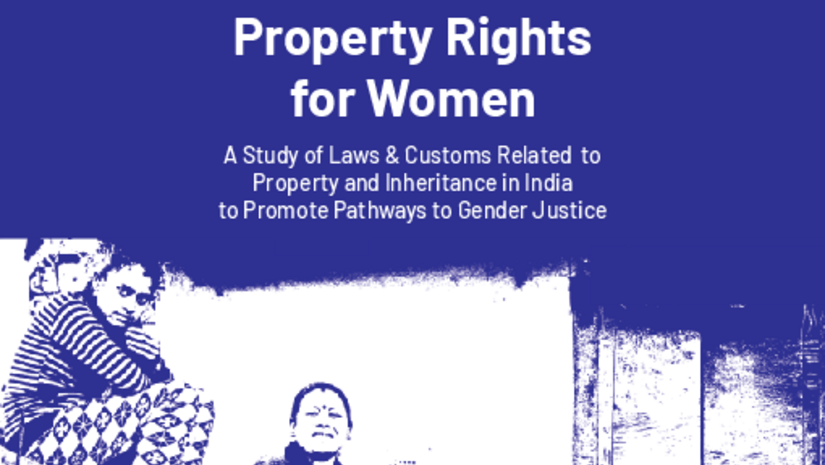
Economic independence is crucial for the emancipation of women, as it enables independence, freedom of choice and liberation from social constraints. Equality in the world of work and the recognition and enforcement of women's property rights are essential to ensure women's economic and financial independence. While lack of access to property is an immediate problem for women in owner-occupied households, there is also the challenge of patriarchal structures and values that affect women in households that acquire property through housing programs
and land reforms.
In India, the complex web of law, custom and social practice shapes women's right to property. The laws on inheritance without a will - some codified in formal laws, others rooted in uncodified customs - play an important role in relation to property rights when a person dies without leaving a will.
While there are no exact statistics on the number of people in India who die without a will, it is common knowledge that a significant proportion of the Indian population does not make a will, resulting in a significant number of deaths without a will. As a result, many estates are distributed according to the legal rules of intestate succession, which vary according to the civil status laws applicable to different communities in India. For example, the Hindu Succession Act of 1956 governs intestate succession for Hindus, Buddhists, Jains and Sikhs, while Muslims are governed by the Muslim Personal Law (Shariat) Application Act of 1937.
Even where there is a will, personal laws affect to varying degrees the way in which the will is executed if objections are raised.
Diverse inheritance laws and changing societal practices often disadvantage women, particularly in relation to land and property rights, highlighting the urgency of securing equitable property rights for women - a key concern of feminist advocacy and essential to achieving the UN Sustainable Development Goals.
This report examines how constitutional, personal and customary law affect women's land rights and presents a comparative analysis to underpin policies that could lead to a more equitable legal framework. In eight chapters, he examines the importance of women's property rights, analyzes religious and customary inheritance rights, and highlights challenges to the ownership of agricultural land.
Using legal analysis and evidence from the field, this report aims to help create a more robust policy framework for women's equal access to property in all communities in India.
We hope that this report will be a valuable resource for researchers, activists and policy makers working on the intersection of property rights and gender issues and will help advance gender equality in property and inheritance law.
Comments and suggestions are always welcome.
Cluster: 1, 2
2021
SDGs from Below: Social Movements, Social Justice and Cultures of Power
"SDGs from Below" introduces the issue of strategic goal orientation and bottom-up policy making in the international context. Although the 2030 SDG agenda outlines far-reaching socio-political goals, they are often disconnected from other justice demands of social movements and suffer from deep tensions with the environmental goals they purport to promote. We argue that a comparative, intersectional and transnational lens is required to analyze the silent otherness that is indirectly reproduced through debates about this international institutional framework. We aim to understand how global social movements influence sustainability debates and how emerging justice narratives might be influenced or marginalized by the SDG framework.
Cluster: 1, 2, 3
---
Project coordinator: Dr. Rirhandu Mageza-Barthel (University of Kassel)
E-mail: mageza-barthel[at]uni-kassel[dot]de
---
Main research partner: Dr. Patricia Northover (University of the West Indies)
E-mail: particia.northover[at]uwimona[dot]edu[dot]jm
---
Research associates: Dr. Simone Claar, Dr. Frauke Banse (University of Kassel)
The SDGs are the subject of debates in development research and international politics, in finance and in social movements, where the various areas of the 2030 Agenda are critically discussed (see Debiel 2018). The tension between the potential of the SDGs and their possible implementation characterizes the discussion, as do their pitfalls and their inability to change global relations (Brisset 2017; see also Banse forthcoming). As values and principles, they express an aspiration that can hardly be fulfilled, but play an important role in political mobilization (Finnemore and Jurkovich 2020). International frameworks such as the SDGs become salient when they are appropriated at the national level and translated into social movement discourses. When faced with contestation, social movements push the boundaries of accepted justice doctrines further and contest international precedents from the bottom up (Mageza-Barthel 2016). Currently, we can observe a growing debate on the dimensions of 'justice', including the question of the different forms of justice and relations possible within distributive, recognitive, procedural and 'refugee justice' claims (e.g. Davis et al. 2019; Moore and Patel 2018; Jenkins et al. 2016; Best and Hartman 2005).
Major obstacles to realizing the transformative potential of the SDGs lie in their colonial continuities (Ziai 2016) and resistance to established human rights norms such as racial and gender equality, human, indigenous and labour rights, which have long formed the core of social movement mobilization (Beckles 2019; Shepherd and Reid 2019; Peet and Watts 2004; Sen 2019; Banse 2016). For social movements attempting to address the SDG agenda from below, the impermeable nature of international organizations and policy makers that reproduce immutable power asymmetries at the global level is significant. Are the SDGs old goals in a new hegemonic wrapper, reproducing a "coloniality of power" (Quijano 2000) or even a politics of "abject blackness" in the pursuit of development (Northover 2012)? Transnational classes are the main perpetrators of this development in green finance (Claar 2020). In long-standing movements such as the race, labor, or women's movements, where great gains have been made in the pursuit of social justice through political struggles and which have produced important conceptual advances, these positions may be eroded in the contemporary era (see Cornwall and Rivas 2015; Mageza-Barthel 2019). Ultimately, this leads to the subordination and marginalization of actors, voices and experiences, making any global agenda incomplete and highly problematic.