

Wert- und Reststoffe
Overview
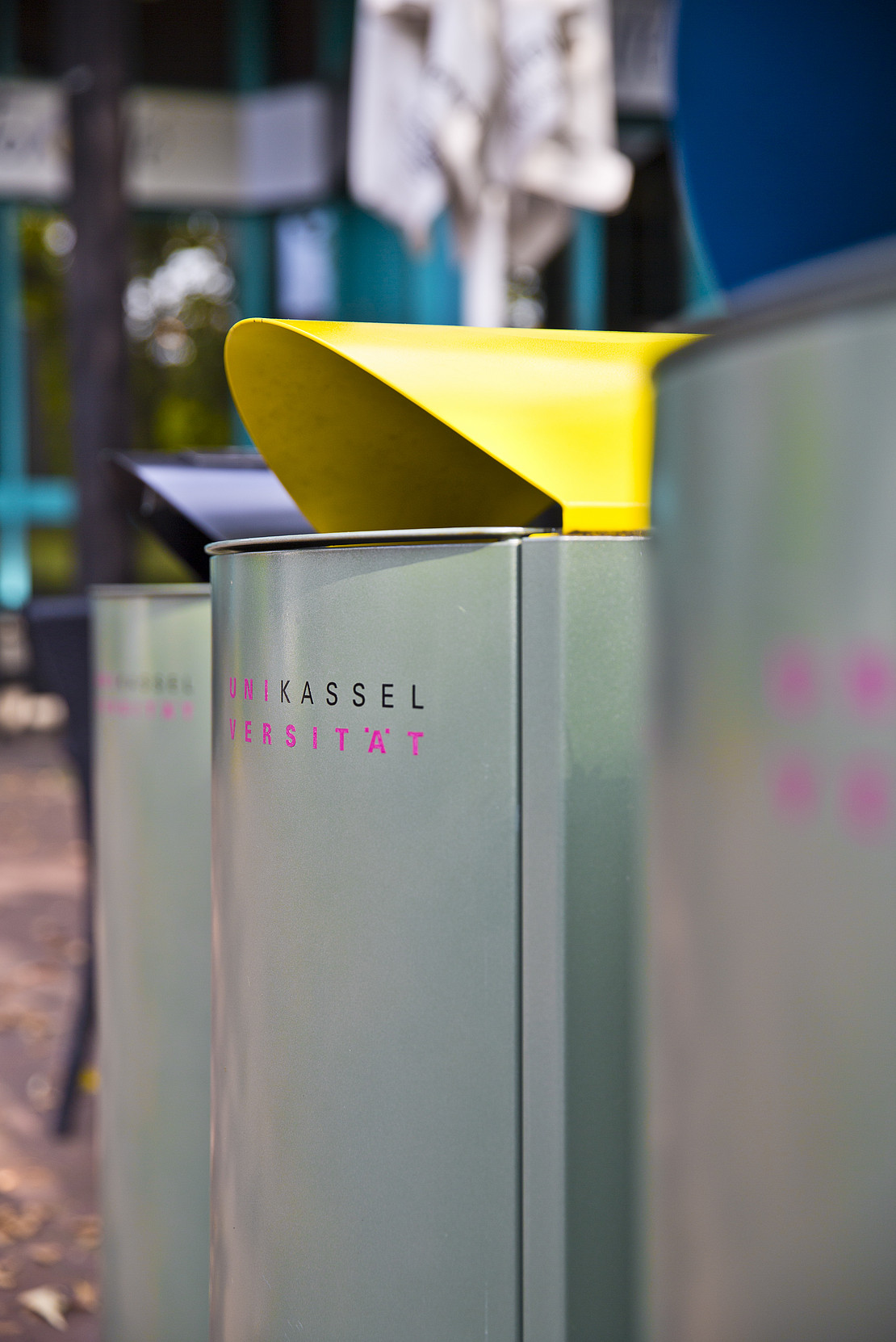
At the Holländischer Platz, Wilhelmshöher Allee, Menzelstraße and Witzenhausen sites, empty toner cartridges, CDs and used batteries can be handed in at the janitor' s offices.
- Toner cartridges should be placed in the disposal boxes, packed in the (plastic) sleeves of the replaced new toner. The outer cartons belong in the paper trash, not in the recycling box. Toner cartridges should not be sent by household mail!
- CDs and DVDs are made of polycarbonate and this is a versatile recyclable plastic. CDs and DVDs do not need to be sorted by manufacturer.
- Used batteries and rechargeable batteries (except car or motorcycle batteries) can also be placed in the collection boxes provided at the various disposal stations.
Other collection points
- Holländischer Platz: InfoPoint (WISO A, building no. 7200), Nora-Platiel-Straße 2 // University administration in the information desk/basement
- Heinrich-Plett-Straße: Central chemical storage in the IBC between 10:00 and 11:00 a.m.
1. registration takes place via the service desk building (-7777) or speak to your janitor's office. If you register in a timely manner, the appropriate bins can be provided or a pick-up will be made by your janitorial staff.
---
(2) We define special events as all waste that is not generated on a regular basis or as part of "special events". This includes, for example, the delivery of large equipment, clearance actions or removals, etc. In order to be able to safely pick up the recyclable and residual materials generated in the process and to forward them to a suitable recycling facility, timely registration is required.
Please dispose of old energy-saving lamps and fluorescent tubes
via your janitor's office.
Old energy-saving lamps and fluorescent tubes should never be disposed of with household waste or in a glass container.
They contain small amounts of mercury. During normal operation, there is no danger whatsoever.
- Ventilate the affected room and leave for approx. 15 minutes.
- Pregnant women must not enter the room until it has been cleaned.
- Leave the window open during the cleaning work. It is best to turn off heaters and air conditioners during the cleaning work.
- Collect large fragments of the lamp (caution: danger of cutting).
- Sweep up and collect smaller pieces using paper and/or cardboard and a damp disposable cloth.
- Remnants can be removed from carpets or upholstery with adhesive tape.
- Caution. Do not use a vacuum cleaner.
- Put all picked up fragments and all used aids (paper/cardboard and cleaning cloth) into a tightly closing container (e.g. screw jar or small bucket with lid).
- Close the container and dispose of it as hazardous waste.
- Disposal is carried out via the hazardous waste collection point.
The sequence of steps consisting of waste prevention, the recycling of valuable materials and only as the last alternative the disposal of residual materials, is the best option from the point of view of environmental protection.
Based on the findings, the main features of an optimized waste management system to be redesigned were defined. These include:
- an extended waste separation through an improved range of containers for recyclables/yellow sack, waste paper, residual waste and organic waste (only in tea kitchens),
- a change in collection processes by users, cleaning staff and janitors, and
- a change in logistics due to the construction of recycling pavilions and central recycling centers (Campus North/South).
The need for the investigations and planning also arose against the background of the campus expansion to the north and the associated extensive new buildings and conversions as part of the HEUREKA construction program.
Offices
The waste paper baskets in the offices are for waste paper only. They are emptied weekly as part of the cleaning process.
Tea kitchens
Containers are available here for light packaging (DSD/green dot) organic waste and residual waste. They are emptied daily during cleaning.
Copy rooms
Larger containers for waste paper are available here. They are emptied daily by the cleaning service provider.
Building entrances/foyers
In the foyers and access areas of buildings with high turnover, triple collection systems are available for paper, lightweight packaging (DSD/green dot) and residual waste.
Outdoor areas
Residual waste containers are available throughout the outdoor areas. Containers for lightweight packaging (DSD/green dot) and waste paper are also provided near cafes and auditorium centers.
The logistical and operational processes were re-planned with a detailed concept:
- Waste concept with structure and process of waste disposal,
- Operational concept for infrastructural building management (collection procedures, maintenance of infrastructure, responsibilities)
- Operating concept for technology and logistics (specifications of technical equipment and logistics areas)
Since 2014, the structural and contractual prerequisites have been created to enable the optimized waste management concept to be implemented across the entire Holländischer Platz campus.