Credit point analysis
The content on this page was translated automatically.
Credit point analysis can be used to compare course proportions, module sizes and the scope of specializations at several university locations.
A credit point analysis enables a detailed comparison of selected courses offered by other universities with a corresponding course at the University of Kassel.
Central questions for a credit point analysis include
- What credit point scope have the universities assigned to the individual training blocks or subject clusters?
- What is the "fingerprint" based on the training blocks at the universities?
Once it has been clarified which degree programs from other universities are to be used for a comparison based on the limited selection of other universities, a credit point analysis can be carried out.
- The starting point for a credit point analysis is an Excel table with the recorded modules, the credit point distribution and the semester assignments for the degree programs for the selected radius of the research. This is based on the respective examination regulations, curricula and module handbooks of the study programs. It is helpful if there is a position paper from departmental conferences or other framework papers for the degree program in question.
- Based on this research, the next step is to assign the modules to different training blocks. In the case of a degree program for which there is a position paper and thus a clear designation of training blocks, this assignment is relatively simple. Assignment is more difficult for degree programs for which there are no official specifications. Here, meaningful summaries of the modules into blocks must be made. Particularly in the cluster of natural science and technical-engineering degree programs, a fine differentiation of the training blocks into subject clusters can be made.
Based on the data collected in an Excel spreadsheet, pivot tables with associated pivot charts can be generated to visualize specific questions. They enable a comprehensive comparison of study program structures and learning content and can be used in this way to sharpen the profile.
In practice, this means that the corresponding data tables for a chart are located in the next worksheet. The evaluation charts for evaluation with pivot charts are provided with various filters (e.g. selection of universities or individual training blocks). It is advisable to highlight worksheets with charts in color, e.g. green for automatically generated charts that can be filtered using Pivot, and yellow for manually created charts.
Please note: Possible display errors and rare cases of lost formatting are special features of Excel pivot charts that have not yet been conclusively resolved by Microsoft. For example, the manual formatting of column and line charts can switch back to automatic mode. In such a case, you should not save the file, but close and reopen it.
Download an example for a degree program in the field of "Mechatronics" → See description under Examples.
The results of the credit point analysis are included in question 18 and question 19 of the study program concept.
Examples
Question:
What specializations and majors are available at other university locations?
Procedure:
For the Master's in History and the Public Sphere, for example, it was helpful to make the individual study components and blocks of different content visible. For example, it was possible to clarify the number of credit points per epoch or to look for geographically structured courses or even modules with their respective credit point shares. In this way, areas of specialization and focus could be visually recorded. For the Master's degree course in History and the Public Sphere, it was of particular interest to see whether the respective degree course at another university offers courses on digital history and, if so, to what extent, whether as a single course, a block or even as a separate focus. As the Kassel Master's in History and the Public Sphere offers the opportunity to complete the "Digital History" certificate as part of the course, which responds to the special opportunities and challenges of digital forms of presentation and digital methods in the field of history, research was carried out at a national level. It was determined at which university locations a similar certificate or even an independent study program is offered.
When researching the M.A. programmes within a radius of 150 km from Kassel, the study programmes that cover a wide range of subjects are joined by specialized Master's programmes. These specialized Master's courses focus either on a specific epoch or geographical region or, in a more interdisciplinary sense, on a range of topics. In turn, some study locations offer a choice between various specializations in the more broad-based history master's programs, which are then certified accordingly. Interdisciplinary Master's programs round off the offer, for example "International Cultural History Studies" at the University of Siegen or "Medieval and Renaissance Studies" at the University of Göttingen.
In addition to the course structure and the special features of the respective study program, the aspects of possible internships and stays abroad were also relevant. With regard to the admission requirements for the Master's degree program, major differences were identified. This was particularly the case for the required language skills. The spectrum ranged from knowledge of modern languages to a combination of modern and ancient languages to requirements for purely ancient language skills.
Question:
What thematic focuses are there for Master's courses on "electromobility" at other university locations?
How many credits do these specializations comprise?
Is a distinction made between specializations for admission requirements or are there admission requirements for courses in the subject area of sustainable mobility / electromobility under investigation?
Procedure:
As part of an environment analysis, all study programs on electromobility were collected based on the databases of the Accreditation Council and with research in the Higher Education Compass and Studycheck platforms. The following information was recorded in individual columns of an Excel table.
- Type of university and clustering of degree programs:
The degree programs found were classified according to HAW and university based on their proximity to the subject area of "electromobility":- Degree course with direct reference:
Degree course in the subject area that focuses on several different aspects of "electromobility". - Related degree course:
Degree course which, in addition to other content from electrical engineering, mechatronics, computer science or mechanical engineering, has a focus or specialization in the field of "electromobility". - Continuing education course:
Continuing education course in the subject area that focuses on several different aspects of "electromobility". - Related continuing education course:
Continuing education course which, in addition to other content from electrical engineering, mechatronics, computer science or mechanical engineering, has a focus or specialization in the field of "electromobility".
- Degree course with direct reference:
- University and location
- Course name:
In some cases, patterns for the typical naming of the subject area can be identified here. - Degree:
Bachelor's or Master's degree including semesters for the standard duration of study - Type/structure of degree program:
The module handbooks and examination regulations can be used to identify the parts of the curriculum that can be assigned to fundamentals, basic modules or specializations and areas of focus. Are there any internships, project modules or practical semesters?
The information collected on the course structure and the number of credits for individual parts of the course were then further subdivided and sorted into the following columns:- Credits for basic modules, compulsory area
- Credits for major 1, technical elective area
- Credits for major 2, technical elective area
- Credits for elective area, integration area (integrated or additive key competencies at the University of Kassel)
- The Master's module was not taken into account, but had a scope of 30 credits for almost all degree programs.
- Start of studies: Summer and/or winter semester
- Admission restrictions and admission requirements
- Language of instruction and examination
The procedure described above was used to identify degree programs with "electromobility":
| HAW | University | |
|---|---|---|
| Degree program with direct reference | 14 | 6 |
| Related degree program | 5 | 5 |
| Continuing education program | 4 | 1 |
| Related continuing education program | 1 |
The results are presented below using the universities as examples:
Only three degree programs included a second major in parallel in the curriculum. In most of the 4-semester masters, the scope of the specializations is between 30 and 95 credits with a large proportion of electives (see Figure 1).
In most degree programs, there are often 3 or more specializations for students to choose from. If the specializations are sorted into thematic clusters according to their frequency, 14 specializations can only be found in one degree course. There are 5 out of 12 specializations in "Drive Technology", 4 out of 12 in "Automotive Engineering", 6 out of 12 in "Autonomous and Connected Driving", 7 out of 12 in "Automotive Engineering" and 10 out of 12 in "Energy Storage and Infrastructure" (see Figure 2).
The following picture emerged for the admission requirements:
At some university locations, a specific Bachelor's degree in subjects such as electrical engineering, mechatronics or mechanical engineering is required, while at other locations certain credit points in defined subject areas (such as mathematics, mechanical engineering fundamentals or electrical engineering fundamentals) are required. In some cases, these approaches are also combined. At some locations, for example, proof of at least 12 CP in mathematics, 15 CP in mechanical engineering and 15 CP in electrical engineering fundamentals is required in addition to a suitable degree.
Example 1:
"Admission requirement: generally a professionally qualifying Bachelor's degree in Electromobility and Regenerative Energy Technology, Electrical Engineering and Information Technology, Microtechnology/Mechatronics or an equivalent course of study (decision of the examination board, if applicable)"
Example 2:
"A passed Bachelor's examination with at least 180 credit points (CP) in a degree course in the field of electrical engineering and information technology or in a related degree course such as mechatronics, automation technology or technical cybernetics with a relevant specialization."
Example 3:
"Professionally qualifying degree in electrical engineering, mechanical engineering and computer science. In addition, admission to the Master's degree program is granted to those who have the following subject requirements
- 12 CP Mathematics
- 15 CP mechanical engineering basics
- 15 CP electrical engineering fundamentals / control engineering
If these required credit points are not fulfilled, admission may be granted subject to conditions amounting to a maximum of 10 CP."
Example 4:
"Completed university degree in:
Mechatronics, Electrical Engineering, Automotive Engineering/Vehicle Systems
or
Mechanical engineering, information technology or a related engineering or natural science degree program in conjunction with proof of previous university-equivalent knowledge in the fields of
- Electrical engineering (at least 10 ECTS)
- Control engineering (at least 5 ECTS)"
Language in courses:
The language of the courses within the modules was also looked at as an example. The majority of courses are offered in German, but a few university locations offer courses in English, some of which are implemented for selected specializations. Only one degree program offered courses in German and English and divided them into winter and summer semesters based on the curriculum.
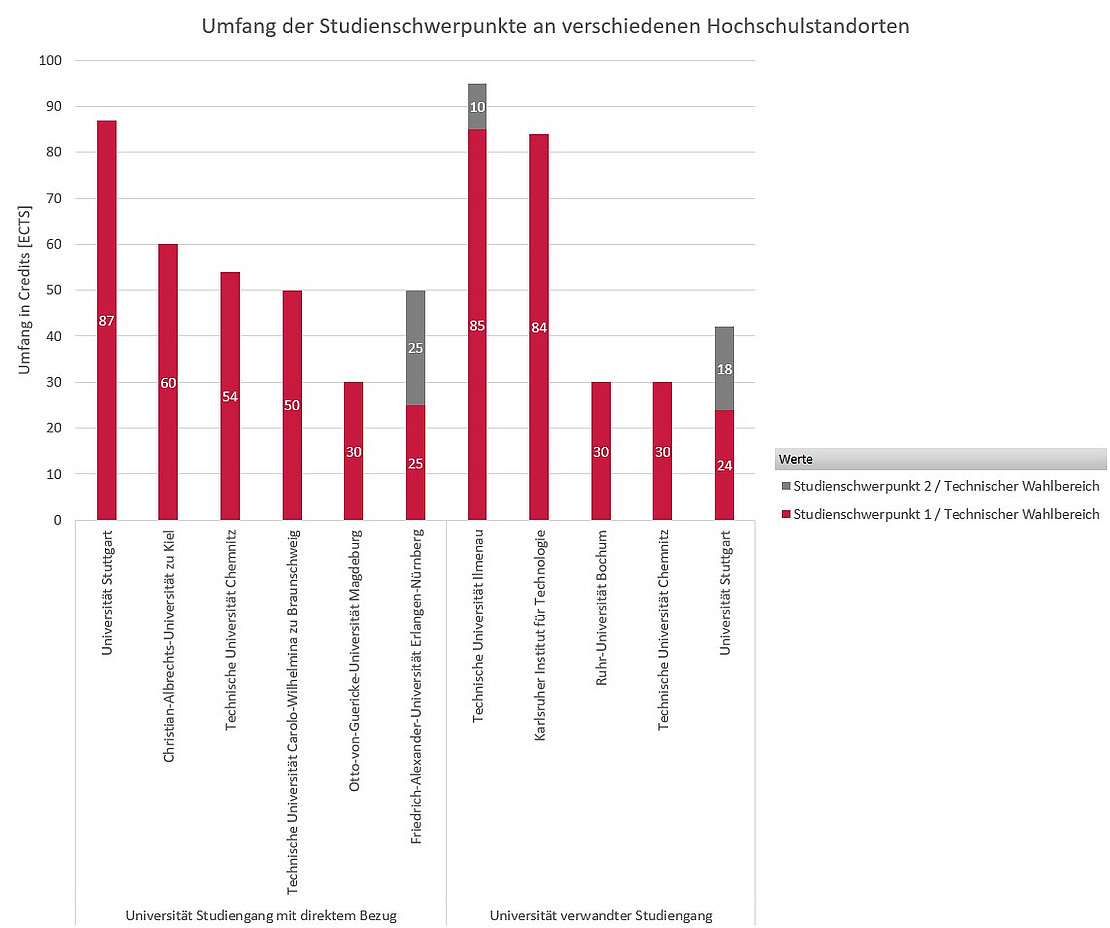 Image: University of Kassel
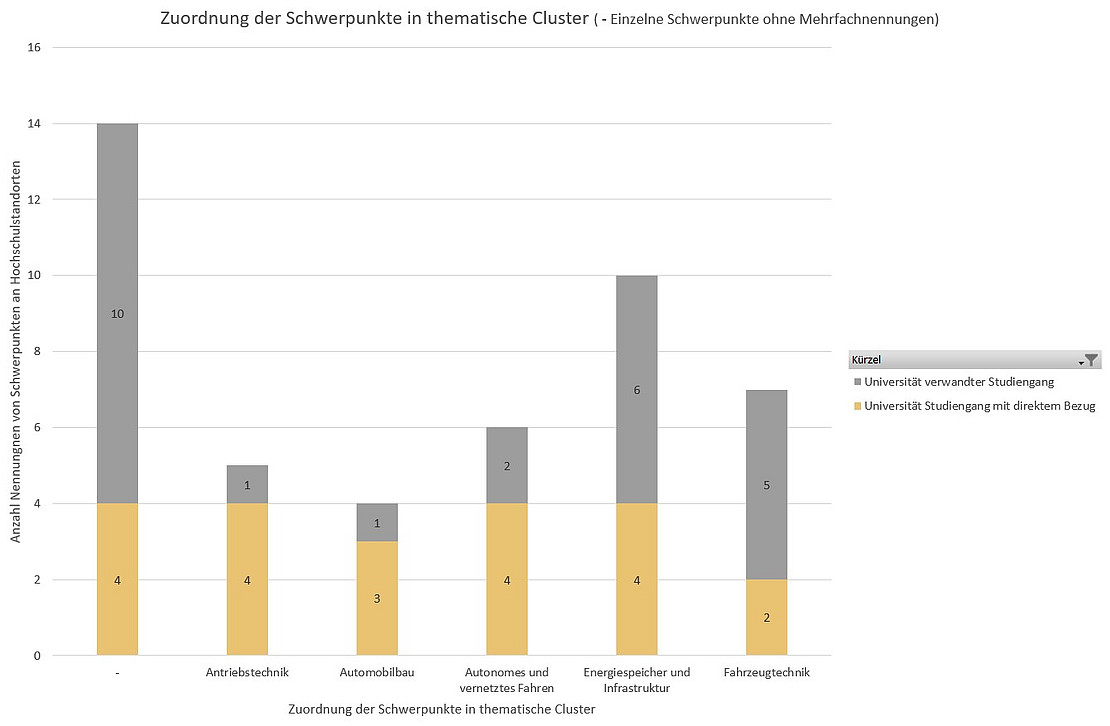 Image: University of Kassel
As part of the credit point analysis, a detailed comparison of selected courses offered by other universities with a corresponding course at the University of Kassel is carried out in the example. This procedure was further developed on the basis of an approach used by the Department of Mechanical Engineering as part of the Concerted Action on Teaching.
The starting point for the analysis is, for example, the framework or position papers of the subject disciplines on student education, which contain detailed information on overarching educational topics, teaching content and modules. In coordination between the experts from the departments and the project team, modules from their own degree program and comparable degree programs at other universities were assigned as comprehensively as possible to the overarching educational topics presented in the position papers.
Question about the "fingerprint":
How are the thematic blocks of learning content divided up based on the framework or position papers of the subject disciplines?
What is the "fingerprint" for each university location?
Procedure:
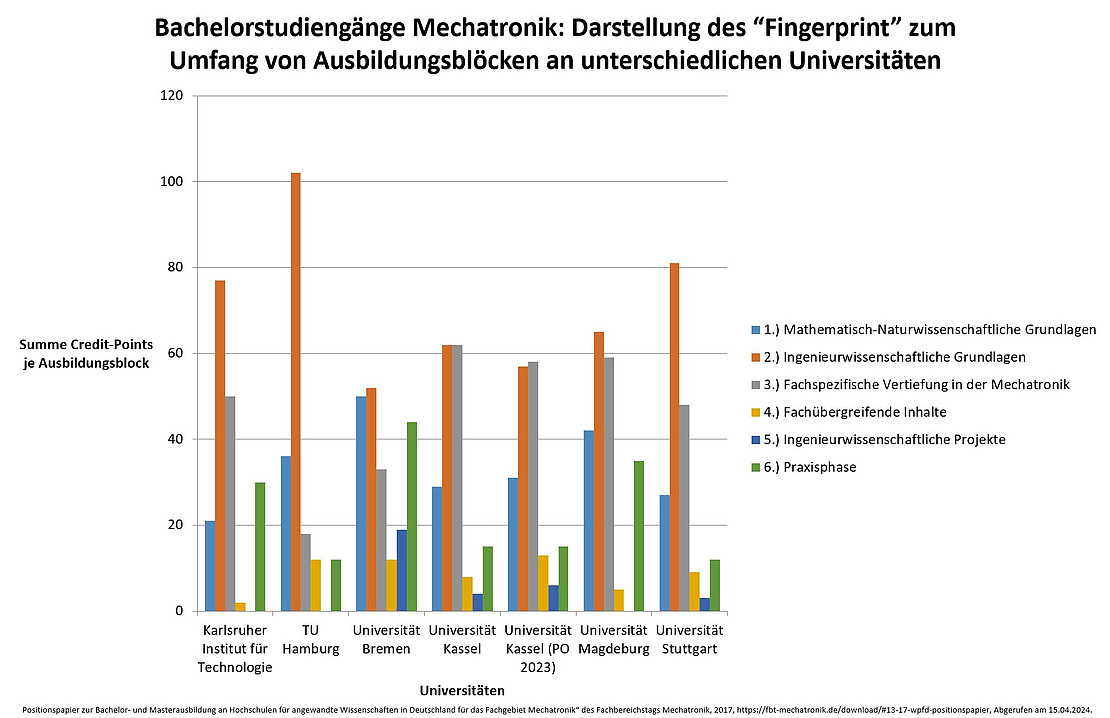
The allocation of the modules and course content to the overarching subject blocks are prepared as so-called "fingerprints" with the help of pivot tables and pivot charts, thus enabling a comprehensive comparison of the degree program structures and course content, as shown in the following figures using the example of the Bachelor's degree program in "Mechatronics":
Bachelor's degree courses in mechatronics: representation of the "fingerprint" (cf. Figure 1)
For the evaluation, the sum of planned credit points for degree courses at selected universities - the "fingerprint" of the degree courses - is presented in defined topics/training blocks based on a position paper from the Mechatronics Faculty Conference. Two "fingerprints" are shown for the degree program at the University of Kassel, one for the module structure of the previous examination regulations (University of Kassel) and one for the module structure of the newly planned examination regulations (University of Kassel PO 2023). The comparison clearly shows that the universities have significantly different priorities in some cases. For example, the degree programs at the Karlsruhe Institute of Technology (KIT), the Technical University of Hamburg and the University of Stuttgart have significantly higher proportions in the area of engineering fundamentals. Although the University of Magdeburg does not have a project component, it does have a larger practical phase. The University of Kassel places a comparatively large emphasis on in-depth courses on mechatronics in the curriculum and has reduced this slightly in the newly planned examination regulations.
Question on clustering according to subject specializations:
How are the modules divided into subject clusters according to content?
What are the differences in the subject focus of the degree programs?
Procedure:
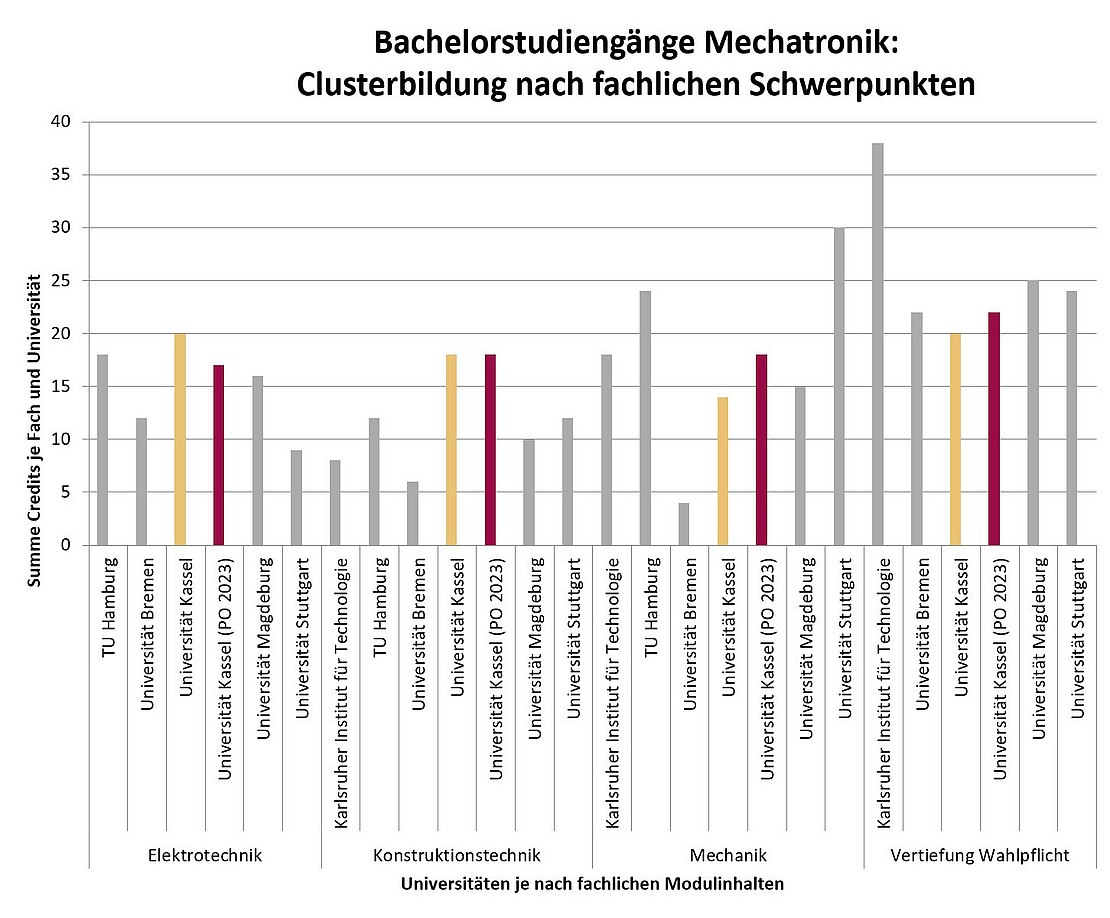
Bachelor's degree programs in mechatronics: Clustering according to subject focus (see Figure 2)
In this step, Bachelor's degree courses in "Mechatronics" are compared in terms of the focus of the individual subjects/training blocks. For this purpose, the modules are assigned to specific subject clusters depending on their content and the number of credit points allocated to specific subject clusters in the individual training blocks is broken down. In this way, differences in the subject focus of the degree courses can be made visible.
With reference to the Bachelor's degree course at the University of Kassel, it can be seen that both the previous and the newly planned examination regulations (University of Kassel PO 2023) place a strong focus on compulsory courses in design engineering and electrical engineering compared to other degree courses, while the KIT, for example, has a much greater focus on electives.
Question about training blocks per semester:
In which subject semesters are training blocks located in the comparison of two university locations?
Procedure:
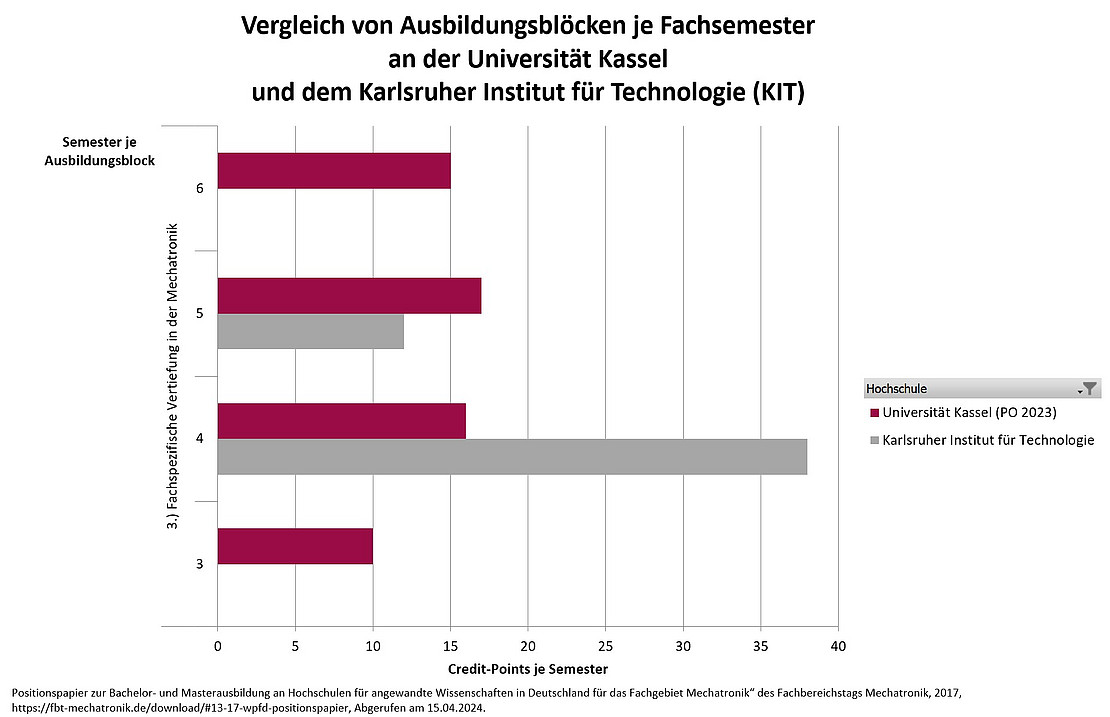
Comparison of training blocks per semester at the University of Kassel and KIT (see Figure 3)
Figure 3 shows the planned scope of the subject-specific specialization for Bachelor's degree courses in mechatronics at the University of Kassel and the Karlsruhe Institute of Technology in order to compare the semester in which certain training blocks are planned. In this comparison, it becomes clear that in the Karlsruhe course, a large number of courses are scheduled in the fourth semester and a few in the fifth semester. In contrast, the more even distribution of the University of Kassel offers the opportunity to take consecutive courses in the semesters and thus acquire in-depth knowledge in selected areas of specialization semester by semester. In the same way, practical content, projects or interdisciplinary content can be presented as part of a credit point analysis.