

The 8 steps of the Concerted Action on Teaching as a framework for course development
This page contains automatically translated content.
The Concerted Action Teaching process in 8 steps
At the start of the project in 2021, a process flow was developed (see Figure 1) and presented to the committees of the University of Kassel. The process consists of eight steps, in the course of which milestones are reached at two points. The aim is to look at degree programs with individually selected focal points and more comprehensively than is usually the case in the context of accreditation:
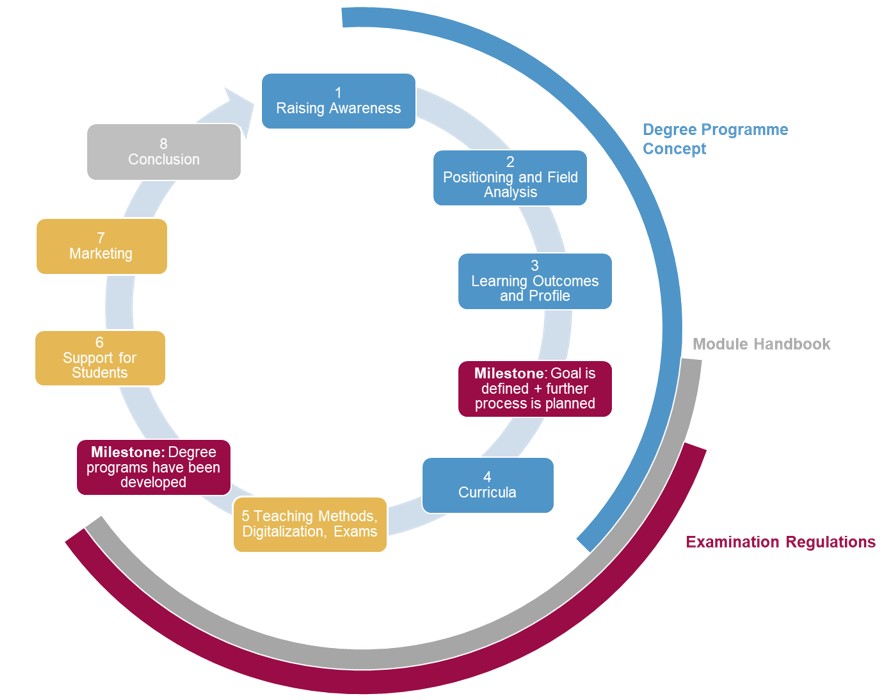
Figure 1: The Concerted Action Teaching in eight steps
In Figure 1, the study program concept, the module handbook and the examination regulations are also marked along the 8 steps to illustrate the steps during which these documents should be prepared (see Accreditation Process Department II Quality Management).
Step list
1.Sensitization
The Concerted Action on Teaching begins with a "sensitization"(step 1) for the special features of the respective degree programme, in which the characteristics of the degree programme are discussed jointly by the faculty and, if applicable, representatives from specialist departments, in order to gain specific access to the degree programme, its content orientation and embedding in the faculty's degree programme portfolio.
2.Positioning and environment analysis
In step 2, a "location determination and environment analysis" is carried out. This includes, for example, an analysis of the selectable specializations, but also the ratio of compulsory and elective courses. For this purpose, an analysis of the module handbooks and study plans is carried out based on the number of semesters, the language of instruction or the start in the winter or summer semester. The structures and contents of courses offered by other universities are included in the comparison.
3.Study objectives and profile
Based on this analysis, the next step is to discuss the "study objectives and profile"(step 3) of the degree program. Closely linked to the description of the study objectives, the desired competencies of the students are discussed in this step and any need for discussion or revision is identified. Current developments in the discipline are taken into account. On this basis, an objective for the modernization or new development of a degree course is developed.
4.Curricula
Once this step has been completed, the first milestone has been reached with the development of the objectives. Building on this, a detailed analysis of the curricula can be carried out in the next step 4 "Curricula". Among other things, the curricula and module plans of other universities and colleges will be used to work out how topics are mapped at module level. As part of a credit point analysis, the modules and courses are assigned to subject categories. Among other things, the scope and timing of basic and advanced subjects, as well as internships, project and team work, are shown in the curricula. This enables a discussion on the detailed planning of the percentage shares within the specifications for the course structure. Framework and position papers from departmental conferences, for example, are used as a basis. If relevant approaches or trends emerge, these are reflected in the curriculum.
Steps 2, 3 and 4 offer points of contact for contributing the experience and expertise of the departments and project initiatives involved in the Concerted Action on Teaching at an early stage of study development. Here, the departments can involve various contact persons from the context of the Concerted Action on Teaching in order to receive support in the areas of student advice, study information, digitalization, educational coaching and marketing, among others. For example, frequent questions from prospective students can be incorporated into the design of the degree program together with findings from analyses of typical search engine queries.
5.Teaching methods, digitalization of teaching, examinations
In step 5 "Teaching methods, digitalization of teaching, examinations", the focus is on questions of teaching format and technical implementation once the module content has been defined by the department. Among other things, the services offered by the Teaching Service Center for the digitalization of teaching can be used here.
After step 5, the revision or development of the curricula is successfully completed. A further milestone (see Figure 1) has thus been reached with the transfer of the adaptations to the examination regulations and module handbooks.
6.Accompanying the students
Step 6 "Student support" analyzes how students can be assisted with support services from the beginning to the end of their studies. Particular attention is paid to the question of how students can not only be informed about existing offers, but also motivated to accept them.
7.Marketing
Step 7 focuses on the topic of "marketing". Here, the University and Student Marketing team from the Communications and Marketing department supports the departments in updating and optimizing the course websites, for example by preparing the results of graduate surveys or data from retention studies to present career prospects or as part of an SEA analysis for search engine optimization.
8.Conclusion
Step 8 marks the "conclusion" of the process flow for a study program. It is also possible to analyze and develop several study programs in parallel, so that several process flows are run through at the same time or with a time delay.