
This page contains automatically translated content.
The 2026 Nora Platiel Prize Honors Research on Human Rights in Melilla
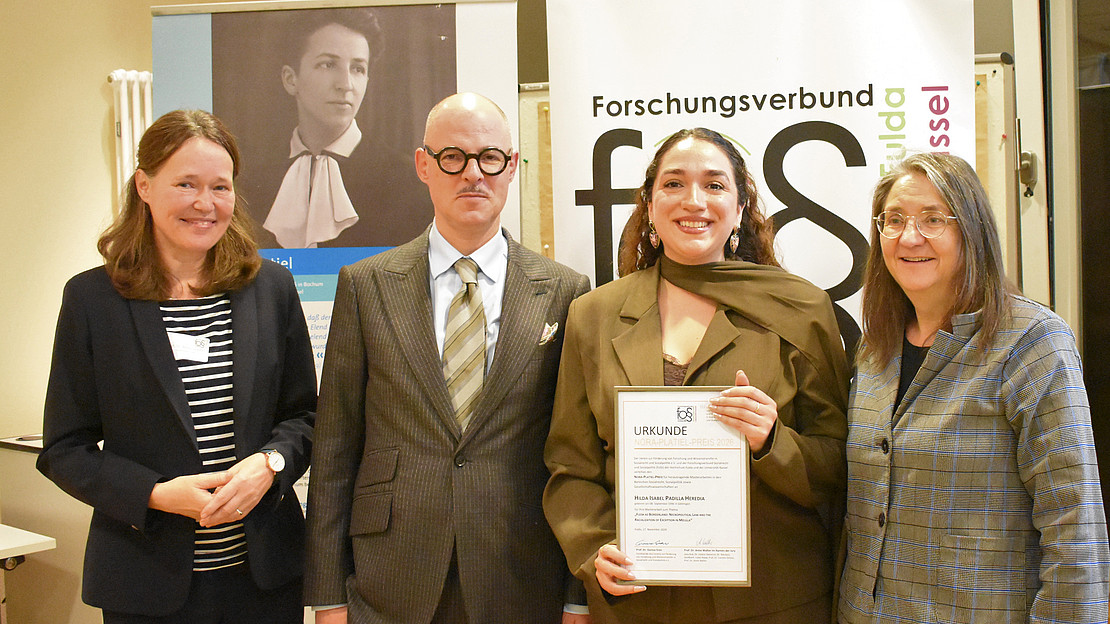 Image: Fulda University of Applied Sciences.
In her work, Padilla Heredia examined how laws, international agreements, and administrative procedures are applied in the exclave on the border with Morocco—with a clear finding: People seeking protection and asylum there receive virtually no adequate protection, particularly due to their origin and gender, while from the outside everything appears to be in accordance with the law. According to the study, these gaps in protection cannot be attributed to a lack of laws or errors by individual authorities, but rather arise from the interplay of existing regulations and administrative procedures.
In this regard, the study identifies three invisible mechanisms: first, a legally engineered lack of protection, in which people are returned through intergovernmental agreements and formal procedures without a serious case-by-case review; second, a structural disregard that depoliticizes political reports—such as those from African women regarding state or collective violence—reducing them to harmless isolated incidents; and third, an institutionally generated absence, in which a lack of documentation and inaccessible information make it impossible to legally scrutinize state responsibility.
“We see that legal discrimination arises not merely from a single erroneous decision or an obvious violation of the law, but also from many individual rules, procedures, and decisions,” says Padilla Heredia. “It is therefore important that we critically examine procedures, areas of responsibility, and decisions.”
Timeliness Convinces the Jury
The jury was impressed, on the one hand, by the study’s high relevance to current events and its sociopolitical significance, and, on the other hand, by its highly transparent presentation. “The study is highly relevant because there is a noticeable trend in Germany and the European Union toward tightening regulations that prevent access to justice. At the same time, the award winner has openly and critically reflected on her field research and her own role as a researcher,” explains jury member Professor Dr. Anne Walter, justifying the selection.
Furthermore, the work builds on the legacy of the award’s namesake, the Jewish lawyer and dedicated social policy advocate from Kassel, Nora Platiel (1896–1979): “As a lawyer and social policy advocate, Nora Platiel lived by precisely this conviction: that structural shortcomings in the application of the law must be identified, even when it is uncomfortable to do so, and that legal and social change cannot be separated from one another,” says Padilla Heredia.
Research with Firsthand Insight
As part of her research, the legal scholar accompanied asylum seekers through hearing and detention proceedings and analyzed, among other things, case files, hearing transcripts, and witness statements. To avoid jumping to sweeping generalizations based on her privileged professional access, she analyzed statements, official documents, and civil society records separately and then examined them for consistency and contradictions.
For the award winner, one thing is clear: “Legal scholarship should help bring concrete problems to light and spur improvements. For me, academic quality and social relevance go hand in hand.”
About the Nora Platiel Prize
The Nora Platiel Prize, endowed with 2,000 euros, is awarded annually by the Association for the Promotion of Research and Knowledge Transfer in Social Law and Social Policy (Verein zur Förderung von Forschung und Wissenstransfer in Sozialrecht und Sozialpolitik e.V.) and the Research Network for Social Law and Social Policy (FoSS). The prize is awarded to master’s theses in the fields of social policy, social law, and social sciences from the University of Kassel, Fulda University of Applied Sciences, and the University of Statutory Accident Insurance in Bad Hersfeld that excel in combining academic quality with social relevance.
What does this mean in a nutshell?
- Lawyer Hilda Isabel Padilla Heredia will receive the 2026 Nora Platiel Prize for her master’s thesis on the European border and asylum regime in the Spanish exclave of Melilla.
- Key finding: Asylum seekers there often do not receive effective legal protection—not because of individual violations of the law, but due to the systematic interplay of existing laws, agreements, and administrative procedures.
- The study shows how structural barriers and a lack of documentation effectively block access to justice, even though the procedures appear formally lawful.