
VELOA Pilot Project: University of Kassel Makes Cycling More Women-Friendly
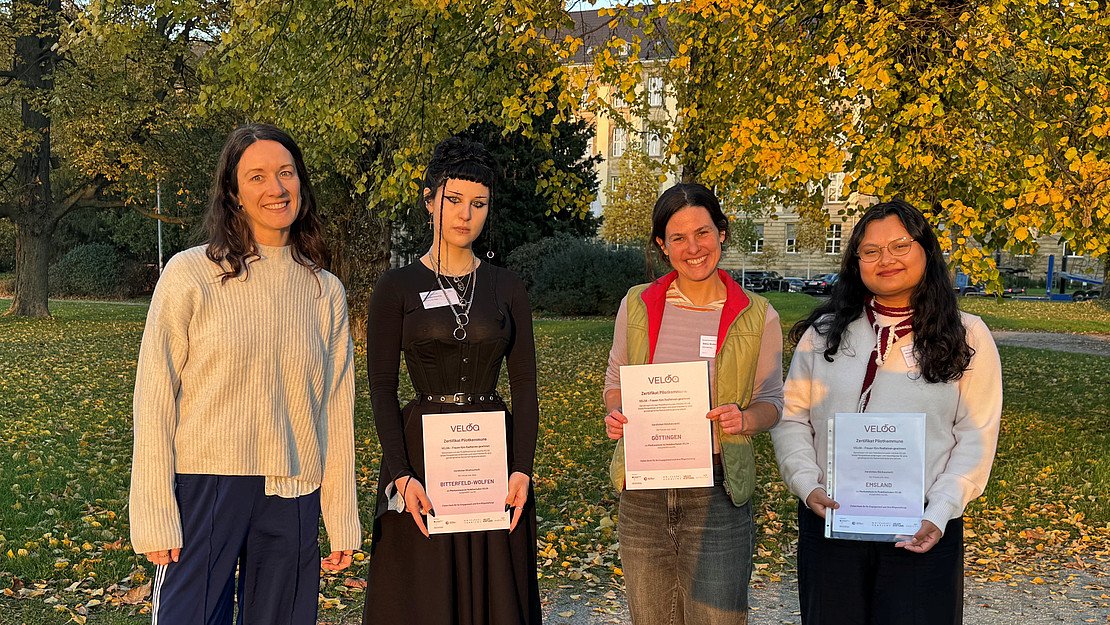 Image: Uni Kassel.
Whether a medium-sized city in eastern Germany, a college town, or a rural area: The project team specifically selected Bitterfeld-Wolfen, Göttingen, and the Emsland district to test measures under different everyday conditions. In collaboration with the consulting firms Mobycon and the Velo Foundation, the University of Kassel is focusing on three groups that have been largely overlooked in transportation planning to date: women with a migration background (2nd and 3rd generations), women in caregiving roles, and female entrepreneurs.
Prof. Angela Francke, scientific director of VELOA and head of the Department of Bicycle Traffic and Local Mobility at the University of Kassel, says: “For decades, our bicycle networks were planned primarily for traditional commuter traffic. However, women’s everyday trips are often more complex—for example, due to chains of errands involving children or shopping—and require consideration of increased safety needs. If this perspective is missing from the planning, barriers arise. This leads many women to feel that cycling doesn’t fit into their lives.”
Women Supporting Women: A Network from Their Own Community
Instead of conducting surveys alone, VELOA involves the target groups directly on the ground. Women from their own communities engage with the participants in their daily lives and motivate them to cycle. Starting in early 2027, researchers—together with local clubs—will accompany the women on their routes, such as to daycare, to run errands, or to visit family members. In this way, the participants highlight barriers directly on the ground. The University of Kassel systematically analyzes these everyday experiences so that municipalities can tailor their bike networks accordingly.
The official kickoff took place at the Municipal Cycling Conference on November 3 in Düsseldorf: At the Women in Cycling Germany networking breakfast, representatives from the three municipalities received their certificates.
“We’re delighted to be part of VELOA with Bitterfeld-Wolfen. The daily commutes of women with caregiving responsibilities, in particular, place special demands on safe and practical cycling routes. We want to better understand these needs and incorporate them more specifically into our planning in the future,” says Heike Krauel, mayor of the city of Bitterfeld-Wolfen.
A Transferable Toolkit for All Municipalities
Based on these real-world examples, the project team will develop a supraregional toolkit with guidelines, templates, and tips by October 2028. This will enable municipalities of all sizes to adapt their bicycle traffic planning in the future. The Women in Cycling Germany network, with over 700 female experts, will also help spread the results to other cities and municipalities.
VELOA is funded by the Federal Ministry of Transport—as part of the “non-investment model projects for bicycle traffic”—using funds allocated for the implementation of the National Bicycle Traffic Plan.
Contact:
Prof. Dr. rer. pol., Dipl.-Verk.wirtsch. Angela Francke
, Head of the Cycling and Local Mobility
Division, angela.francke[at]uni-kassel[dot]de
What does this mean in summary?
- Gender-Equitable Cycling Planning: Under the scientific leadership of Prof. Angela Francke (University of Kassel), the VELOA pilot project—funded with approximately 703,000 euros by the Federal Ministry of Transport—will develop new planning approaches by October 2028 for women in care work, female entrepreneurs, and women with a migration background.
- Field testing and a municipal toolkit: Together with the pilot municipalities of Bitterfeld-Wolfen, Göttingen, and the Emsland district, the team will analyze real-life daily commutes starting in early 2027 and use this data to create a transferable toolkit of guidelines for municipalities of all sizes.