

Own communication and social media
The content on this page was translated automatically.
The University of Kassel welcomes independent science communication. This is because it makes an important contribution to ensuring that science has an impact on society and participates in the opinion-forming process. Social media offers the possibility of authentic, interactive and participatory communication - if used correctly. With these guidelines, we would therefore like to support all researchers at the University of Kassel who use personal social media profiles in a professional context.
Guide for researchers
Notes such as "private here" or "posts reflect my own opinion" are common in descriptions of private profiles of university members on social media. You are also welcome to use such a reference. However, please be aware that you are also perceived as a representative of the University of Kassel. If you express personal opinions in a post, please also mark this as such. Ultimately, you are responsible for the content you publish on social media. Do not publish any internal university information on private channels.
1 First of all, think about why you want to communicate about (your) science. Answering this question will help you to determine the topics, target group, medium, style and goal of your communication.
2. build up a personal network on the subject of science communication. Here you can exchange ideas, learn from each other, motivate each other and support each other in difficult situations. Ideas for discussion partners are University communication employees, communicating researchers, associations, journalists ...
3. do not take on too much. Communication to the "general public" usually ensures that no target group really feels well addressed. So keep your specific target group in mind when selecting your topics and formulations.
4. communication is dialog. Listen to what your counterpart is saying, take others seriously and communicate directly with each other. Respond to links to your profiles and comments if you are addressed directly and it seems appropriate to you.
5 The Guidelines for Safeguarding Good Scientific Practice (DFG) provide orientation for good scientific communication. This is because good science communication, like good scientific practice, is "of equal integrity in its content and methods, it is relevant, comprehensible, understandable and transparent. It is research-based and reflects its conditions for success for society and science accordingly."(#FactoryWisskomm, Perspectives for action in science communication, Berlin 2021, Introduction). Guidelines for good science PR with a checklist for researchers have been published by Wissenschaft im Dialog and the Bundesverband Hochschulkommunikation (linked below).
Posts on social media are not scientific articles. Therefore, adapt your communication style to the medium, target group and topic. Social media serve to create a "we-feeling". Communication is more like that in a cafeteria: it is ad hoc, with unplanned topics and casual colloquial language. Address your target group at eye level. Science communication in social media benefits in particular from a personal touch. In addition to the fact-oriented communication of science, you are also welcome to express your emotions. Please do not exaggerate and make it clear that it is your personal opinion. However, be careful with irony, satire or sarcasm. These styles can only be read/heard online and can easily be misunderstood without personal communication.
- Post regularly, e.g. at least once a week. A collection of topics and ideas or an editorial plan can be helpful.
- Network yourself. Follow other accounts in your community, for example from your department (journals, associations, cooperation partners, related research institutions, etc.) and, of course, accounts from your own university. The university is currently represented on Twitter, Mastodon, LinkedIn, Instagram, Facebook and YouTube.
- When sharing content, please observe applicable laws such as copyright and the right to one's own image (see below).
You can find further information in the Social Media Guidelines of the University of Kassel.
Social media is not a legal vacuum. Especially in connection with photos, videos and comments, you should be familiar with the relevant legal regulations. Copyright infringements can be expensive, and comments with offensive, defamatory, anti-constitutional, racist, sexist, violence-glorifying or pornographic content can have disciplinary, contractual and criminal consequences.
Relevant legal texts and areas of law are:
- The German Telemedia Act (TMG) contains information on the imprint obligation, the liability of the owner of the respective social media presence and data protection.
- The right of expression regulates the permissibility of (public) statements. The freedom of expression under Article 5 of the German Basic Law (GG) is very far-reaching. Untrue statements of fact, insults and abusive criticism are not permitted.
- The Federal Data Protection Act (BDSG) contains regulations on the collection, storage and processing of personal data.
- The German Art Copyright Act (KunstUrhG) contains the regulations on the right to one's own image. With a few specific exceptions (images of public gatherings, persons of contemporary history or images in which the persons are only accessories), the consent of the person is required before publication.
- The Copyright Act (UrhG) regulates the protection of texts, images, audio and video content (so-called works). In most cases, the publication or distribution of such works is only permitted with the consent of the respective rights holder.
- The German Trademark Act (MarkenG) contains regulations on the protection of names and logos.
- Legal regulations also arise from the employment relationship. In particular, the duty of confidentiality/official secrecy and the duty of loyalty should be mentioned here.
The generalterms and conditions, terms of use and guidelines of the provider of the chosen social media service must always be observed. The most common elements include:
- Provisions on limitations of liability of the portal and user liability
- The provider grants licenses to user-generated content. This means that the user may have no influence whatsoever on the use of the data provided and the profile data generated through use.
- The terms and conditions of use of many providers contain specific requirements for holding competitions or other (prize) competitions on the respective portal. These should be observed to avoid problems with the provider.
- There is no obligation for the provider to maintain its offer permanently.
- The provider determines the choice of law and place of jurisdiction. These may be located outside the German legal area.
Source: Federal Association of University Communication
You are welcome to contact the social media team in the Communications department if you have any questions about dealing with problematic posts or comments. Nevertheless, here are a few tips:
- You should report any illegal content, comments or links on your channel immediately, provide screenshots and then delete them.
- You should clear up misunderstandings as quickly as possible.
- Acknowledge constructive criticism and thank people for their feedback.
- Do not give any attention to provocations, abuse, accusations or insults.
- If such incidents accumulate, you can...
- make a single factual statement, but then leave the conversation alone.
- report or block the author. Here too: Best documented with screenshots.
- Respond with "counter-speech": You can ask your personal network to counter hate speech with arguments, other perspectives or humor.
If you have the feeling that inappropriate criticism is getting out of hand or you are affected by controlled digital attacks, please contact the press office or the social media department of the University of Kassel. Contacts can be found below.
There is further support outside the university, for example
- SciComm-Support: information and resources in the form of guides, strategies and training opportunities as well as free personal advice. SciComm-Support is a joint initiative of the Federal Association of University Communication and Wissenschaft im Dialog.
- Hate Aid: Advice and legal support in cases of digital violence.
- The associated app MeldeHelden: Here you can report digital violence quickly and easily. On your own and third-party channels. Available for Android and iOS.
- Reporting form of the reporting office HessenGegenHetze
- Internet complaints office
- You can reach supporters within the scientific community via the MayDay button in the WissKonn network
Create social media videos
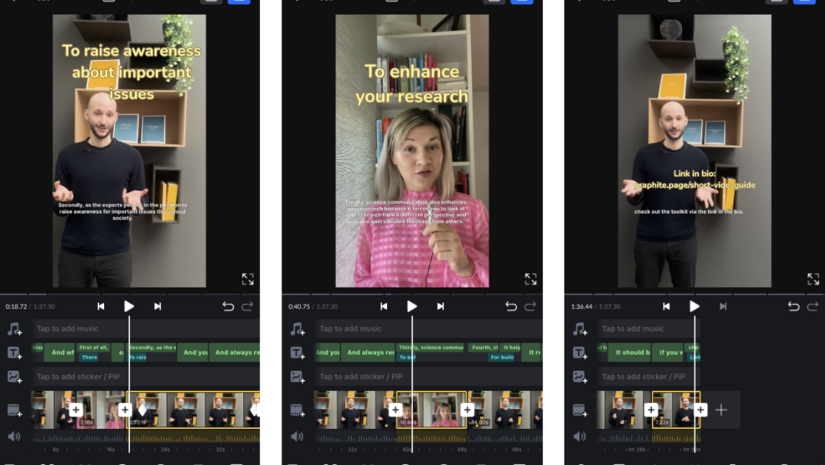
Do you create short videos for social media?
Contact persons
Link list
- Communicating Research: Key points from the Junge Akademie - a guide to science communication by and for scientists (opens in a new window)
- "Guidelines: Communicating Research" from the Junge Akademie on dealing with media inquiries (opens in a new window)
- Guidelines for good science PR with a checklist for researchers published by Wissenschaft im Dialog and the Federal Association of University Communication (opens in a new window)
- www.wissenschaftskommunikation.de: Platform for information and discussion for communicators, researchers, science journalists and interested parties (opens in a new window)
- WissKonn - The network and conference for communicating researchers (opens in a new window)