
Science communication and press releases
This page contains automatically translated content.
How we bring your topic into the public eye
Do you research and teach at the University of Kassel and have something interesting to report? Have you achieved relevant results in a research project, are you planning an innovative teaching format or have you been awarded a prize? Perhaps you would like to take part in a public debate as an expert?
You have a topic - now what?
The University of Kassel has developed an editorial system in which news from the institutes and departments is "passed on" to the central news pool and from there distributed to the public via the press distribution lists and other channels of the press office. The Infotheques on the web have a central function.
You can post news in these Infotheques independently or with the help of your department's web administration: from the announcement of a workshop and reports from courses to personalia and the acquisition of projects and research results. News at institute level can be easily transferred to your department's Infothek and from there to the university homepage. The Press Office scans the Infothek for topics that are of interest to the general public. However, you are also welcome to inform us directly about larger topics - preferably at least two weeks in advance.
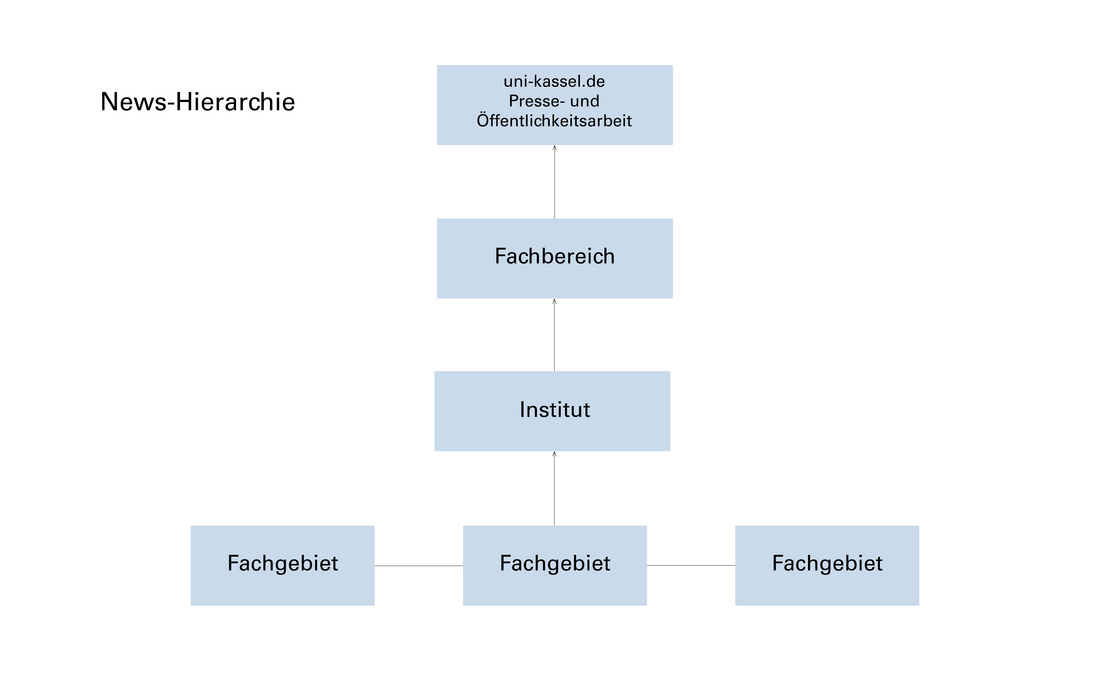
Use understandable language and concentrate on one message per text. Answer the Ws: who, when, what, why, where. If applicable, include funding amounts and project durations, as well as contact information (name, subject area, telephone, e-mail), scientific cooperation partners and/or other project participants from business and society. Also helpful: addresses of websites with further information. If possible, include photos (but remember: you must have the image rights and the consent of those depicted).
In our central news pool, we take from the Infotheques what we know from experience will interest the general public and editorial offices in particular. This includes, in particular, research results, but also original and innovative teaching projects, prizes and big names, unique selling points and much more.
(Examples of topics that are more interesting for your department or for a specific scientific community and therefore have a better place in the Infothek).
From university to the media
Good communication is a strategic success factor. Science communication creates openness for the interests of research and teaching and an understanding of scientific developments. It makes a decisive contribution to positioning our university and our subject areas in the competition for reputation, funding and students. Last but not least, society has an understandable interest in being informed about the use of public funds.
The content is checked by us according to quality-guided guidelines and made available via one or more of our channels depending on its suitability. The most important channels are
- target group-oriented press distribution lists and personal contacts in the editorial offices
- Podcasts and videos
- the university website with the calendar of events
- the university magazine publik
- our high-reach social media channels (including Instagram, Bluesky, LinkedIn)
Training and further education for researchers
The University of Kassel welcomes independent science communication by its researchers. This is because they make an important contribution to ensuring that science has an impact on society and participates in the opinion-forming process. We are happy to support you in this.
The Hessian science communication network"Science Meets Media" has completed its program. The collected know-how, tips and tricks, how-tos and acquisition as well as organizational concepts, i.e. a wealth of knowledge on building competence in the field of science communication for researchers can be read here:
Science Communication is part of the graduate program at the University of Kassel. It is open to interested doctoral students from all faculties.
Social media offers the possibility of authentic, interactive and participatory communication - if used correctly. We would therefore like to support all researchers at the University of Kassel who use personal social media profiles in a professional context with a guide.
Contact for press and public relations
| Name, Forename | Contact | |
|---|---|---|
| Mense, Sebastian Deputy Head of the Communication & Marketing Office, Spokesperson, Head of Editorial Office News | Telephone +49 561 804-2474 | Image: Sonja Rode  |
| Dr. Gebhardt, Andreas Press Adviser | Telephone +49 561 804-3575 | Image: Sonja Rode  |