
This page contains automatically translated content.
Previously Unknown Deformation Behavior in Shape-Memory Alloys Decoded
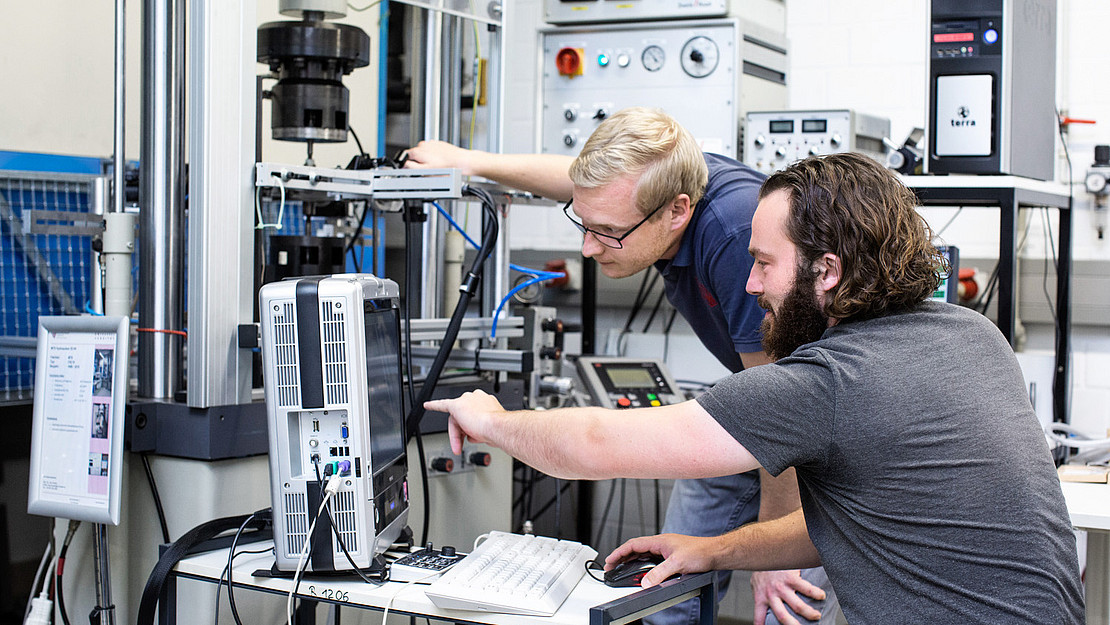 Image: Christine Buhl.
Until now, it was unclear exactly what happens inside shape-memory materials when they are released from stress after being severely deformed and return to their original shape. This unique “memory” has so far been described mostly in phenomenological terms and has been used primarily in tiny medical components such as stents. The research from Kassel now shows for the first time in detail how the material’s structure changes at the atomic level during this relaxation phase.
Combined measurement methods make atomic processes visible and audible
Using special cobalt-nickel-gallium crystals as an example, the Kassel team demonstrated exactly how the mechanism works: When the pressure drops, a previously unknown restructuring takes place, during which the crystal regions arrange themselves in a new way. As a specific crystal variant grows, the so-called twin boundaries within the material shift.
It is precisely this atomic movement within the crystal structure that generates acoustic signals, which the team was able to decipher for the first time. “We were able to examine the material using neutron diffraction, simultaneously monitor its deformation via acoustic emissions, and interpret the processes in parallel using a model,” explains Dr.-Ing. Christian Lauhoff, first author of the study and head of the Shape Memory Materials research group at the Institute of Materials Science and Engineering. “We essentially watched, listened to, and understood the material at work all at the same time.”
International Collaboration Paves the Way for New Applications
“Once we fully understand the mechanisms at play, we can design long-term stable systems for entirely different industries,” explains Prof. Dr.-Ing. Thomas Niendorf, head of the department. “Looking ahead, we’re considering sectors such as construction and transportation, where such materials could serve as high-load-bearing damping elements to counteract varying loads and mechanical vibrations in the future.”
The collaboration is based on a long-standing partnership funded by the German Research Foundation (DFG). Under the leadership of the University of Kassel, which was responsible for the mechanical testing, leading partners pooled their expertise: The TU Bergakademie Freiberg provided the acoustic analysis, LMU Munich and the Rutherford Appleton Laboratory in Oxford were responsible for neutron diffraction, while the Czech Academy of Sciences in Prague developed the theoretical models.
The publication is freely available in the journal *Nature Communications* at: https://doi.org/10.1038/s41467-026-73946-9
Contact:
Prof. Dr.-Ing. Thomas Niendorf
Department of Metallic Materials
Tel.: +49 561 804-7018
Email: niendorf[at]uni-kassel[dot]de
In summary, this means:
- For the first time, the Kassel research team has deciphered at the atomic level how shape-memory alloys return to their original shape after being subjected to stress by simultaneously “watching and listening” to the processes within the material.
- This new understanding of the material’s structure paves the way for durable and highly resilient damping elements in the construction and transportation industries, whereas these materials have primarily been used in medical technology until now.