
Working Together for Strong Real-World Laboratory Research
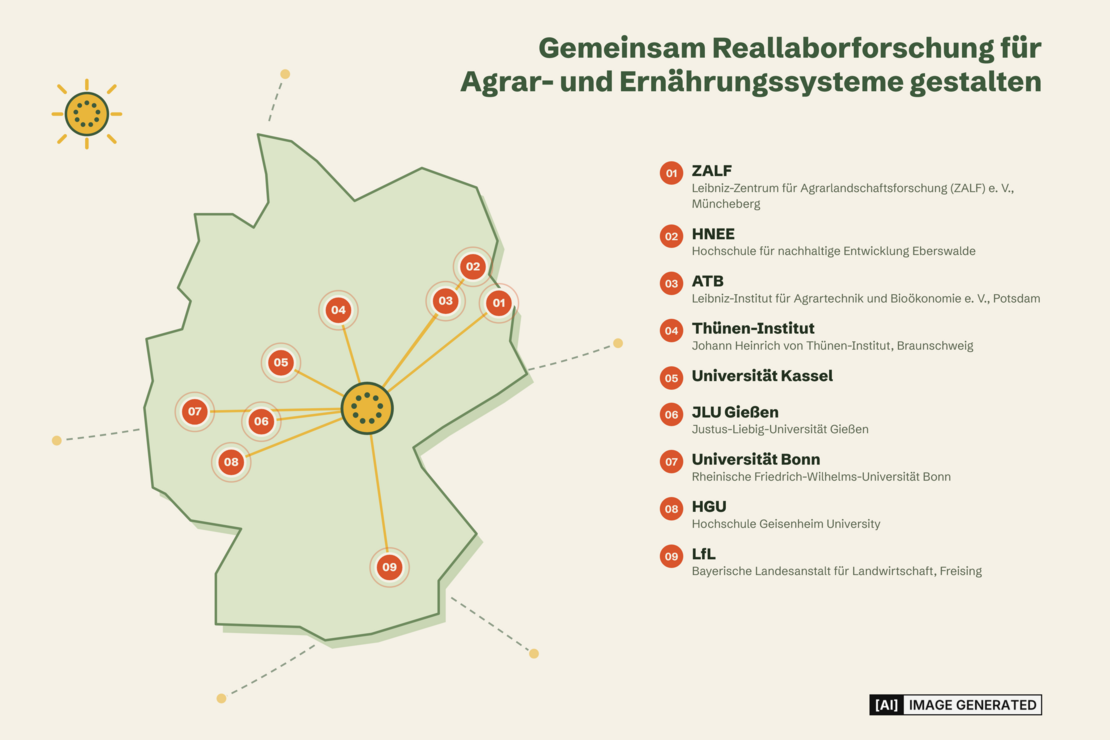
The initiative was presented on September 24, 2026, during an event hosted by the Innovation Center for Agricultural System Transformations (IAT) in Giessen; its formal establishment is planned before the end of the year. The consortium was initiated by the Leibniz Center for Agricultural Landscape Research (ZALF) and the IAT—in which the University of Kassel participates—together with seven other founding partners from various German states.
In real-world labs, researchers work together with stakeholders from agriculture, civil society, and politics to develop and test practical solutions directly on-site in fields, on farms, and in regions. The planned network focuses not on individual labs, but on overarching research in and about real-world labs. The goal is to consolidate methodological experience, transfer successful approaches more quickly across regions, and establish real-world labs as permanent, innovative research infrastructures in Germany. In addition, the initiative aims to integrate with European and international networks.
“With the planned network, we want to help researchers learn from one another and develop joint research concepts that can be translated into suitable research infrastructures. At the same time, we aim to visibly expand the expertise required for this type of research,” explains Prof. Bettina Matzdorf, co-director of the IAT at ZALF. “In doing so, we aim to live up to our commitment that this research will make a significant contribution toward the development of sustainable and resilient agricultural and food systems throughout Germany.”
In the coming months, the participating institutions will launch their first joint projects to further develop the institutional and funding-related framework conditions for real-world labs. Following the establishment phase, the consortium will also be opened up to other research institutions with a corresponding strategic focus.
Consortium Partners (Founding Members):
• Leibniz Center for Agricultural Landscape Research (ZALF) –
Initiator• Faculty of Agricultural, Food, and Engineering Sciences, University of Bonn•
Bavarian State Institute for Agriculture (LfL)
• Eberswalde University for Sustainable Development (HNEE)
• Geisenheim University•
Justus Liebig University Giessen (JLU)
• Leibniz Institute for Agricultural Engineering and Bioeconomy (ATB),
Potsdam• Thünen Institute (TI)
• University of Kassel