
New Consortium Aims to Strengthen Real-World Laboratory Research in Agricultural and Food Systems
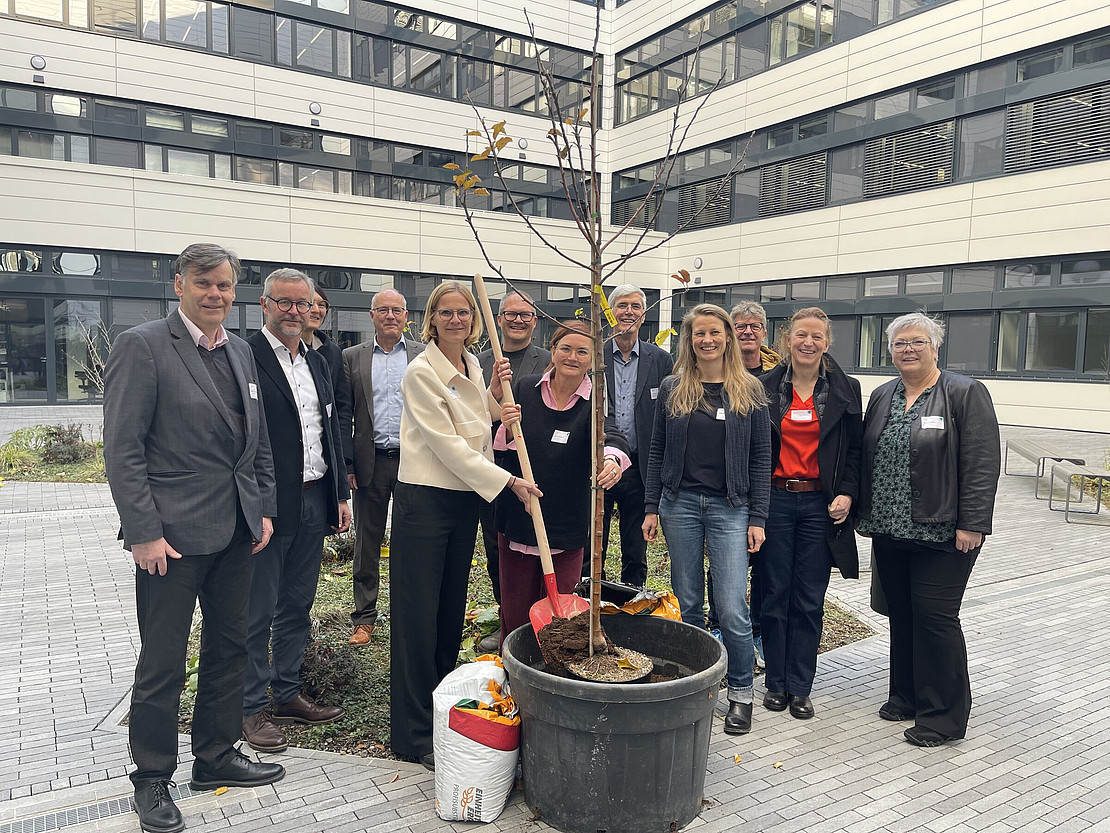 Image: University of Bonn, Susanne Plattes
In agricultural research, real-world laboratories are environments in which researchers work together with farmers, consumers, and other stakeholders from the field and the political arena to develop and test solutions to real-world problems. This takes place directly in the field, on farms, or across entire regions. In doing so, they combine knowledge and methods from various disciplines to contribute to sustainable changes in practice. This approach is rapidly gaining importance in agricultural and food research. Many universities and research institutions are working with a real-world laboratory approach, the design of which must differ for agricultural and food systems compared to, for example, urban areas.
“With this consortium, we are creating a space for exchange where research organizations can learn from one another and develop joint concepts for real-world labs as research infrastructures. In this way, we aim to contribute to sustainable and resilient agricultural and food systems throughout Germany,” says Prof. Dr. Bettina Matzdorf, co-director of the Innovation Center for Agricultural System Transformation (IAT) at ZALF and co-spokesperson for the new consortium.
What the consortium partners are planning
The consortium is a strategic alliance of research institutions at the national level that are committed to real-world laboratory research in the agriculture and food sector over the long term and are developing real-world laboratories as research infrastructures. The members aim to share what constitutes good real-world laboratory research, identify common research questions and conditions for success in achieving impact, and coordinate their strategies for the long-term establishment of this type of research. In this way, the consortium also aims to contribute to the further development of institutional, political, and funding-related frameworks. The network complements existing networks and initiatives.
“Good research must also prove itself in practice. That is why we bring science and practice together in our network’s real-world laboratories. Together with stakeholders from the field, we develop and test new approaches directly on-site and accelerate the implementation of innovations for sustainable agricultural and food systems,” says Prof. Dr. Jens Dauber, Director of the Thünen Institute of Biodiversity and co-spokesperson for the new consortium.
In the coming months, the members plan to coordinate and develop their areas of focus. This will allow for better integration of results from various real-world lab research activities. Another goal is to identify successful research approaches more quickly and transfer them to other regions. In addition, the consortium partners intend to expand their collaboration with European and international initiatives, such as the International Forum on Agroecosystem Living Labs (IF-ALL), an international network of agricultural real-world labs. Following an initial development phase, the consortium will also be open to other institutions that are similarly committed to long-term real-lab research in the agriculture and food sectors.
The founding partners of the consortium:
- Leibniz Center for Agricultural Landscape Research (ZALF)
- Johann Heinrich von Thünen Institute (Thünen Institute)
- Leibniz Institute for Agricultural Engineering and Bioeconomy (ATB)
- Bavarian State Institute for Agriculture (LfL)
- Faculty of Agricultural, Food, and Engineering Sciences at the University of Bonn
- Eberswalde University for Sustainable Development (HNEE)
- Geisenheim University
- University of Kassel
- Justus Liebig University Giessen (JLU)