
On the "Kasseler WELLE" to Success
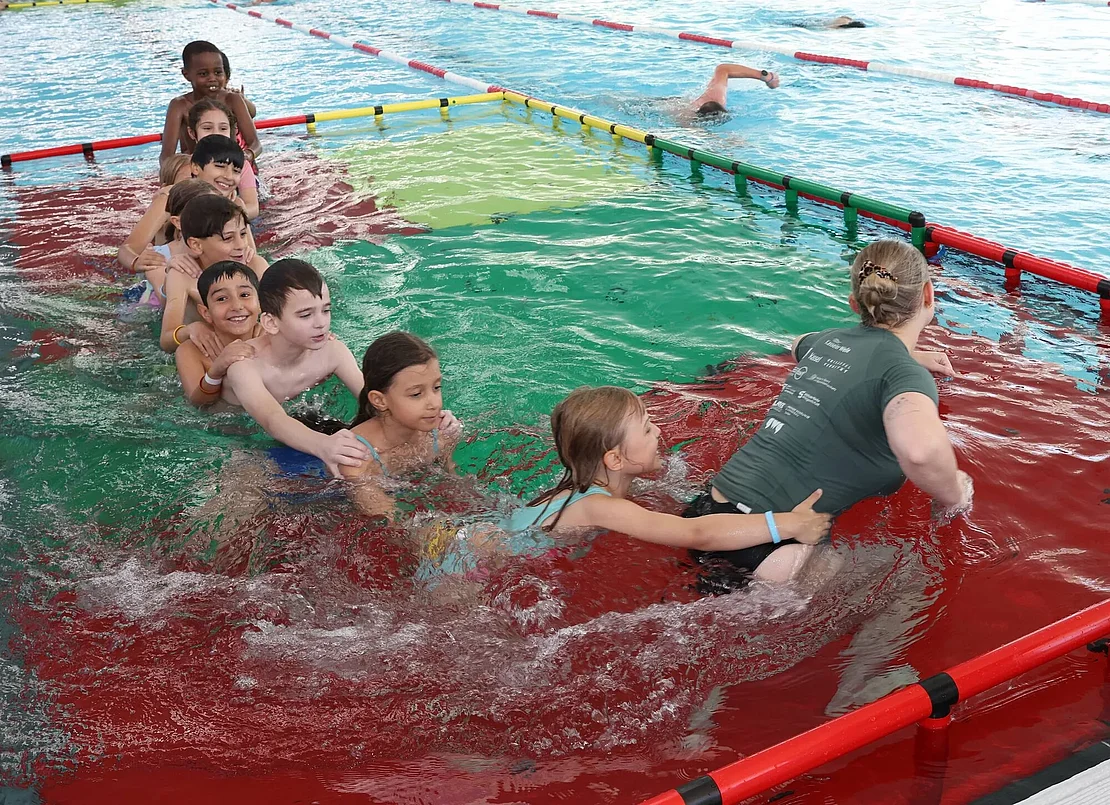 Image: Weber/Stadt Kassel
“The ‘Kasseler WELLE’ program impressively demonstrated right from its very first session what is possible when we give children the time, attention, and best possible conditions they need to learn. It’s impressive to see how, step by step, gentle water familiarization can lead to genuine water and swimming skills. But the ‘WELLE’ has achieved much more: It has given children self-confidence and a love of water—even though some of them had never been in a swimming pool before,” said Mayor Dr. Sven Schoeller and Mayor Nicole Maisch enthusiastically.
Since August 10, 2026, 1,400 second-graders from 19 elementary schools in Kassel have been able to use the Auebad daily for about ninety minutes each day for a week as a safe place to learn and gain their own experience in the water. The so-called “Pillar 1” of the Kassel pilot project combines an assessment at the beginning of the training week—which evaluates the children’s water skills—with a clearly structured curriculum for basic swimming instruction taught by trained students from the University of Kassel. The goal is to give all children—regardless of their social or cultural background or whether they have health limitations—the same opportunities to learn basic skills and safety in the water. For this reason, typical critical situations were also practiced with the children in the water, such as an air mattress tipping over or getting out of the water without assistance.
What does an owl have to do with swimming?
Scientific support was provided by the Institute for Sport and Sports Science at the University of Kassel. All 1,400 children took part in the so-called “EulenCHECK” on the very first day of their Water Week. This assessment tool measures the children’s individual learning levels based on five standardized tasks. For example, the second-graders had to demonstrate whether they could submerge their heads underwater—without holding their noses.
The children were then divided into four groups: from pink for “anxious” to blue for “confident,” so that the students could assess each child’s level at any time. As soon as the children feel more confident in the water, they receive a yellow band. This makes it clear: they can float in the water—almost like an astronaut. Children with a green band can already move around well in the water. Blue stands for the children who already feel truly confident in the water. “Some of the children were afraid of the water due to their experiences as refugees; others could already swim; and still others first had to learn to properly assess their own abilities and not overestimate themselves,” explains Boris Reichenbach, director of the city’s Office of Schools and Education. Together with his staff, he coordinated the pilot project. “It was all the more wonderful to see at the end of the week: Suddenly, children from the anxious group were on the verge of earning their Seepferdchen certificate. And children who didn’t even want to get into the water on the first day were standing in the pool laughing on the fifth day, thanks to the students’ excellent work and individualized support.”
Initial Figures Confirm Success
The Motor Skills Module Study (MoMo) found that, for the survey period from 2018 to 2020, 22 percent of elementary school children nationwide aged five to ten cannot swim at all. In the subsample of seven- to eight-year-old children—the age group corresponding to second grade—this proportion of non-swimmers rises to around 30 percent, according to MoMo.
The results currently achieved by the “Kasseler WELLE” program are significantly higher than the national reference data, despite the very young age of the participating children. “Already 85.2 percent of the second-graders tested in Kassel were able to submerge safely by the end of their water acclimatization week and thus have a basic familiarity with water. After our courses, 44 percent of the children were able to float steadily on their stomachs and backs, while 30.7 percent could move independently in both positions,” explains Dr. Sebastian Fischer, a research associate at the Institute for Sports and Sports Science at the University of Kassel. Under his guidance, more than 50 physical education students learned how to assess and teach swimming skills in a course specifically designed for the “Kasseler WELLE” program.
The results illustrate that early, systematic assessment is worthwhile because it often reveals that many children already possess key foundational skills in swimming, which can then be further developed in a targeted manner. By evaluating the playful tests, the students and supporting teachers from Kassel’s elementary schools were able to tailor activities precisely to each child as early as the second day of the water week. The Auebad’s height-adjustable underwater platforms also made it possible to flexibly adjust the water depth to the learners’ needs.
“We are now continuing the scientific evaluation to assess development over the course of the week, verify the sustainability of the learning progress achieved, and further develop the model for widespread implementation. To this end, thousands of data sets are being analyzed according to various criteria,” Fischer continued.
“Kasseler WELLE” Attracts Nationwide Interest
Throughout the three weeks, professional swimmers and experts visited repeatedly to observe this project, which is unique in Germany. The German Swimming Federation (DSV) is also impressed by the “Kasseler WELLE” and views the project as a nationwide pioneer that should be implemented throughout Germany. “The Kasseler Welle is a fantastic project. It’s exceptionally well thought out, with expert input from the university and the city administration. And in addition to the necessary political support, you can see the attention to detail and the determination to do this as well as possible. This applies to so many of the people involved whom I’ve seen in the water and at the poolside. We will now work together to figure out how to turn this into a ‘new German wave,’ building on the Kasseler Welle. “I see a great deal of potential here—if, in addition to those who have come together here, we can find even more dedicated and intelligent people in other places,” says Jan Pommer, Chairman of the DSV, with conviction.
Continuation During Fall Break
Now that the first pillar, “Kasseler WELLE – Experience Water, Learn, Preserve Life,” has been completed for 2026, the second pillar, “Kasseler WELLE – Swimming Safely Together,” will begin during the fall break.