
This page contains automatically translated content.
Further developing agriculture: University involved in transnational network
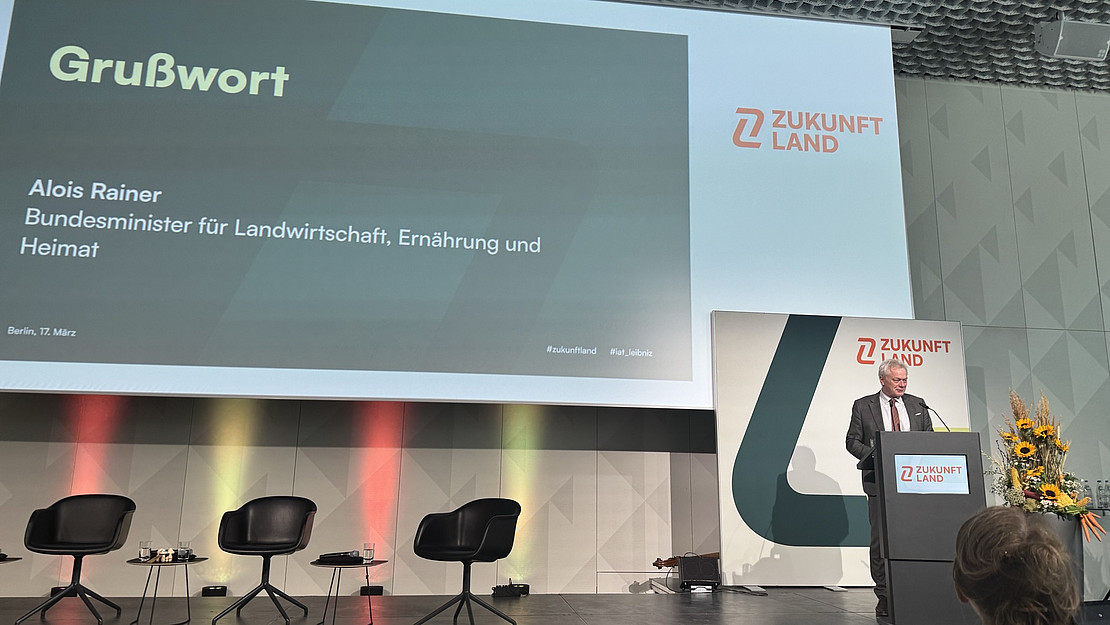 Image: University of Kassel.
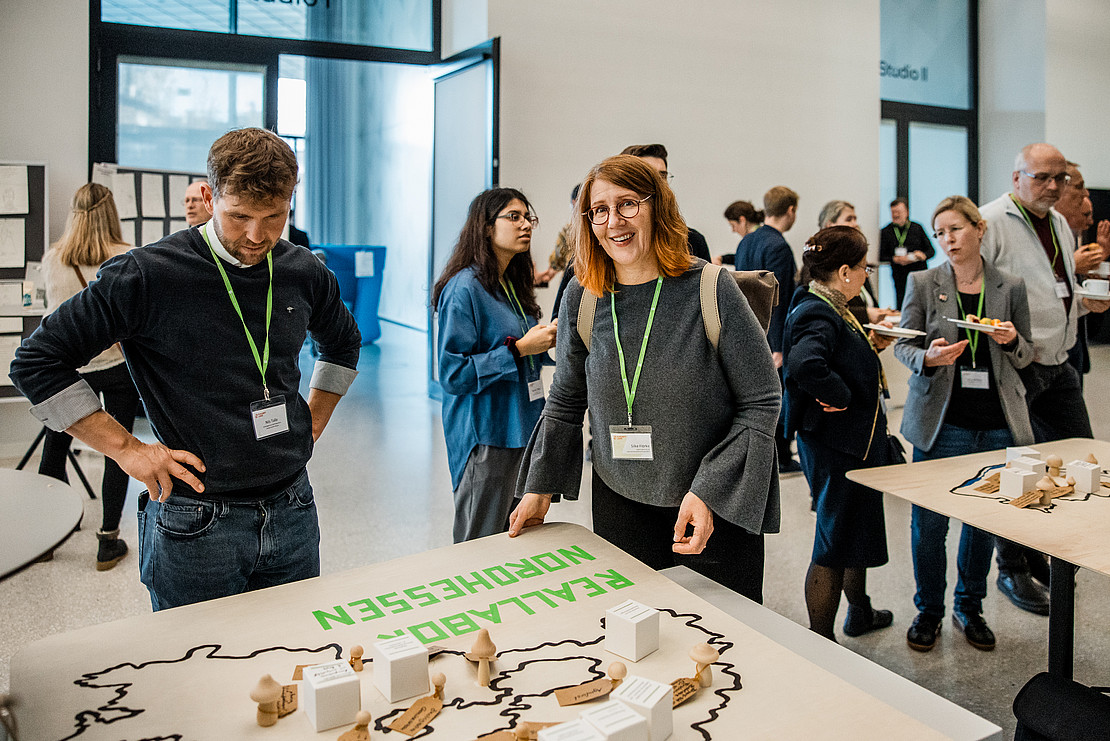 Image: ZALF
How can agriculture be competitive, environmentally friendly and climate-resilient and at the same time guarantee food security and food safety even in times of crisis? The Leibniz Center for Agricultural Landscape Research (ZALF), the University of Kassel, Justus Liebig University Giessen and Geisenheim University are breaking new ground with the Innovation Center for Agricultural System Transformation (IAT), which was officially opened today at the Futurium in Berlin. In five regions in Brandenburg and Hesse - the real-world laboratories - innovative solutions for key challenges in agriculture and food systems will be developed and tested under real conditions together with practitioners. Around 250 guests from politics, agriculture, science and society attended the ceremony.
The IAT does not view agriculture and the food industry in isolation through the eyes of individual disciplines or individual players, but rather at a regional landscape level in the interplay between production, processing, marketing and social expectations. Decisions in arable farming, grassland management, animal husbandry or energy production have an impact on entire regions - in ecological, economic and social terms. At the heart of the IAT are five real-world laboratories as permanent spaces for cooperation and experimentation. Here, research, agricultural businesses, local authorities, administration, business and civil society work together over many years to develop viable approaches.
Prof. Dr. Michael Wachendorf, Vice President of Research at the University of Kassel and himself an agricultural scientist, emphasized: "This is an exciting, relevant and extremely promising project which, thanks to its long-term funding, opens up the prospect of testing the knowledge gained beyond short cycles and putting it into practice. Above all, we are contributing our expertise in organic farming, but also our many years of experience in cooperating with partners from practice and society. We are very much looking forward to working closely with ZALF and two other universities in Hesse."
Three special professorships will be established for the project at the Faculty of Organic Agricultural Sciences at the University of Kassel. Special professorships primarily have a research assignment at an external institution (in this case ZALF), but also take on a certain teaching load at the university and supervise students there. They also have the right to award doctorates, which opens up additional research and career opportunities for young scientists.
The professorships have the denominations "Organic Vegetable Production", "Animal-based Mixed Crop Systems" and "Sustainable Entrepreneurship". Appointments are expected to be made in the coming months. The new professorships will develop the content of the planned real-world laboratory "North Hessian Solution Level". Together with partners from agricultural practice, politics and society, the aim is to find new production, processing and marketing solutions in North Hesse that are as sustainable as possible. "For the Faculty of Organic Agricultural Sciences, we see the potential here to finally promote the important topic of vegetable growing and the integration of animal and plant production in a much more visible way. Together with the Chair of Sustainable Entrepreneurship, an important contribution can be made here to the transformation to climate-adapted and sustainable agriculture," said the Dean of the Faculty, Prof. Dr. Maria Finckh.
The IAT will be realized with funds from the federal and state governments with an increase in ZALF's basic funding of 7.2 million euros in 2026 (9.5 million euros annually from 2027), based on a decision by the Joint Science Conference (GWK) on 22 November 2024.