
This page contains automatically translated content.
Digital training courses for economics teachers freely available
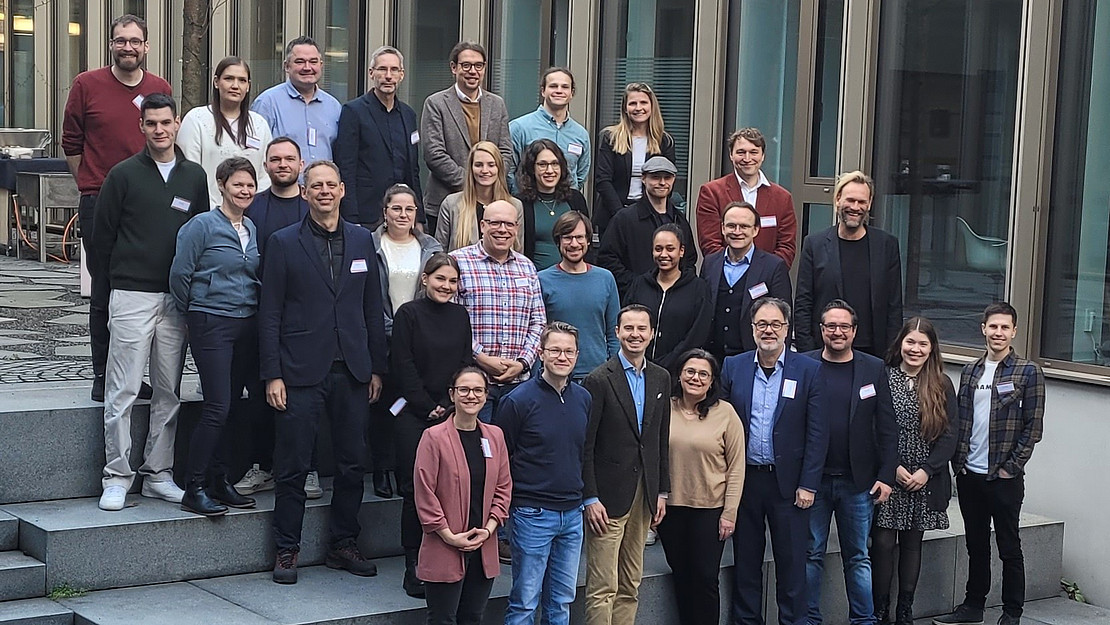 Image: University of Kassel.
The aim of the network was to systematically advance the digital transformation in business teacher training and to support teachers. In 14 sub-projects, the participating universities developed and tested digital learning environments and training modules that can be used both in teacher training and in teaching at general and vocational schools.
The offerings include:
Branching scenarios on the topic of late payment and goodwill decisions: As part of the training, teachers develop an authentic learning situation using software that is mapped interactively. Learners can navigate within this themselves and have to complete interactive tasks and make realistic decisions (University of Kassel).
LUCAOffice: This training course demonstrates the possibilities of using an office simulation for teaching business studies. In this office simulation, prospective business people have the opportunity to go through realistic commercial work scenarios and reflect on them (University of Mannheim).
Digital experiments in economics lessons: In this training course, teachers learn how to integrate digital economic experiments into their teaching units as a subject-specific method of experience-based learning (IÖB Oldenburg).
Explanatory videos on subsidies: Teachers receive further training that enables them to reflect on the use of explanatory videos in their lessons, supplement existing videos with additional elements and guide pupils in the creation of explanatory videos (Eberhard Karls University Tübingen).
KIWI-MOOC: An online self-study course has been made available for further training, which serves to promote the skills of (prospective) teachers in the field of "artificial intelligence" (AI). The course comprises seven modules covering various topics relating to the application of AI in the teaching profession (University of Leipzig & PH Schwäbisch Gmünd).
"The digital transformation in economic and business education can only succeed in close dialogue between science and practice," emphasizes Klusmeyer. "With WÖRLD, we have developed and disseminated innovative training formats that directly support teachers throughout Germany." The courses developed will remain available beyond the end of the joint project and thus form a basis for the further digitalization of business teacher training. In this way, the project network ensures the sustainable transfer of the developed offerings into educational practice.
The materials are now available free of charge as open educational resources via the ComPleTT, HubbS, WirLernenOnline and Zenodo platforms. All project information, including the recorded lecture series "Around the WÖRLD", is also available at @woerld_house | Linktree.
More information on the WÖRLD results: https://lernen.digital/wp-content/uploads/2025/12/Broschuere_Wirtschaft_2_Auflage.pdf
Contact:
Prof. Dr. Jens Klusmeyer
Institute for Vocational Education and Training
Subject area: Business education with
Focus on vocational teaching and learning
E-mail: klusmeyer[at]uni-kassel[dot]de