
This page contains automatically translated content.
Climate, Kassel, and the Social Question: On Climate Justice and Political Responsibility in the Global South and North
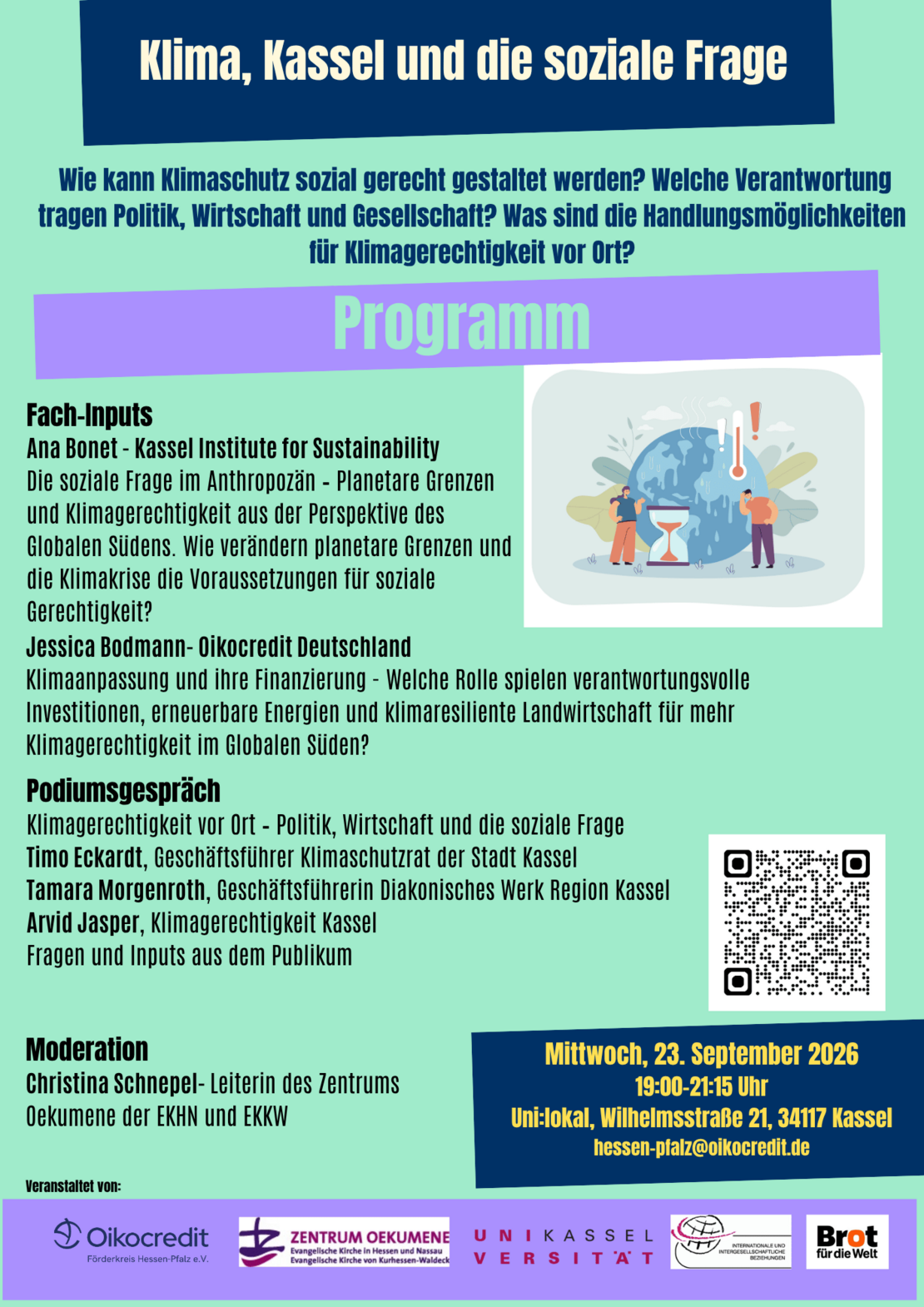
Climate change is dramatically altering our environment. Heat, drought, and extreme flooding are destroying the living conditions of people, animals, and plants worldwide. It is making access to essential resources—water, air, health, food, energy, and mobility—scarcer and more expensive. Climate change is making people—and our planet—sick.
These profound changes are not distributed evenly across the globe and affect people in very different ways. The Global South has contributed the least to climate change, yet people there suffer the most from its effects, while having hardly any resources for climate protection and adaptation.
This phenomenon can be observed worldwide. People with low incomes—who consequently have a low carbon footprint—will be most severely affected by the consequences of climate change. This is true in Germany as well. So what does climate justice mean for these people, whether in the Global South or the Global North—for example, in the city of Kassel?
What responsibility do politics, business, and society bear for the social dimensions of climate change? How can the costs of climate impacts be distributed equitably between the rich and the poor? What can the city of Kassel do—through its associations and organizations, its business community, and its educational institutions—to ensure a fair and equitable response to the consequences of climate change
Wednesday, September 23, 2026
7:00 p.m. – 9:15 p.m.
Uni:lokal
Wilhelmsstraße 21, 34117 Kassel
Organized by:
Oikocredit, Förderkreis Hessen-Pfalz e.V.
Universität Kassel, Fachgebiet Internationale und intergesellschaftliche Beziehungen
Zentrum Ökumene der EKHN und EKKW