
This page contains automatically translated content.
Climate, Kassel, and the Social Question: Climate Justice and Political Responsibility in the Global South and North
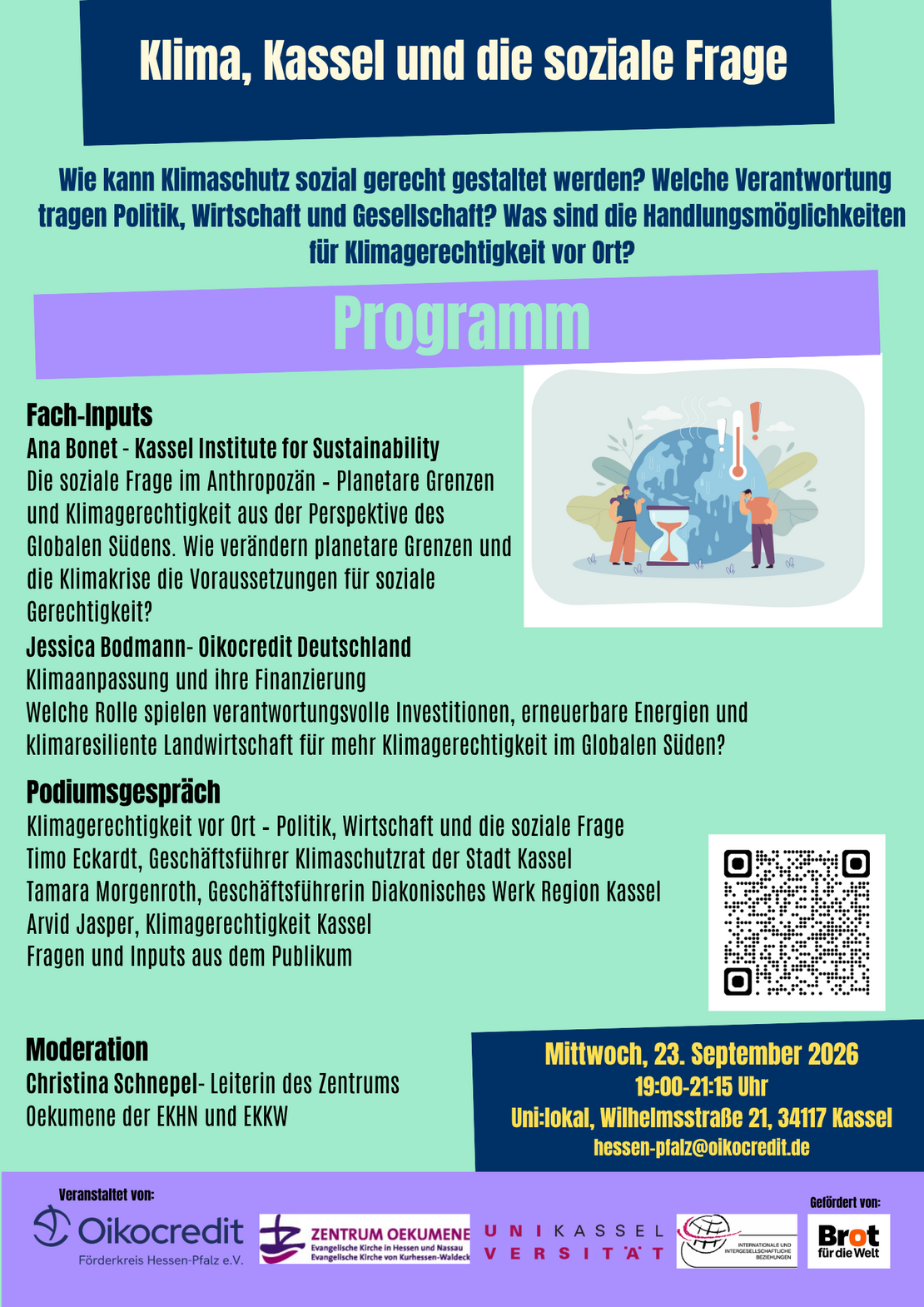
Climate change is dramatically altering our environment. Heat, drought, and extreme flooding are destroying the living conditions of people, animals, and plants worldwide. It is making access to essential resources—water, air, health, food, energy, and mobility—scarcer and more expensive. Climate change is making people—and our planet—sick.
These far-reaching changes are not distributed evenly across the globe and affect people in very different ways. The Global South has contributed the least to climate change, yet people there suffer the most from its effects, while having hardly any resources for climate protection and adaptation.
This phenomenon can be observed worldwide. People with low incomes—who consequently have a low carbon footprint—will be most severely affected by the consequences of climate change. This is true in Germany as well. So what does climate justice mean for these people, whether in the Global South or the Global North—for example, in the city of Kassel?
What responsibility do politics, business, and society bear for the social dimensions of climate change? How can the costs of climate impacts be distributed equitably between the rich and the poor? What can the city of Kassel do—through its organizations and associations, its business community, and its educational institutions—to ensure a fair and equitable response to the consequences of climate change?
Event:
1. Welcome
Organizer:
University of Kassel, Department of International and Intersocietal Relations
Ecumenical Center of the EKHN and EKKW
Oikocredit, Förderkreis Hessen-Pfalz e.V.
2. Moderation and Introduction
Christina Schnepel, Director of the Ecumenical Center of the EKHN and EKKW
3. Climate Impacts, Climate Adaptation, and Climate Justice.
The Socio-Ecological Transformation and the Social Question
Ana Bonet, Kassel Institute for Sustainability
The Social Question in the Anthropocene.
Planetary Boundaries and Climate Justice from the Perspective of the Global South
The ecological crisis is changing the conditions under which social justice can be achieved today. Against the backdrop of planetary boundaries, this paper examines the connections between the ecological footprint, global inequalities, and climate justice
Jessica Bodman, Oikocredit Germany
Climate Adaptation and Its Financing
Advocacy and the role of renewable energy and agricultural adaptation in the Global South. This article describes the current situation, explores possibilities, and provides examples of responsible investments to promote greater climate justice in the Global South.
4. Climate Justice on the Ground
Politics, the Economy, and Social Issues
Panel Discussion
Timo Eckardt, Executive Director of the Climate Protection Council of the City of Kassel
Tamara Morgenroth, Executive Director of the Diakonisches Werk Kassel Region
Arvid Jasper, Climate Justice Kassel
What are the consequences of the climate crisis in the Global North?
What does climate justice specifically mean in the Global North?
How are people here also suffering from climate change?
How should policymakers support, mitigate, and finance the socio-ecological transformation and its consequences for urban society?
Questions from the audience
Following the event: Wrap-up in the lobby of uni:lokal