
This page contains automatically translated content.
Physicist from Kassel Honored with Argentine RAÍCES Prize
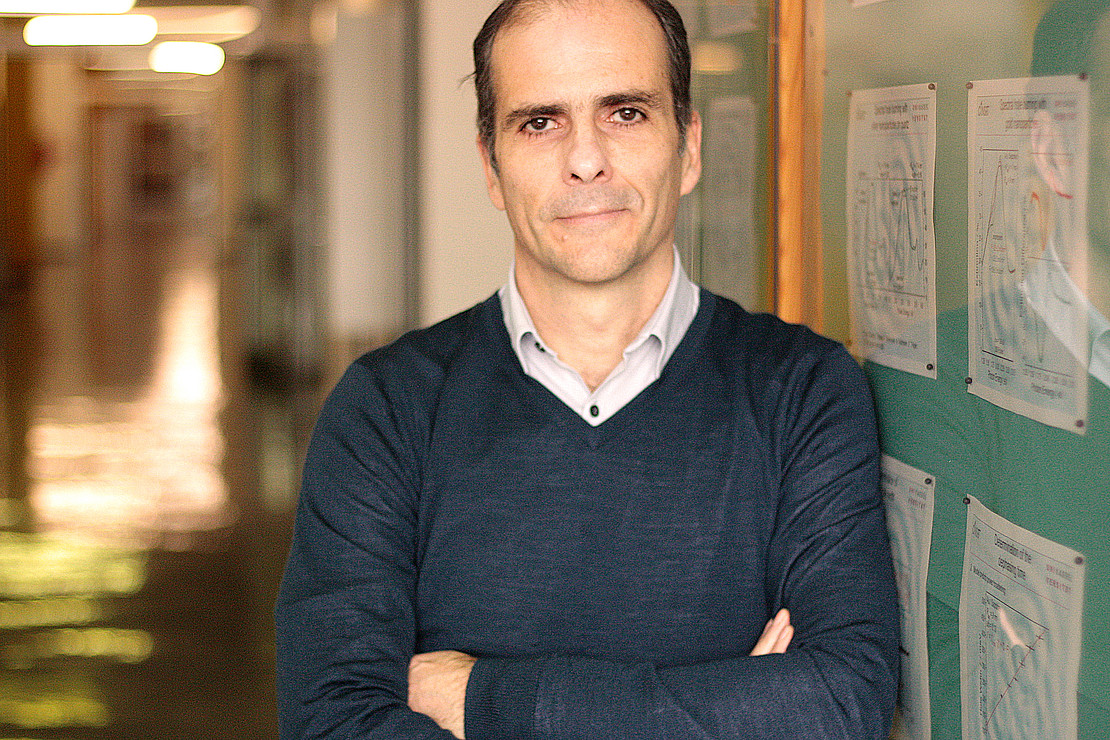 Image: University of Kassel.
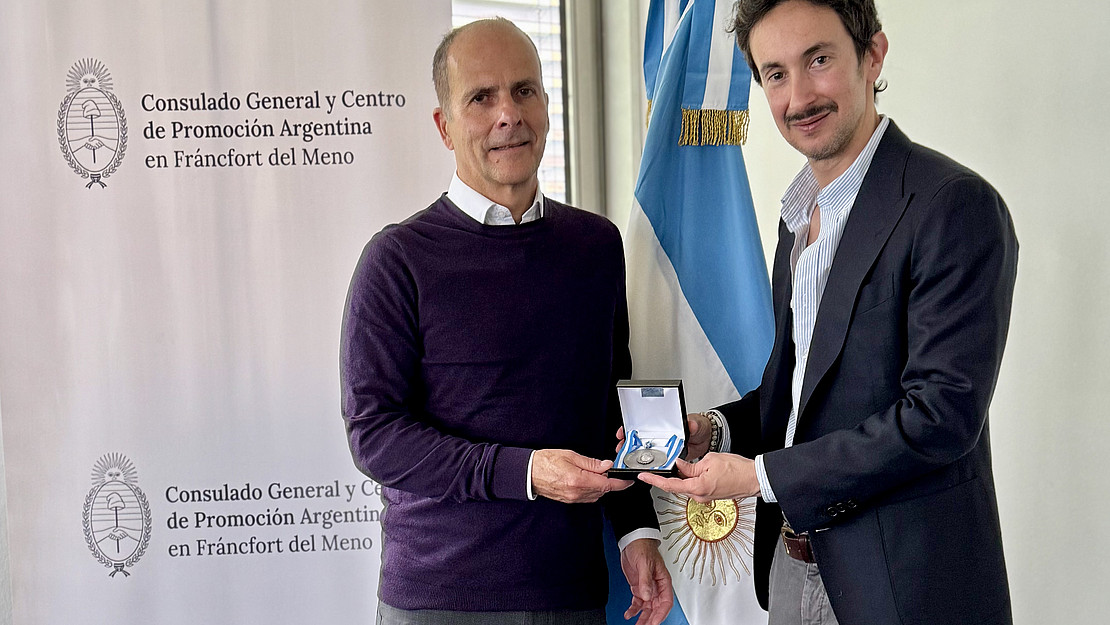 Image: Garcia.
The RAÍCES Prize is awarded by the Argentine government to Argentine scientists living abroad who have made an exceptional contribution to strengthening Argentina’s science and technology system. Prof. Garcia received the award in the field of natural sciences.
The official citation highlights Prof. Garcia’s international scientific work, his support for young researchers from Germany and Argentina, and his commitment to fostering collaboration between the University of Kassel and several Argentine universities. Prof. Garcia has been dedicated to scientific cooperation between Germany and Argentina for many years. Together with other faculty members from Kassel University, including President Prof. Dr. Ute Clement, he was involved in establishing university partnerships and signing corresponding cooperation agreements in Argentina. He played a key role in initiating and establishing the partnership with the Universidad Nacional de La Plata (UNLP). Among other things, these collaborations have facilitated student and faculty exchanges.
Prof. Garcia continues his commitment to supporting young researchers from Argentina to this day. On June 10, 2026, Argentine physicist Mauro Ariel Forlino completed his doctoral degree in Prof. Garcia’s research group as part of the Graduate College “Multiscale Clocks,” earning an overall grade of summa cum laude. His dissertation, “Biological timekeeping beyond the cell nucleus: multiscale modeling of ion-channel dynamics, oscillations, and synchronization,” focuses on theoretical models of biological timekeeping. Since July, Dr. Natalia Lavalle from the Universidad Nacional de La Plata has also been conducting research in Garcia’s research group in the field of theoretical biophysics.
“For me, the RAÍCES Prize is not only a personal honor but, above all, a confirmation that a country’s connection to its scientists endures even across great distances,” says Prof. Garcia. “Many of us who work abroad maintain contact with the Argentine scientific community through joint projects, professional training for young researchers, and the development of scientific networks. I am particularly pleased that this collaboration between Kassel and Argentina remains very vibrant today.”