
EFI expert Bünstorf: Better exploitation of universities' transfer potential
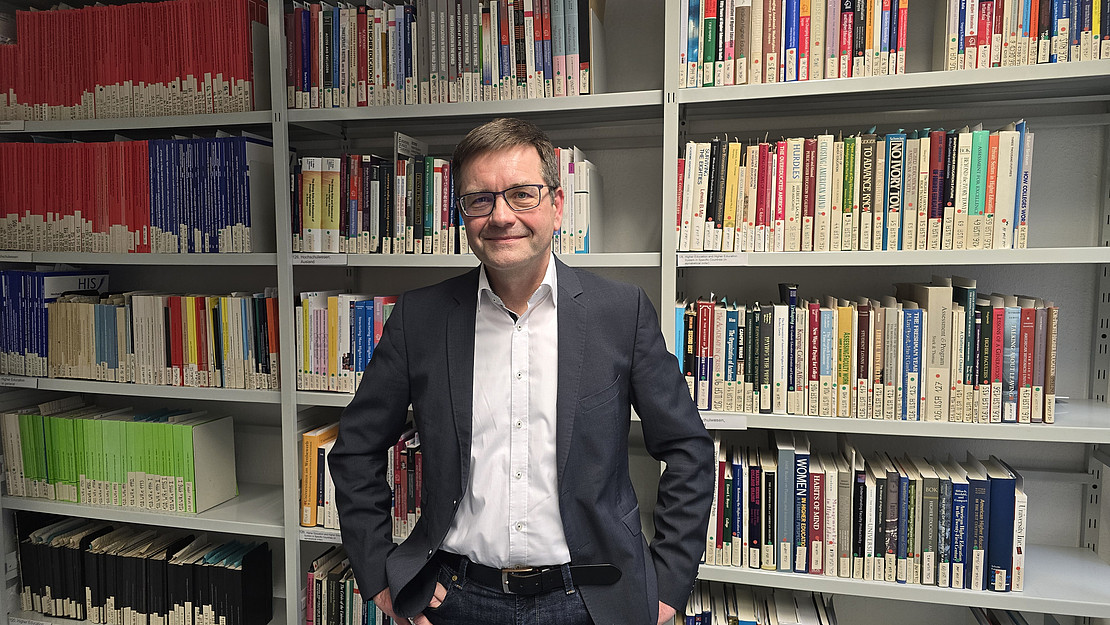 Image: University of Kassel.
Transferring scientific findings into application is a key success factor for Germany's innovative strength. In its current annual report, the Commission of Experts for Research and Innovation (EFI) calls for targeted reforms to strengthen the transfer of knowledge and technology as a core task of universities. "Universities with a strong research base occupy a leading position both in terms of patent applications and scientific publications cited in patents," states Prof. Dr. Guido Bünstorf, member of the EFI and professor at the University of Kassel. The report was presented to the German government in Berlin today (February 11).
Bünstorf emphasizes: "Especially in application-oriented basic research, scientific excellence often goes hand in hand with concrete application potential. Many technological breakthroughs - from lasers to mRNA vaccines - have emerged from this type of research." However, the potential is often not exploited consistently enough. Structural obstacles such as lengthy intellectual property negotiations and a lack of incentives slow down transfer activities.
The analyses in this year's report are not only focused on Germany, but also include the European research and innovation system. For example, the Expert Commission calls for the conditions for leap innovations in the EU to be optimized and for the European Innovation Council (EIC) to be given more room for manoeuvre in future. It also calls for the excellence and independence of the European Research Council (ERC) to be safeguarded.
"The success of the ERC is largely based on its independence from political, regional or thematic guidelines as well as on transparent and quality-assured selection procedures," explains EFI member Bünstorf. "However, international developments - for example in the USA - are a painful reminder of how fragile the freedom of research and research funding is." The ERC is also a potential gateway for political influence. "In order to secure the scientific excellence and independence of the ERC in the long term, we recommend giving it an independent status - comparable to that of the European Investment Bank - and providing it with a stable long-term budget," says Bünstorf.
The EFI also supports the introduction of a uniform, EU-wide legal form for companies (so-called 28th regime) in order to help start-ups scale their business models across Europe. However, it is important that a 28th regime is geared towards the needs of start-ups and dispenses with complicated access criteria that lead to additional bureaucratic burdens.
The Commission of Experts for Research and Innovation (EFI) provides scientific policy advice to the German government and submits an annual report on research, innovation and Germany's technological performance. The main task of the EFI is to analyze the strengths and weaknesses of the German innovation system in an international and chronological comparison and to evaluate the prospects of Germany as a location for research and innovation. On this basis, the EFI develops proposals for national research and innovation policy.
Among other topics, the 2026 report focuses on competition and innovation in the German higher education system as well as European research and innovation policy and the so-called 28th regime for the European single market. Dr. Guido Bünstorf holds a professorship for Economic Policy, Innovation and Entrepreneurship at the University of Kassel. He is also spokesperson for the International Center for Higher Education Research.
Contact:
Prof. Dr. Guido Bünstorf
University of Kassel
Department of Economic Policy, Innovation and Entrepreneurship
Tel.: +49 561 804-7403
Mail: buenstorf[at]uni-kassel[dot]de
Dr. Helge Dauchert
Commission of Experts for Research and Innovation (EFI)
Head of Office Pariser Platz 6 | 10117 Berlin
Tel: +49 30 322 982-562
Mail: helge.dauchert[at]e-fi[dot]de