
How do city travelers explore their vacation destination?
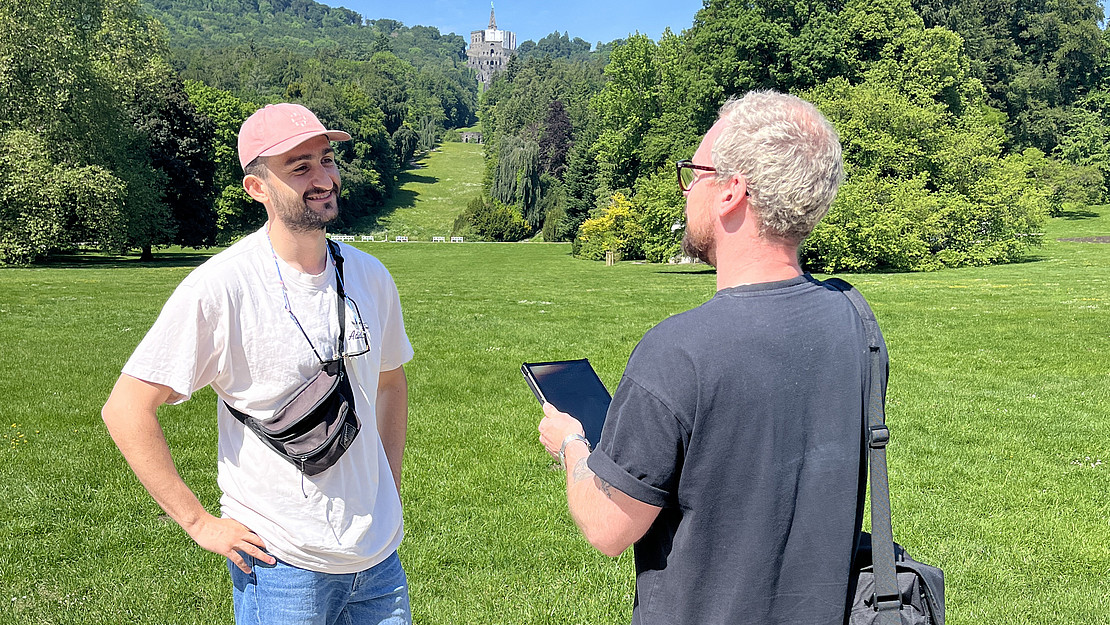 Image: University of Kassel.
Anyone visiting Bergpark Wilhelmshöhe or Karlsaue in Kassel in the coming weeks may be approached by interviewers from the University of Kassel to participate in a survey. This is part of a large-scale study designed to gather insights into the mobility patterns of visitors at the destination through interviews and a specially developed smartphone app.
The survey has been conducted at various major tourist destinations in the city since May and will continue through the end of August. For the first time, the mobility patterns of city travelers will be tracked using a tracking app. The app automatically logs the activities and routes of participating visitors, identifies the modes of transportation used, and classifies types of activities. This will make it possible to track the movement and activity patterns of visitors much more precisely in the future.
The survey is intended to provide, for the first time, a comprehensive and reliable dataset on the mobility of city travelers, as such basic data has been largely lacking until now. This is problematic from a transportation planning perspective: According to the 2025 Travel Analysis, the number of day trips and short vacations in Germany reached a new high in 2024. Vacationers and day-trippers account for a significant share of traffic demand not only in traditional tourist destinations; cities such as Kassel also feel the impact of tourism-related traffic quite distinctly. This traffic contributes significantly toCO2 emissions and other pollutants. However, without a sufficient database, tourist traffic cannot be satisfactorily modeled in the practice of transportation planning, which is why the effects of measures on the behavior of city travelers cannot be precisely predicted.
Models developed as part of a previous project are to be further refined using the collected data in order to map tourist mobility behavior even more precisely. “The goal is to be able to assess the effects of traffic management measures before they are implemented. This applies above all to plans for managing tourist traffic, which have so far been possible only to a limited extent due to a lack of knowledge about tourist mobility behavior,” says Prof. Dr.-Ing. Carsten Sommer, emphasizing the relevance of the research. The three-year research project will run through August 2028 and is funded by the DFG with a total of 490,000 euros.
Contact:
Luka Jurišić, M.Eng.
University of Kassel
Department of Transportation Planning and Transportation Systems
Tel.: +49(0)561/804-3631
Email: luka.jurisic[at]uni-kassel[dot]de