
"Kasseler WELLE": Column Two Features a Frog and a Seahorse
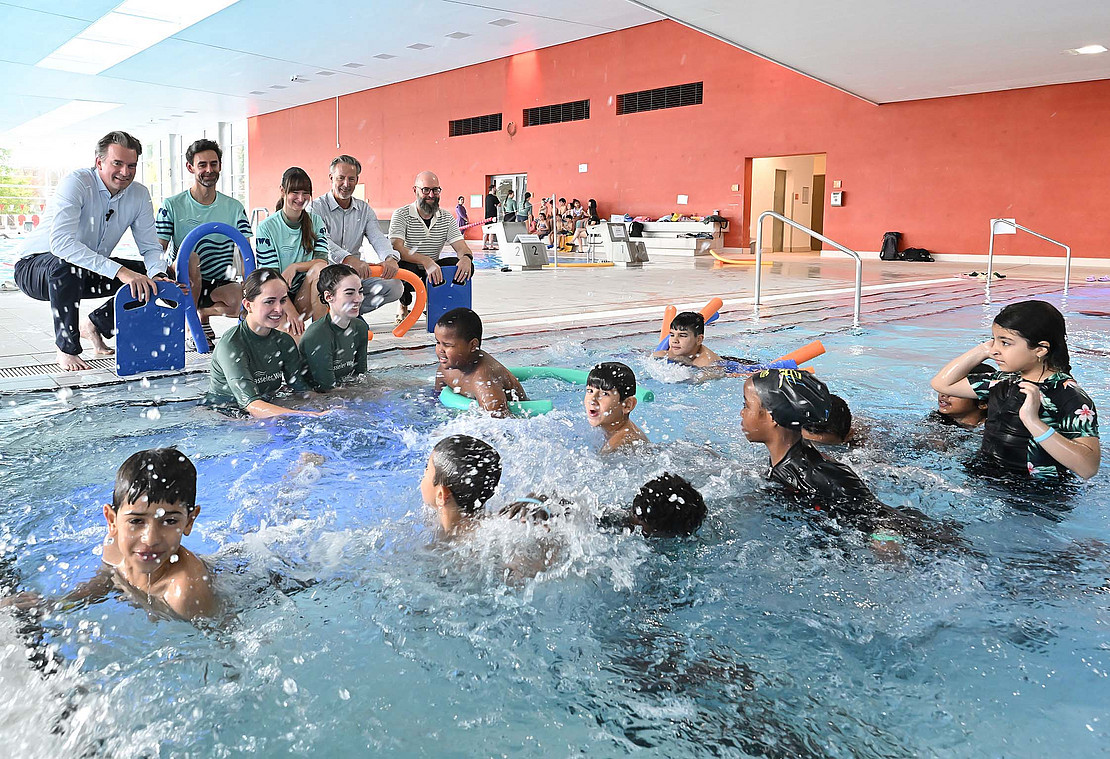 Image: City of Kassel, Harry Soremski
“The ability to swim should not be a privilege. It contributes to good health and, in an emergency, can save lives. Knowing how to swim means more than just staying afloat for a few meters. It’s about safety, self-confidence, and inclusion,” say Mayor Dr. Sven Schoeller and Deputy Mayor Nicole Maisch with conviction. “With the second pillar of the ‘Kasseler WELLE,’ we’re bridging the gap between basic water skills and advanced swimming instruction. This is exactly how we’re on the right track to achieving our goal: Every child in Kassel should be able to swim.”
What exactly is the “Kasseler WELLE”?
Experiencing water—but safely! That is precisely the goal of the “Kasseler WELLE” project. Launching in the summer of 2026, this visionary initiative will not only teach students basic swimming skills but also establish a groundbreaking model for inclusive sports and preventive health promotion.
In the first phase, the program was initially aimed at all second-graders in Kassel. Over the course of one week each, 1,400 children learned swimming and water skills free of charge from more than 50 trained physical education students from the University of Kassel. The children were systematically observed and assessed at their respective skill levels, for example in the areas of water acclimatization, water awareness, mobility, and safety in the water. This allowed for the selection of water exercises tailored to each child based on sports science findings, enabling the students’ instruction to be optimally adapted to the learners’ needs. Thus, the “Kasseler WELLE” is a preventive program that is currently unique in the German-speaking world. By 2030, the first pillar of the “Kasseler WELLE” aims to reach up to 2,000 children per grade level in Kassel.
The project is being implemented through close cooperation between the City of Kassel’s Office of Child Day Care, the Office of Schools and Education, and the Sports Office; the University of Kassel; the municipal utilities; the State School Authority; and Kassel’s elementary schools, after-school care centers, and independent providers.
How It All Began
The “Kasseler WELLE” emerged as a further development of the after-school swimming program run by the City of Kassel and the University of Kassel. Since 2022—following an initiative by the Rotary Club of Kassel—approximately 1,000 children have been offered a free two-week swimming course, during which they typically take the “Seepferdchen” swimming test. Effective immediately, after-school swimming forms the “Kasseler WELLE” as the second pillar of the project.
What is the difference between after-school swimming and Pillar 2 of “Kasseler WELLE”?
What’s new is that insights from the first phase of the project are being used to support the children in ways tailored to their abilities. The goal is to reinforce and further develop the basics of swimming and to support the children’s progress toward safe swimming and earning swimming badges.
“We use the insights from the first pillar to meet each child where they are,” explains Dr. Sebastian Fischer from the Institute for Sport and Sports Science at the University of Kassel. “This allows us to provide targeted support and give the children exactly the help they need for their next step in swimming. The activities are neither too challenging nor too easy.”
Preparation for the Bronze/Freischwimmer Certificate Now Possible
for the First Time Another new feature is that, as part of the second pillar, more advanced swimmers now have the opportunity for the first time to work specifically toward the requirements of the German Bronze Swimming Certificate, known as the “Freischwimmer.” This expands the program’s scope upward: Children who are already more confident in the water can further develop their skills and work toward a recognized level of proficiency.
The focus includes, among other things, swimming longer distances, safe behavior in deep water, diving, jumping, and basic knowledge of swimming rules and self-rescue. The goal is not only to enable movement in the water but also to build genuine safety.
Scientific Basis: “Kasseler WELLE” and ALFAC
The further development of the program is based on scientific findings from the European research project “Aquatic Literacy for All Children” as well as on experience gained from previous swimming courses in Kassel. The studies show that children come from very different backgrounds: Some first need to get used to the water and overcome their fears, while others can already glide, dive, or swim short distances. At the same time, many children underestimate the risks in the water.
“The ‘Kasseler WELLE’ has a clear goal: No elementary school child in Kassel should leave school without being able to swim safely. The second pillar is a central component of this initiative: It helps support children according to their individual abilities and guides them step by step on their path to safe swimming,” says Mayor Sven Dr. Schoeller.
The university and the city’s Office for Schools and Education are currently developing Pillar 3, “Kasseler WELLE – Everyone Swims Along,” for the year 2027. This pillar explicitly targets children with disabilities—whether physical or intellectual. Children with disabilities can also participate in Pillar 1, the water acclimatization component. However, during the swimming lessons themselves, individual strengths and needs must be taken into account in an even more nuanced way, so that a tailored program can be provided. Pillar 1 of the “Kasseler WELLE” program for all second-graders will
also resume in 2027 after the summer break.