
Work in the Past: What the Hand Axe Tells Us About Workplace Safety
How ergonomic is a hammer? Anyone who asks this question on a construction site rarely gets reliable data. Even today, risk assessments in the skilled trades are mostly based on the subjective judgments of supervisors or on surveys of employees conducted after the fact. Until now, it has not been possible to precisely measure the physical forces that actually act on tendons and wrists during a strike. Dr. Johannes Pfleging from the Department of Work and Organizational Psychology at the University of Kassel is now presenting a measurement setup designed to replace this habitual gut feeling with hard data. Ironically, he draws on prehistory as his starting point.
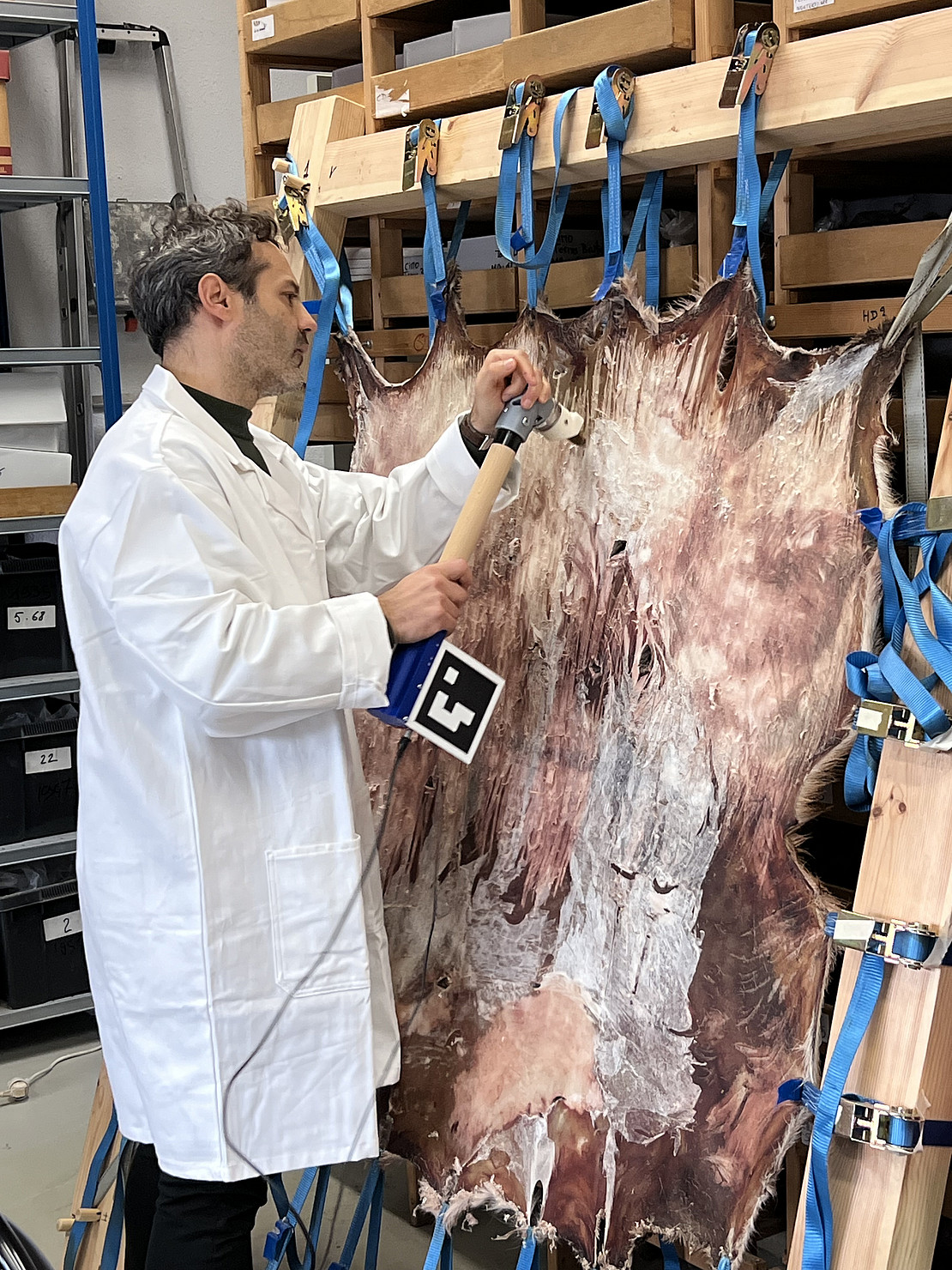 Image: Dr. Sylvie Beyries
Film Technology in the Stone Age Lab
The idea behind this has a long history. As early as 2015, while working on his doctoral dissertation at ETH Zurich, Pfleging was already studying trace analysis. This archaeological method involves examining notches and wear patterns on prehistoric tools to reconstruct their exact function. Together with an international consortium, Pfleging turned this approach on its head. The researchers had test subjects handle replicas of Stone Age tools in the lab, for example, while simulating spear thrusts. The technical core of the setup consists of a combination of camera systems, motion sensors, and a force and torque transducer. This sensor fusion simultaneously captures movements and applied forces in high resolution within three-dimensional space. This allows signs of use on tools to be directly linked to specific movement sequences and force requirements. “Until now, archaeology has mostly focused on determining how old a find is,” explains Pfleging. “We’re interested in the precise kinematics behind it: How exactly is the tool guided, what forces act on the body, and where do improper loads occur? This provides us with direct insights for the design of modern work tools.”
From the Spear Thrust to the Forestry Operation
What sounds primarily like basic research for history books actually has direct practical applications for the present. In Kassel, Pfleging, together with Prof. Oliver Sträter—head of the department and an expert in ergonomic measurements—developed a derived concept that demonstrates how the measurement setup can be directly integrated into tools in the future. This enables the precise analysis of activities in skilled trades, horticulture, landscape maintenance, and forestry.
The researchers distinguish technically between different categories: from free movements with minimal contact force to hand-held power tools with vibrations—such as drills—and impact tools with hard impacts. To ensure reliable data, people of very different builds—from small and slender to tall and sturdy—conduct tests in the laboratory. After all, what works ergonomically for the statistical average person can quickly lead to improper strain when body measurements differ.
Research That Makes a Difference on the Construction Site
For this integration of anthropology and ergonomics, Pfleging accepted the second project award of the prestigious Hans Martin Prize 2025 on behalf of the international consortium. Over the next six months, a comprehensive research proposal will be submitted with the aim of implementing the method on a broad scale in practice. It remains to be seen whether the data from Kassel will ultimately lead to the redesign of tools in hardware stores. However, Pfleging also sees this approach as a matter of academic integrity: “We receive taxpayer funds, including from people who do physical labor every day. Research is often perceived as isolated because workers feel it doesn’t affect their daily lives. If our data helps make work tools less physically taxing, we are providing a concrete benefit to society.” Should the data from Kassel actually make the hammer on construction sites easier on the joints in the future, the hand axe will once again serve a new purpose after millennia.
This article appeared in the fall issue of the university magazine “publik” (2026/3) in October 2026. Text: Bastian Puchmüller