
How is the course structured?
This page contains automatically translated content.
The Bachelor's degree course in Psychology is modularized and consists of 22 modules (including Module 20 Supplementary Subject and Module 21 Career-Oriented Internship). The courses are based on the fundamentals and fields of application of psychology.
After an introduction to the systematics and methods of psychology and the basic subjects, an overview of the fields of application of psychology is provided. In-depth modules are included in the further course of study, as well as the Bachelor's thesis at the end of the program. From the 5th semester onwards, a career-oriented internship is planned to provide an insight into practical activities.
Sample study plans
Study plan for the career goal of psychotherapist
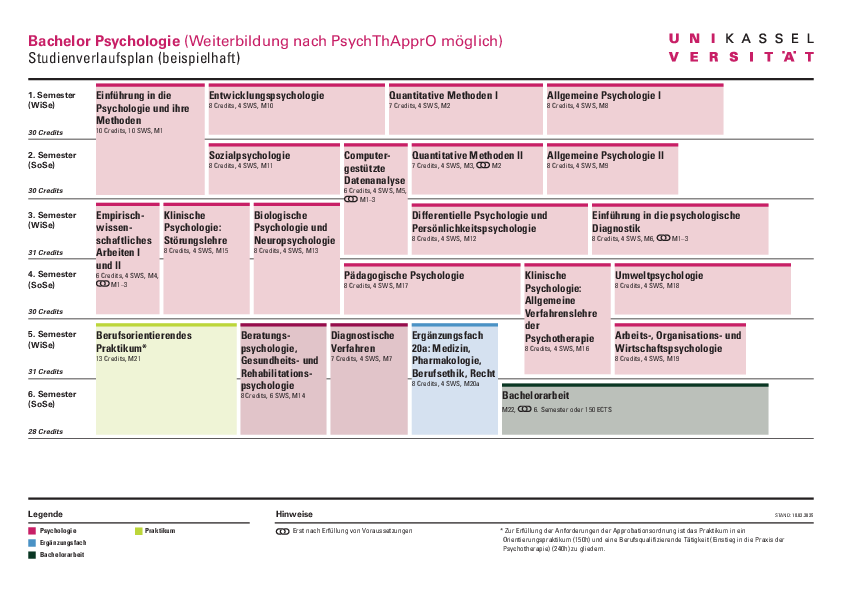
Download
Study plan for other career goals

Download
Each of the 22 modules is associated with a certain amount ofwork (workload). 1 credit corresponds to a workload of approx. 30 hours. The entire Bachelor's program comprises 180 credits.
Active participation in the courses as (ungraded) coursework is just as relevant for passing the module as the (graded) examinations. Examinations usually take the form of written examinations, term papers or oral examinations. Ungraded coursework includes, for example Preparation of minutes, presentations, seminar presentations.
Further information
Here you will find the current course offerings for the 26/27 winter semester.
The credits earned there must be certified by the respective instructor (form) and submitted to the Examinations Office (IfP, Ms. Braun).
Please note the information regarding this module in the examination regulations/module handbook. In most degree programs, you must attend two courses (see module descriptions). In one of the two courses, you must complete a course assignment; in the other, a graded examination. The examination grade determines the final module grade. Check the module description to see which course formats are permitted. In some other degree programs, it is sometimes common for graded assessments to be completed in seminars as well; please check with the respective instructors in advance regarding the specific requirements.
Please note: If you are pursuing the clinical master’s degree leading to a medical license, you are required to take Module 20a, “Medicine, Pharmacology, Professional Ethics, and Professional Law”!
For courses in the fields of sports science or sociology, please contact the program coordinator, as there are enrollment limits for these courses.
Please note that coursework completed in other departments is credited toward the Psychology program at a rate of 8 credits, even if the actual number of credits earned is higher.
You can find information about the internship here
Information on registration and the procedure can be found here.
| Module no. | Module name | Person responsible for module | |
|---|---|---|---|
| 1 | Introduction to psychology and its methods | Ralf Rummer | |
| 2 | Quantitative Methods I | Florian Scharf | |
| 3 | Quantitative Methods II | Florian Scharf | |
| 4 | Empirical-scientific work | Ralf Rummer | |
| 5 | Computer-aided data analysis | Johannes Zimmermann | |
| 6 | Introduction to psychological diagnostics | Ulrich Schroeders | |
| 7 | Diagnostic procedures | Ulrich Schroeders | |
| 8 | General Psychology I | Ralf Rummer | |
| 9 | General Psychology II | Ralf Rummer | |
| 10 | Developmental Psychology | Mirjam Ebersbach | |
| 11 | Social Psychology | most recently Sven Kachel; vacant as of April 26 | |
| 12 | Differential Psychology and Personality Psychology | Johannes Zimmermann | |
| 13 | Biological Psychology and Neuropsychology | Sarah Glim | |
| 14 | Counseling Psychology, Health and Rehabilitation Psychology | most recently Friederike Winter; vacant as of April 26 | |
| 15 | Clinical Psychology - Disorders | most recently Miriam Henkel; vacant as of April 26 | |
| 16 | Clinical Psychology - General Procedures | most recently Miriam Henkel; vacant as of April 26 | |
| 17 | Educational Psychology | Martin Hänze | |
| 18 | Environmental Psychology | most recently Andreas Ernst; vacant as of April 26 | |
| 19 | Industrial, Organizational and Business Psychology | Oliver Sträter, Sandra Ohly | |
| 20 | Supplementary subject | ||
| a | Medicine, pharmacology, professional ethics, professional law | most recently Friederike Winter; vacant as of April 26 | |
| b | Sociology | Kerstin Jürgens | |
| c | Political Science | Sabine Ruß-Satter | |
| d | Philosophy | Dirk Stederoth | |
| e | Biology | Langer, Weising, Gutekunst | |
| f | Economics | Peter Eberl, Jan Marco Leimeister | |
| g | Arts and Humanities | Kai-Uwe Hemken, Martina Sitt | |
| h | Human-machine systems | Ludger Schmidt | |
| i | Cognitive Sciences Linguistics | Holden Härtl | |
| j | Sports Sciences | Norbert Hagemann, Armin Kibele | |
| k | Musicology | Jan Hemming | |
| 21 | Career-oriented internship | Martin Seip | |
| 22 | Bachelor thesis | Supervisor |