
Psychology (Bachelor)
This page contains automatically translated content.
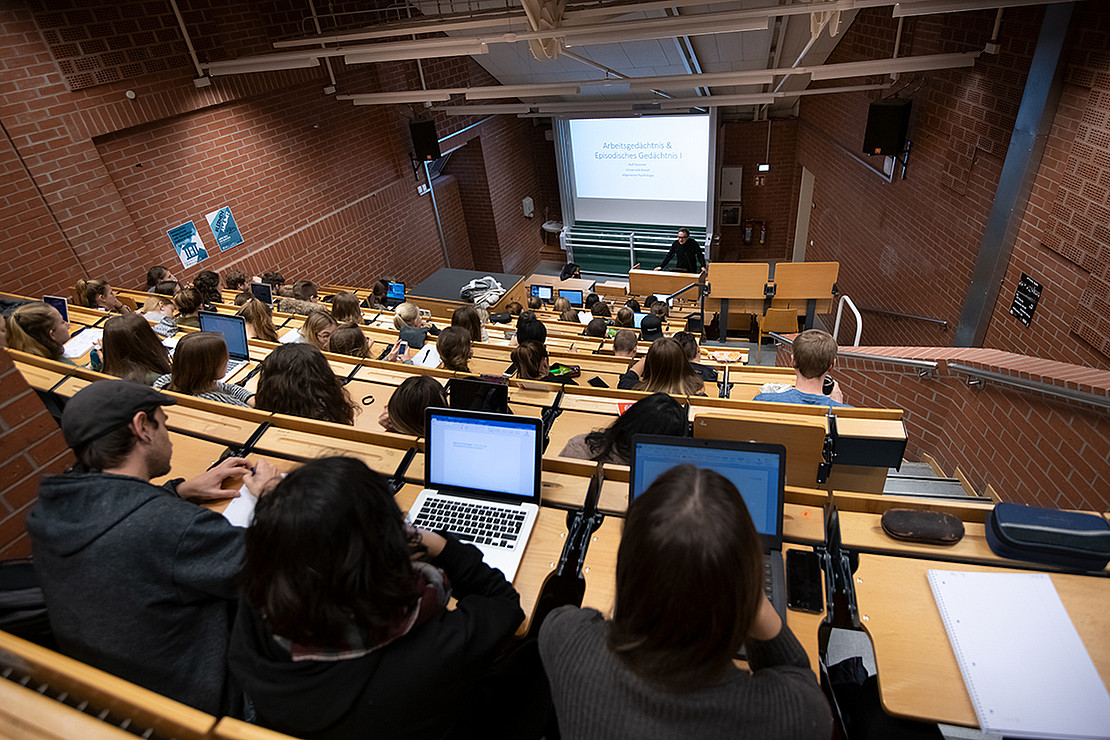 Image: Paavo Blafield
Why do people act the way they do? How do emotions, decisions, and relationships arise—and how do mental disorders develop? To what extent do genes and the environment determine who we are? In the Bachelor’s program in Psychology, you’ll explore these questions from a scientific perspective: You’ll learn to understand human experience and behavior, plan your own studies, analyze data, and critically evaluate results.
At a Glance
About the Program
Psychology Is More Than Just Therapy and Counseling
When people think of psychology, many first think of psychotherapy. But the field is much broader: it examines how people perceive, learn, feel, make decisions, develop, and interact with one another—in everyday life, at school and work, within organizations, and in their interactions with the environment. The bachelor’s program introduces you to this entire spectrum.
What You’ll Study
The first semesters focus on the fundamentals, addressing questions such as these:
- How do perception, attention, memory, and thinking work? Why do we forget—and why are we deceived? (General Psychology)
- What motivates us, how do emotions arise, and how do we understand and produce language? (General Psychology)
- How do people change from conception through old age? (Developmental Psychology)
- Why are people so different—and how can personality or intelligence even be measured? (Differential Psychology and Diagnostics)
- How do other people, groups, and social situations influence us? (Social Psychology)
- What happens in the brain and body during these processes? (Biological Psychology and Neuropsychology)
Building on this, you’ll explore the fields of application: How do mental disorders arise, and how are they treated (Clinical Psychology and Psychotherapy)? How do children and adults learn effectively (Educational Psychology)? How do counseling, prevention, and rehabilitation work? Why do people often fail to act as environmentally friendly as they actually intend to (Environmental Psychology)? And how do you select personnel, lead teams, and organize work (Work, Organizational, and Business Psychology)?
What you’ll actually do—and why methods are part of it
Psychology is an empirical science. A personal experience, a convincing-sounding explanation, or a widely held opinion does not constitute knowledge. That’s why, during your studies, you’ll learn not only what is known about people, but also how we know it and how to discover it for yourself. This isn’t just a side note—it’s at the heart of the discipline—and it takes up more space than many initially expect.
Specifically, for example, you’ll
- plan and conduct experiments, surveys, and observational studies yourself—first as a participant in studies, and starting in the third semester, in your own research project in small groups;
- analyze data using statistical software such as R or jamovi and present results graphically;
- assess whether a finding is reliable or could have arisen by chance, due to bias, or through other explanations;
- become familiar with psychological tests and questionnaires and apply them yourself—and learn how to determine whether a test actually measures what it claims to measure;
- Conduct interviews and diagnostic conversations and evaluate them systematically;
- Read scientific articles (mostly in English), critically evaluate them, and present your own findings clearly.
This program is a good fit for you if you’re interested in people and also enjoy testing claims against data. A passion for precise thinking and a curiosity about numbers are helpful. You don’t need any special prior knowledge beyond the standard high school curriculum.
The Bachelor’s program in psychology is structured largely the same way throughout Germany—in part because it must meet the legal requirements for a career in psychotherapy. The fundamentals you’ll learn in Kassel are taught at every university. However, you’ll find a few unique offerings here:
- Environmental psychology as a required module. Kassel is one of the few universities in Germany where environmental psychology is a distinct applied field within the Bachelor’s program. It addresses questions such as: How do people make decisions related to the environment? Why is there so often a gap between environmental awareness and behavior? And how can psychological insights be used to promote sustainable behavior?
- Counseling, Prevention, and Rehabilitation as a separate module. With its own professorship, this field of application carries more weight in Kassel than it does at most other universities. You’ll learn about prevention and rehabilitation programs and conduct training sessions yourself under supervision.
- Clinical psychology from more than one perspective. In Kassel, research and teaching are grounded in behavioral therapy, systems theory, depth psychology, and psychoanalysis. The behavioral therapy and depth psychology/analytical approaches are each represented by their own professorship. This means you’ll learn about scientifically recognized psychotherapy methods not just from a single perspective, but from experts in each respective therapeutic approach.
- One elective subject of your choice. Eleven subjects from across the entire university are available—ranging from philosophy to human-machine systems to musicology.
First, an honest answer: A bachelor’s degree alone does not qualify you for any established career path in psychology. To work independently as a psychologist—to diagnose, counsel, conduct research, or provide treatment—you must have a master’s degree in Germany. That’s why almost all graduates go on to pursue a master’s degree. The bachelor’s degree provides the academic foundation for this and helps you figure out which direction is right for you.
You can find detailed information about which master’s programs are available to you after your bachelor’s degree and what requirements you must meet to pursue a career in psychotherapy on our page about career prospects.
The German Psychological Society provides an overview of career fields in psychology: www.dgps.de/psychologie-studieren/berufsfelder/
The Professional Internship
The program includes a ten-week full-time internship, typically during the fifth semester. It can be divided into segments of at least four weeks. You choose the professional field yourself—such as hospitals, counseling centers, school psychology, human resources departments, research institutes, or market research—and will be supervised there by a psychologist. For many students, the internship is the moment when it becomes clear which master’s program is the right fit.
Studying Abroad
A semester abroad is possible, for example through Erasmus+ at one of our partner universities, and the department will support you in planning it. To be honest, however, in the Bachelor’s program in Psychology, often only a portion of the coursework completed abroad can be credited because the program is intensive and highly standardized—and almost none at all if you’re pursuing a career in psychotherapy. Realistically, you should therefore expect to add an extra semester. Many still find it worthwhile.
The Bachelor’s degree in Psychology (B.Sc.) typically lasts six semesters and comprises 180 credits. The program begins each winter semester. It consists of required modules, a required elective module (supplementary subject), a professional internship, and the bachelor’s thesis.
1st and 2nd Semesters: Introduction and Fundamentals
In the module “Introduction to Psychology and Its Methods,” you’ll learn about the field, its history, and areas of application, as well as scientific research methods—and you’ll participate in studies as a test subject yourself. At the same time, you’ll begin “Quantitative Methods I and II” and “Computer-Assisted Data Analysis,” as well as the first foundational modules: General Psychology I and II, Developmental Psychology, and Social Psychology.
3rd and 4th Semesters: Deepening Foundations, First Applications
This is followed by Differential and Personality Psychology, Biological Psychology, and Neuropsychology, as well as an introduction to psychological assessment. In the “Empirical Research Methods” module, you’ll conduct your own research project in a small group. At the same time, the first applied modules begin: Clinical Psychology (Psychopathology; Psychotherapy Methods), Educational Psychology, and Environmental Psychology.
5th Semester: Application and Practice
The curriculum includes Counseling, Health, and Rehabilitation Psychology; Work, Organizational, and Business Psychology; and the module “Diagnostic Procedures” (interviewing, observation, and conversation techniques). You will also complete a ten-week professional internship and select a supplementary subject from another field: Sociology, Political Science, Philosophy, Evolutionary Biology and Ecology, Economics, Art History, Human-Machine Systems, Cognitive Linguistics, Sports Science, or Musicology. Those aiming for a career in psychotherapy should instead choose the supplementary subject “Medicine, Pharmacology, Professional Ethics, and Professional Law” (see Section 4).
6th Semester: Bachelor’s Thesis
To complete the program, you will independently address a psychological research question in your bachelor’s thesis—typically using data you have collected yourself.
You can find the complete study plan and the module handbook here: Study Plan & Module Handbook

Contact and Consultation
Go-Link of this page: www.uni-kassel.de/go/b_psychologie/