This page contains automatically translated content.
KIDaS: Project for an AI-supported data platform for social services
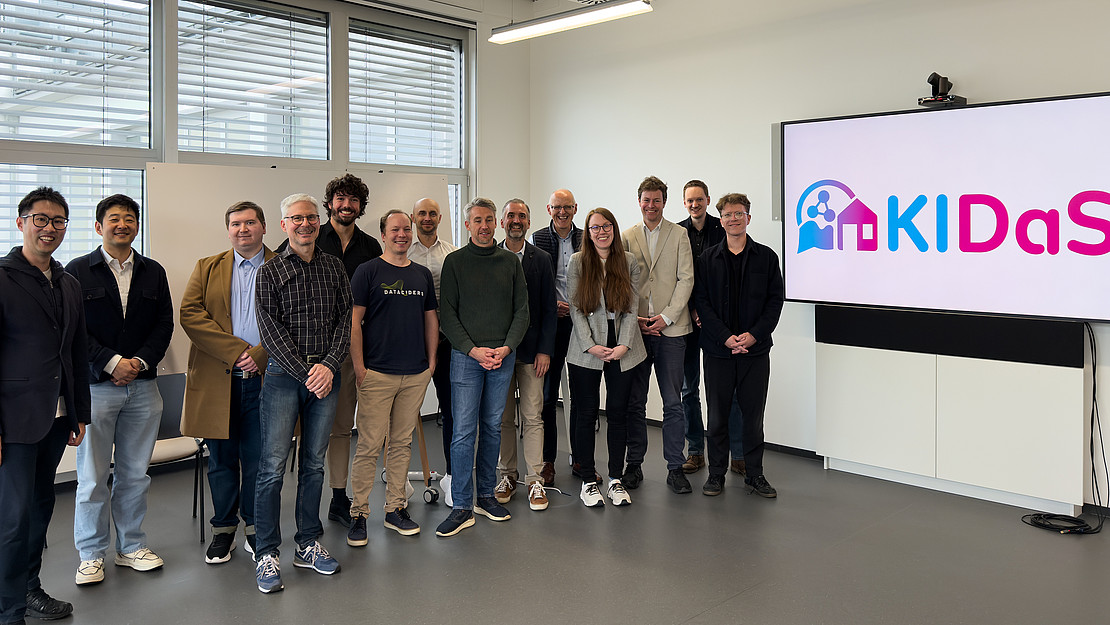 Image: University of Kassel
The kick-off meeting with all four project partners and the project sponsor recently took place in Nuremberg. During the meeting, a common understanding of the objectives was developed and the next steps in the project were agreed.
Over two million people in Germany receive social assistance (Social Code, Twelfth Book - SGB XII). However, many of them have to wait months for their support or do not receive an offer that really meets their needs. The reasons for this include fragmented information systems, incomplete or incorrect data, complex administrative processes and limited data exchange between the organizations involved. In practice, this means a high manual coordination effort for social workers when arranging social services.
Against this background, KIDaS aims to develop an AI-supported data platform that links service providers (e.g. social welfare offices and state welfare associations), service providers (e.g. social institutions and advice centers) and service recipients. The University of Kassel, represented by the Department of Information Systems (Prof. Jan Marco Leimeister), is responsible for research into responsible AI. A central component of the platform is the use of specialized AI agents that access existing data sources and take on clearly defined tasks. For example, AI agents can act as web crawlers to automatically collect, update and merge relevant information on social services, while other agents act as a kind of "service sonar" to analyze needs, usage patterns and gaps in provision and derive impulses for the further development or redevelopment of social services.
"KIDaS is an important step towards sustainably improving the Coordinator of Social Services," explains Prof. Dr. Jan Marco Leimeister, Head of the Department of Information Systems at the University of Kassel. "By using AI-supported data platforms, fragmented information can be brought together, processes can be made more efficient and social services can be tailored more precisely to the individual needs of service recipients."
At the University of Kassel, design principles are being developed for the AI agents that automatically collect, complete and maintain data. The platform will be designed to ensure value orientation, transparency, fairness and acceptance. In the long term, KIDaS should not only improve the Coordinator of social services, but also promote the exchange of knowledge between actors, establish regional competence networks and serve as an innovation platform for new social-technical solutions.
Project Leader at the University of Kassel is Dr. Mahei Manhai Li and Antonia Tolzin. The practical implementation of the concepts developed at the Kassel site is being carried out in close cooperation with ANLEI-Service GmbH, which is contributing its application-oriented expertise to the development and testing of the platform. In addition to the University of Kassel, FAU is part of the consortium as project coordinator (Chair of Digital Industrial Service Systems, Prof. Dr. Martin Matzner) and Dataciders PRODATO GmbH is the second industrial partner. In addition, so-called value partners have already been acquired, including the State Welfare Association of Hesse (LWV), the Regional Association of Westphalia-Lippe (LWL), the Regional Association of the Rhineland (LVR) and Barthildisheim e. V. These partners contribute their technical and practical expertise and support the project in defining requirements, validating the AI agents and testing them in real application contexts.
The research project will run for three years. It is funded with over 1.9 million euros by the Federal Ministry of Research, Technology and Space (BMFTR) as part of the funding measure "Benefits in data ecosystems: Competition - Communication - Cooperation (DigiNutzenDat)" funding measure.
Contact:
Prof. Dr. Jan Marco Leimeister
Tel: 0561 804-6064
E-mail: leimeister[at]uni-kassel[dot]de