
Crane Masters
The content on this page was translated automatically.
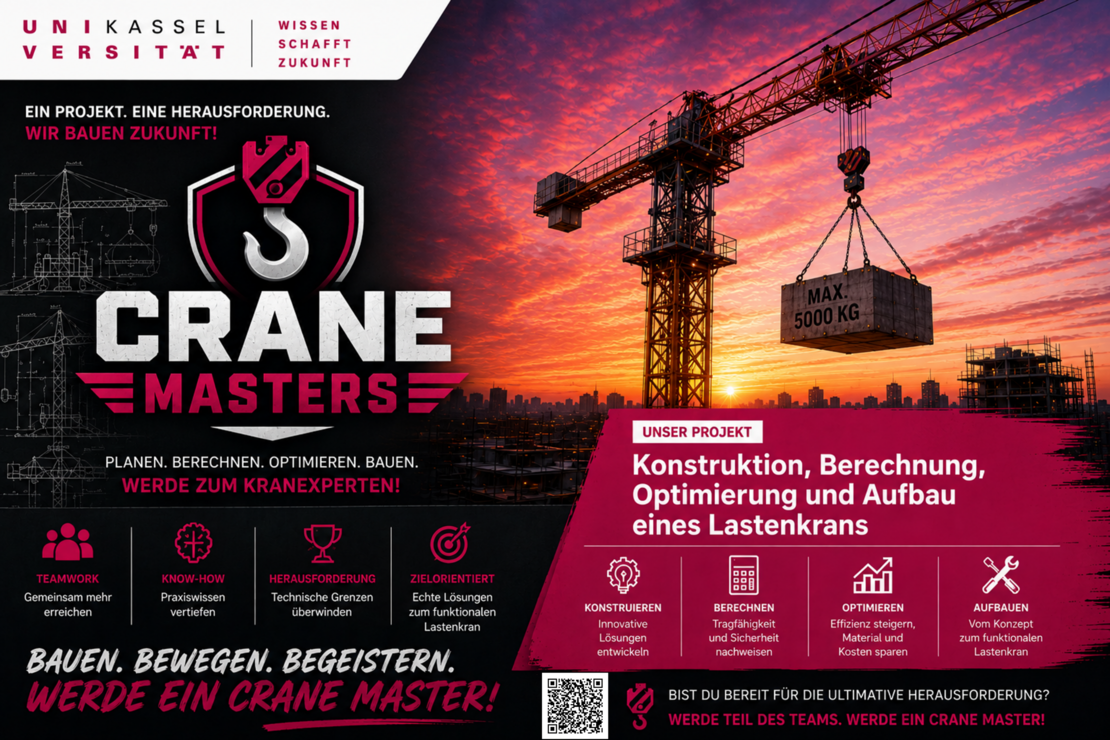
Crane Masters is a three-semester project in which you’ll learn about the entire development process of an engineering product—from the initial idea through design and manufacturing to experimental validation and optimization. Working in interdisciplinary teams, students develop a model crane, applying methods from design, strength of materials, CAD, manufacturing technology, measurement technology, and simulation in a practical setting.
The focus is on project-based work: Students take responsibility for the entire development process, make design decisions based on technical calculations, and verify their results experimentally. This fosters not only technical skills but also teamwork, project organization, and engineering thinking.
Here's what our project participants can expect
- Design and CAD: From the first hand-drawn sketch to a complete 3D CAD model, students develop their own model crane and gain hands-on experience with the systematic design process.
- Calculation and Design: Load cases are defined, strength analyses are performed, and designs are technically optimized for load-bearing capacity, stability, and functionality.
- Optimization: Various design variants are analyzed, evaluated in terms of weight, material usage, and performance, and then improved.
- Manufacturing and Assembly: The developed components are manufactured independently in the workshops and then assembled into a fully functional model crane.
- Experimental Measurement Techniques: Load tests as well as measurements using strain gauges (SG) and Digital Image Correlation (DIC) enable the investigation of actual load-bearing and deformation behavior.
- Simulation and Validation: Numerical calculations and simulations are compared with the experimental results to verify and further develop the models.
- Lightweight Construction and Innovation: In the final project semester, students optimize existing designs using modern methods of numerical optimization and lightweight construction.
- Team-Based Project Work: Throughout the project, students work together in small teams, independently organize their development process, and present their results at the end of each project phase.
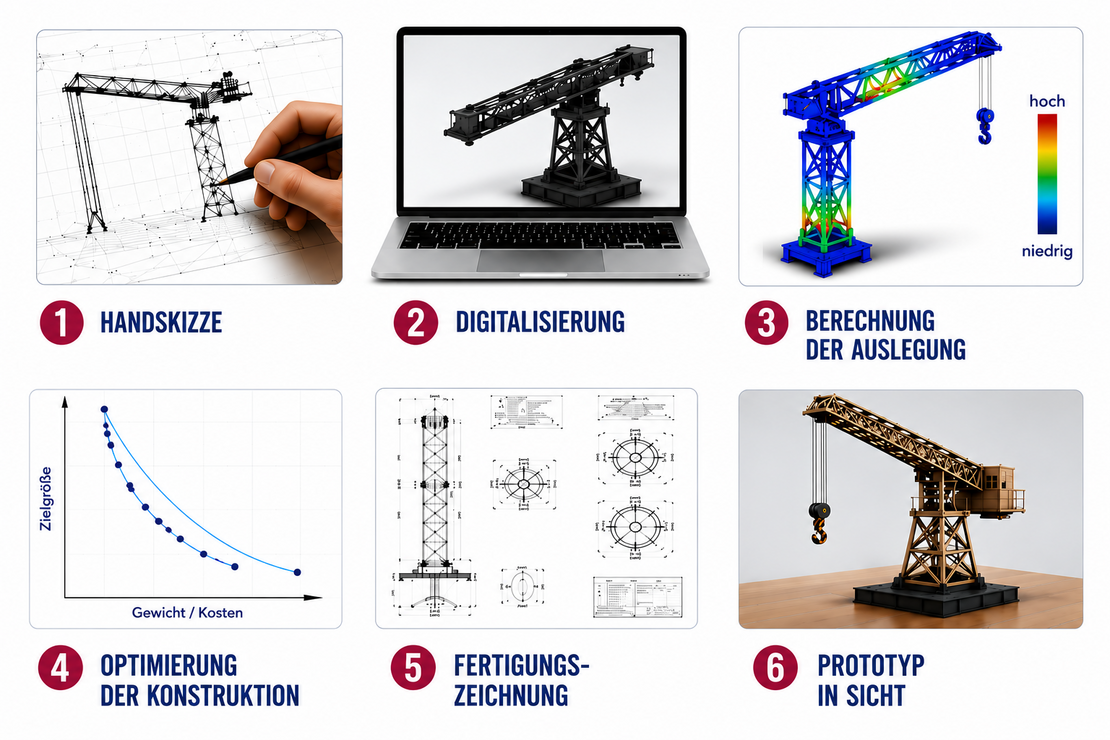
1. Hand-drawn sketches: You’ll develop initial ideas for your crane, create hand-drawn sketches, and evaluate the feasibility of various concepts.
2. Digitalization: You will then convert your idea into a 3D CAD model and further develop the design down to the individual assemblies.
3. Design Calculations: You’ll define the load cases for your crane, perform the necessary strength analyses, and verify the design.
4. Design optimization: Based on the calculations, you’ll compare different variants and improve your design in terms of stability, weight, and function.
5. Manufacturing Drawings: Finally, you’ll create manufacturing drawings and bills of materials that comply with standards as the basis for building your crane.
6. Prototype in Sight: With a complete design and all manufacturing documents, your crane is ready for production and the subsequent presentation.
From Idea to Design
1. Manufacturing: You will manufacture the components of your crane independently using the workshop’s existing machines and equipment. In the process, you will gain hands-on manufacturing experience and implement the design documents on your own.
2. Assembly: You will then assemble the manufactured components into your crane and check its function and dimensional accuracy.
3. Load Testing: In the next step, you will conduct load tests on your crane to experimentally investigate its load-bearing and deformation behavior.
4. Strain Gauges/DIC: During the tests, you will record the strains and deformations occurring in your crane using strain gauges and Digital Image Correlation (DIC).
5. Validation: Finally, you will compare the measured data with your calculation and simulation results to validate your crane model.
From Design to Reality
1. Analysis of a Given Crane Model: You will analyze a crane and evaluate its load-bearing behavior, weak points, and potential for optimization using professional software tools.
2. Numerical optimization: Using numerical methods, you will develop improvements for this crane and make targeted adjustments to its design.
3. Comparison of design variants: You will create and evaluate different design variants in terms of load-bearing capacity, weight, and efficiency to identify the best solution.
4. Lightweight Design: You will then optimize the crane according to lightweight design principles, reducing material usage while maintaining the required stability.
5. Simulation: Finally, you will verify the optimized design using simulations and evaluate the effects of the changes made.
Engineering Beyond the Prototype