
Flow³
The content on this page was translated automatically.
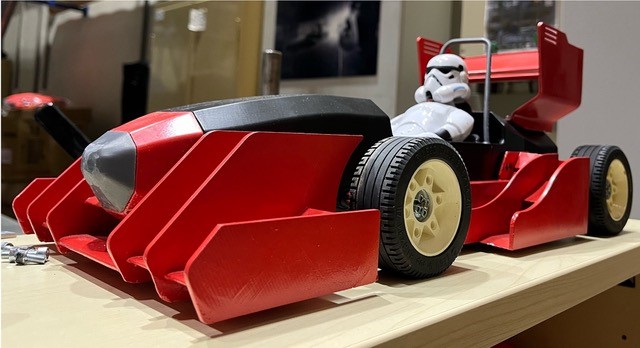
Flow³ is a three-semester project in which you’ll immerse yourself in the world of aerodynamics and not only gain a theoretical understanding of vehicle wings and aerodynamic systems, but also actively develop, test, and improve them. Working together as a team, you’ll explore exciting questions in vehicle engineering—and motorsports in particular—from the initial idea through wind tunnel testing to digital simulation. In the process, you’ll experience fluid mechanics and aerodynamics not as mere theory, but as tools you can use to solve real technical challenges and put your own solutions to the test on the track.
The three projects, which build on one another, combine experimental investigations in the wind tunnel with numerical flow simulations and the development of active aerodynamic systems. Students go through a complete development process—from the experimental investigation of fundamental aerodynamic relationships, through numerical simulation, to the development and testing of an active system.
Here's what our project participants can expect
- Experimental Aerodynamics: In the wind tunnel, students investigate various NACA profiles and analyze the influence of angle of attack and wing geometry on the resulting aerodynamic forces.
- Experimental Design and Measurement Techniques: Students design their own experiments, explore calibration, measurement uncertainties, and error analysis, and learn to systematically evaluate and interpret experimentally obtained data.
- Design and 3D Printing: Based on the experimental results, students design front and rear wings according to the specifications of Formula Student Germany. The designed components are manufactured using 3D printing and tested on a 1:6 scale vehicle model.
- Numerical Flow Simulation: Using CFD methods, aerodynamic components and the entire vehicle model are numerically analyzed. In the process, students learn to build simulation models, define boundary conditions, and evaluate flow fields and pressure distributions.
- Simulation and Validation: The results of the numerical simulations are compared with experimentally obtained measurement data. Through this process, students learn to validate simulation models and critically evaluate results in terms of their validity.
- Sensors, Actuators, and Programming: Sensors and actuators are integrated into the aerodynamic system and controlled via microcontrollers. Students develop, program, and test the necessary control system.
Students receive an introduction to the fundamentals of flow around airfoils and aerodynamic forces. The focus is on wind tunnel tests using various NACA airfoils. Based on these test results, front and rear wings are designed in accordance with the Formula Student Germany (FSG) regulations, manufactured using 3D printing, and mounted on a 1:6 scale model. This model is tested in the wind tunnel to evaluate its aerodynamic efficiency.
Project Objectives and Content:
• Understanding aerodynamic principles and the forces acting on airfoils
• Experimental design, measurement uncertainties, calibration, and error analysis
• Experimental analysis of different angles of attack and wing geometries
• Design according to Formula Student Germany specifications
• Additive manufacturing (3D printing)
• Interpretation of measurement data for aerodynamic optimization
In Project 2, the aerodynamic components and the entire vehicle model are simulated numerically. The results are compared with the measurement data from Project 1.
Objective and Content:
• Introduction to numerical methods in computational fluid dynamics (CFD)
• Setup, boundary conditions, and execution of CFD simulations (2D and 3D)
• Comparison of simulated and experimental data for validation
• Visualization of flow fields and pressure distributions
• Critical evaluation of simulation results
In the third project, students develop active aerodynamic systems, such as a Drag Reduction System (DRS) based on concepts from Formula 1. These systems are controlled by microcontrollers and regulated by sensors and actuators.
Objectives and Content:
• Development and design of active aerodynamic elements (e.g., DRS)
• Integration of sensors (e.g., for measuring pressure and velocity) and actuators
• Evaluation of response time and system efficiency
• Analysis of energy efficiency and integration into the vehicle concept
• Programming and testing a microcontroller system (e.g., Arduino, STM32)
• Evaluation of the effectiveness of active systems compared to static designs