
Process engineering processes
The content on this page was translated automatically.
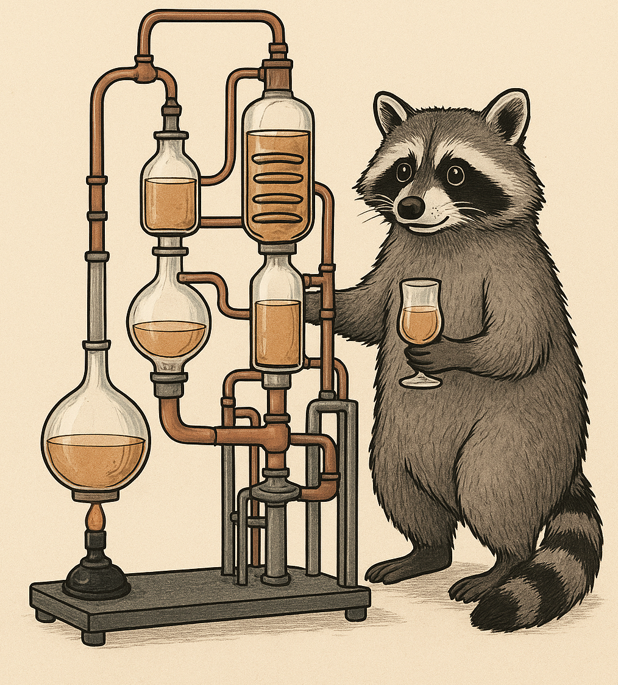
In the "Process Engineering Processes" project series, students design, investigate and optimize different aspects of distillation - one of the central thermal separation processes in process and environmental engineering. Using illustrative experiments, digital methods and a sustainable focus, they deepen their theoretical knowledge and develop practical skills in the areas of thermodynamics, process engineering processes, in particular thermal separation processes, process optimization, digitalization and materials engineering.

In a series of sub-projects, the students work in teams on various tasks that are relevant to the operation and development of a distillation plant. The long-term goal of the project series is to increase the energy efficiency and sustainability of distillation through innovative approaches.
The projects are supported by the Department of Technical Thermodynamics (TTK). The interdisciplinary collaboration - including with the Department of Metallic Materials - gives participants an insight into various areas of research and introduces them to practical, interdisciplinary work.
What our project participants can expect
Calculation and design: Knowledge of thermodynamics and process engineering is applied to calculate energy balances, determine the energy efficiency of the thermal separation process of a distillation plant and check it in experiments.
Design and construction: Students apply their knowledge of design and CAD in practice when designing and optimizing components, e.g. column trays.
Digitalization and measurement technology: Measurement systems and sensors are calibrated and integrated in order to record temperature, pressure and flow data and thus evaluate the energy efficiency of the processes.
Modelling and simulation: Distillation is mapped using suitable models so that process parameters can be simulated and optimization potential identified.
Experimental studies: In practical trials - from the distillation apparatus and the test solution to be separated through to laboratory columns - measurement data is collected and used for further development in an iterative process.
Sustainability: New materials and production methods, such as additive manufacturing, are used to develop innovative solutions for energy-efficient operation.
Competition & teamwork: In a comparative approach, the teams compete against each other to demonstrate the creativity, accuracy and efficiency of their process solutions.
In Project I, participants learn the basics of distillation. Milestones are
Introduction to procedural processes
Construction and operation of a distillation column
Investigation of the thermal separation process and energy efficiency
Initial evaluation and presentation of the results
The focus here is on data processing and modeling approaches for thermal separation processes. The measured data is evaluated, digitized and used to validate the process simulation. The aim is to use digital methods to understand and optimize the energy efficiency of the process. Milestones are:
Development and use of a measurement and data acquisition system
Acquisition and analysis of temperature, pressure and concentration profiles
Introduction to process simulation and data visualization
Validation of the process simulation using own measurement data from Project I
Presentation and systematic data management
This project is being carried out on an interdisciplinary basis with the Department of Metallic Materials at the Institute of Materials Engineering. Optimized column trays for energy-efficient and multi-stage operation are being developed on the basis of process simulation and our own measurement data. These are additively manufactured together with the Department of Metallic Materials. Milestones are:
Development of optimized column trays and selection of sustainable materials
Conception, design and additive manufacturing of column trays
Experimental investigation of the influence of additively manufactured column trays on energy efficiency
Presentation and evaluation in an interdisciplinary team