
This page contains automatically translated content.
Poppies will soon also be available in dark purple
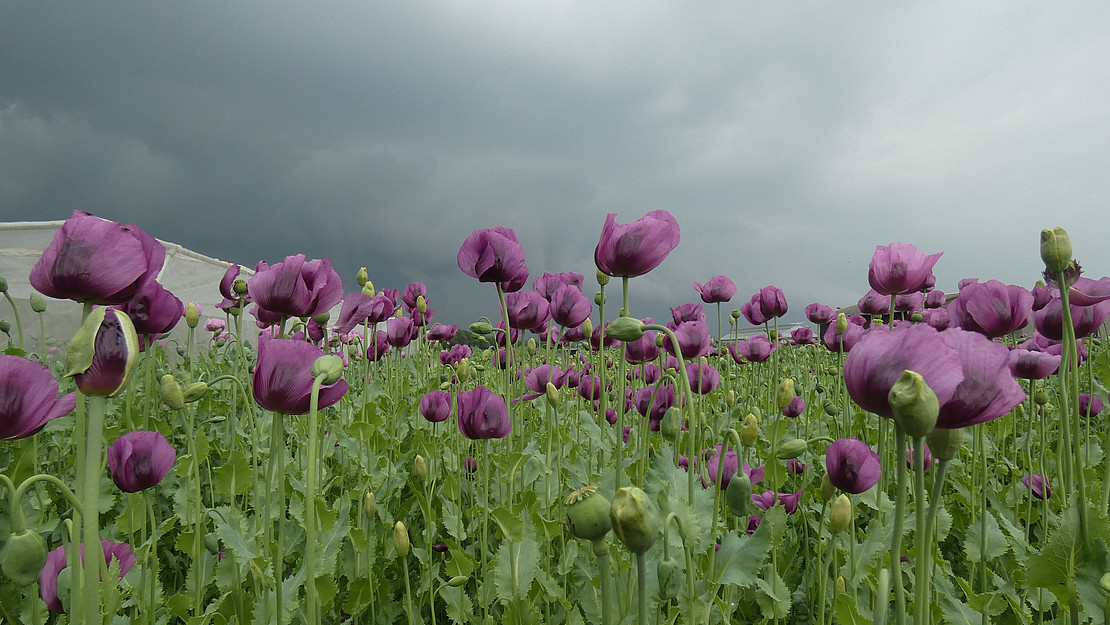 Image: University of Kassel
Pink and magenta flowers as far as the eye can see - this is what it looks like when the poppies bloom in the region's fields in June. But as colorful as the flowers are, cultivation is restricted. In Germany, poppies may only be cultivated under certain conditions. The reason for this is that the poppy plant (Papaver somniferum), also known as the opium poppy, is subject to the Narcotics Act due to its high morphine content. This is because the anesthetic or painkiller opium can be produced from the milky sap of the poppy capsule. Only three strictly controlled, low-morphine varieties are admitted for cultivation in Germany (not to be confused with the wild red poppy in the fields) and are used exclusively as food. Anyone wishing to cultivate or breed poppies requires a cultivation permit from the Federal Opium Agency. For this reason, poppy cultivation is still not very widespread in Germany, with around 1,000 hectares. Yet there is certainly demand for it, as poppy seeds are rich in valuable oils and proteins and are a popular ingredient in baked goods. However, on the shelves of German supermarkets you will mainly find imported poppy seeds from Australia, for example. Expanding domestic cultivation would therefore have ecological and economic benefits, as it reduces dependence on imports and improves the CO2 balance thanks to short transportation routes. As a flowering plant, poppy is also attractive to insects and contributes to biodiversity in the field.
The "Mohnopoly" research project aims to increase the supply of poppies from Germany - in several ways. An interdisciplinary team led by Prof. Dr. Miriam Athmann from the Department of Organic Agriculture and Crop Production at the University of Kassel is investigating how the cultivation of admitted varieties can be increased. And at the same time, which new low-morphine poppy varieties are suitable for regional and site-adapted cultivation in Hesse and Thuringia.
 Image: Uni kassel / Hanna Blum
Project team member Hanna Blum is responsible for the practical trials and is investigating the site conditions of various partner farms in Hesse and Thuringia: "Our aim is to identify varieties that perform well, i.e. deliver high yields, are competitive and at the same time cope well with the specific conditions." To ensure a certified seed supply from organic cultivation, the team is working closely with the Marold farm in Thuringia, which is responsible for seed propagation for the experiments.
It must be worthwhile for farms to grow poppies. In order to guarantee yield and thus supply security, they not only need high-performance, site-adapted varieties, but also important key figures, i.e. information on various agronomic characteristics such as seed yield, plant height and flowering and ripening time. This data is currently lacking. In order to scientifically record precisely these factors, the team is conducting so-called exact trials on the fields of the five participating project farms, for example on the Meißnerhof farm in Germerode, on the Hardthof farm in Naumburg and on the Jung farm in Pohlheim. At the beginning of April, the three approved varieties were sown in narrow strips with three replicates each and monitored regularly. Until the harvest in midsummer, the researchers will investigate when the respective varieties flower, how many capsules they form and how large these are. Later, the oil and protein content of the seeds will be determined in the laboratory in Witzenhausen.
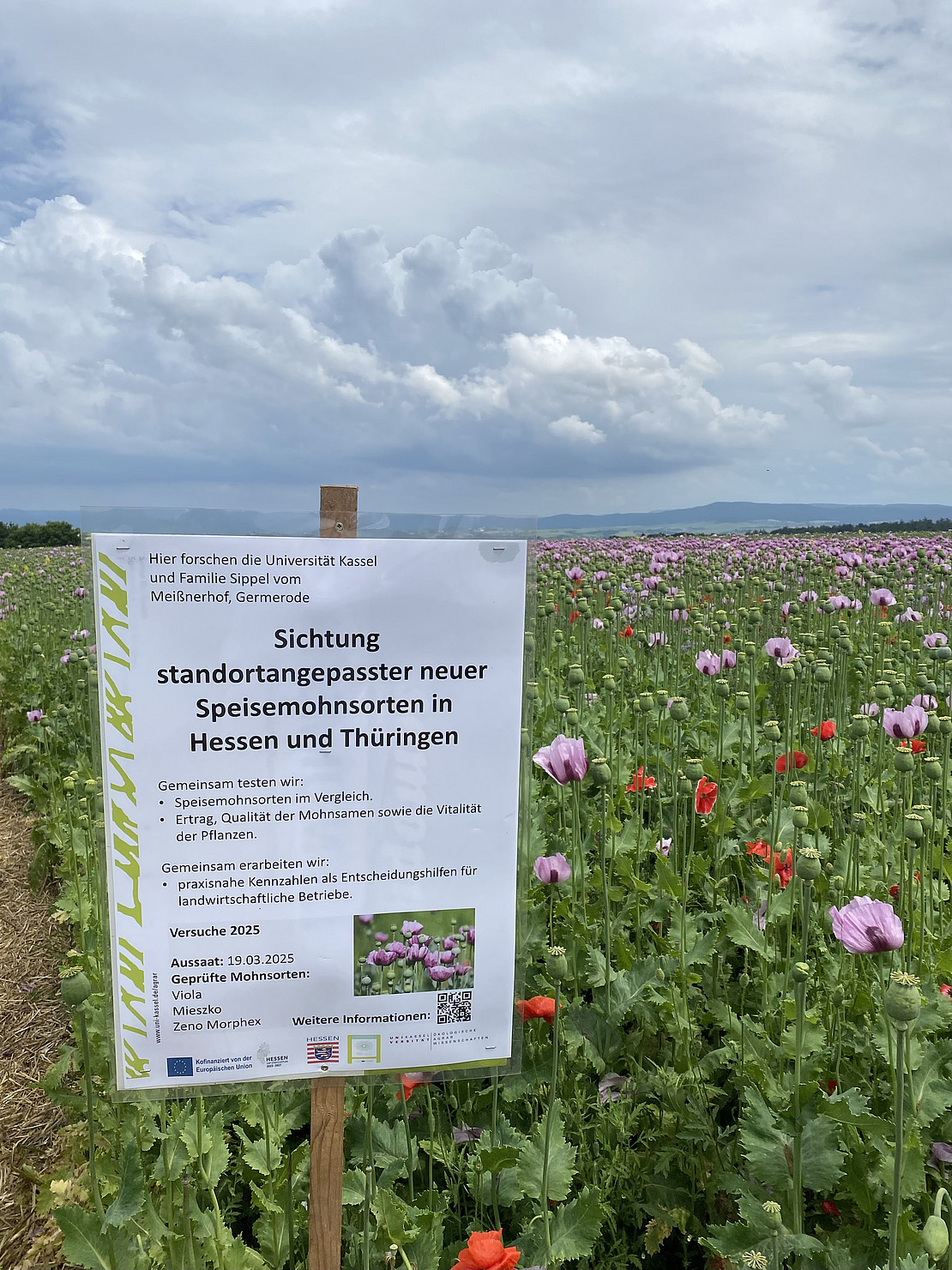 Image: University of Kassel
However, "Poppyopoly" does not stop at strengthening existing varieties. Two new, high-performance poppy varieties are currently being tested on the trial areas of the Frankenhausen domain. The university has a scientific cultivation permit from the Federal Opium Agency for this purpose. The two varieties come from an Austrian breeder and have an improved root system compared to the currently approved varieties. As a result, fuller poppy capsules develop and yields increase. The new varieties also differ visually from the old ones: instead of pink and magenta, they bloom in strong dark red and purple. Blum is confident about the new varieties: "The preliminary trial results are promising. If everything goes according to plan, seed for the new varieties could be available on the market in fall 2026." Germany could then increase its market share in the medium term and establish itself as a supplier of high-quality, sustainable poppies in Europe. And many fields could be even more colorful in June.
This article appeared in the university magazine publik 2025/2. Text: Hannah Eichenberg