
This page contains automatically translated content.
Residual Stress in Materials Science and Engineering 2026
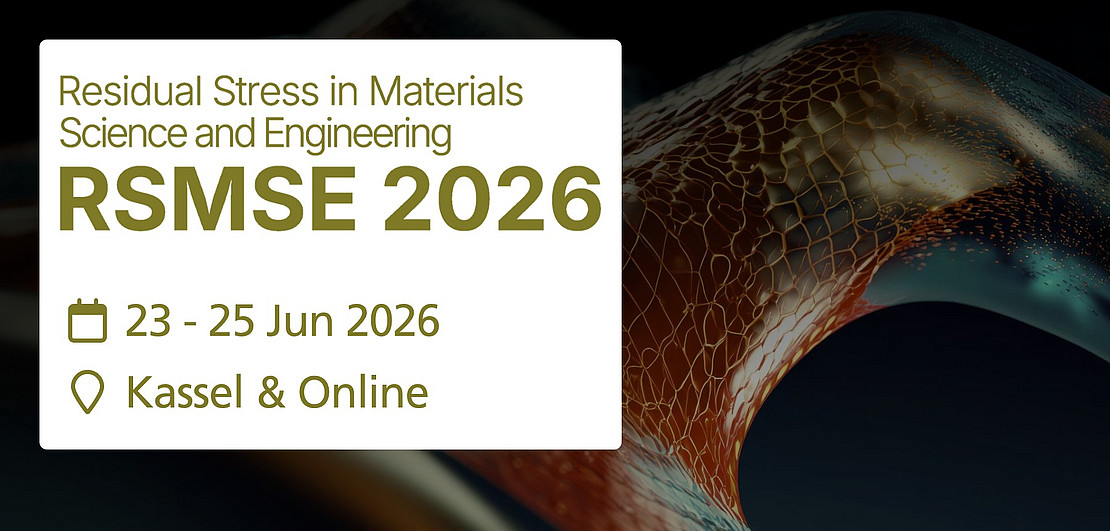 Image: German Society for Materials Science e.V.
Residual stresses are among the most influential yet often overlooked factors affecting the performance, reliability, and lifetime of engineering components.
They originate from diverse sources — mechanical loading, thermal gradients, or manufacturing processes — and can either strengthen or weaken materials depending on their magnitude and distribution. The Residual Stress in Materials Science and Engineering 2026 symposium explores the evolution, analysis, and management of residual stresses.
The symposium addresses the full spectrum of this complex topic: from the fundamental mechanisms behind stress evolution to state-of-the-art methods for analysis and characterization — spanning lab-scale to large-scale methods. Topics include stress development under various thermal and mechanical conditions, advanced experimental and numerical characterization methods, and their influence on the performance of components. A deep understanding of residual stresses is essential for designing more durable and sustainable products, optimizing manufacturing routes, and preventing premature failure.
The symposium will discuss the latest research findings and practical insights on how understanding residual stresses enables improved performance and reliability — from fundamental science to industrial application.
Responsible: Faculty of Mechanical Engineering, Institute of Materials Engineering - Metallic Materials
Contact: Julia Richter (University of Kassel), Stephan Siewert (DGM)
Further information: dgm.de/rsmse/2026