
Kassel research provides new insights into the evolution of a protein family
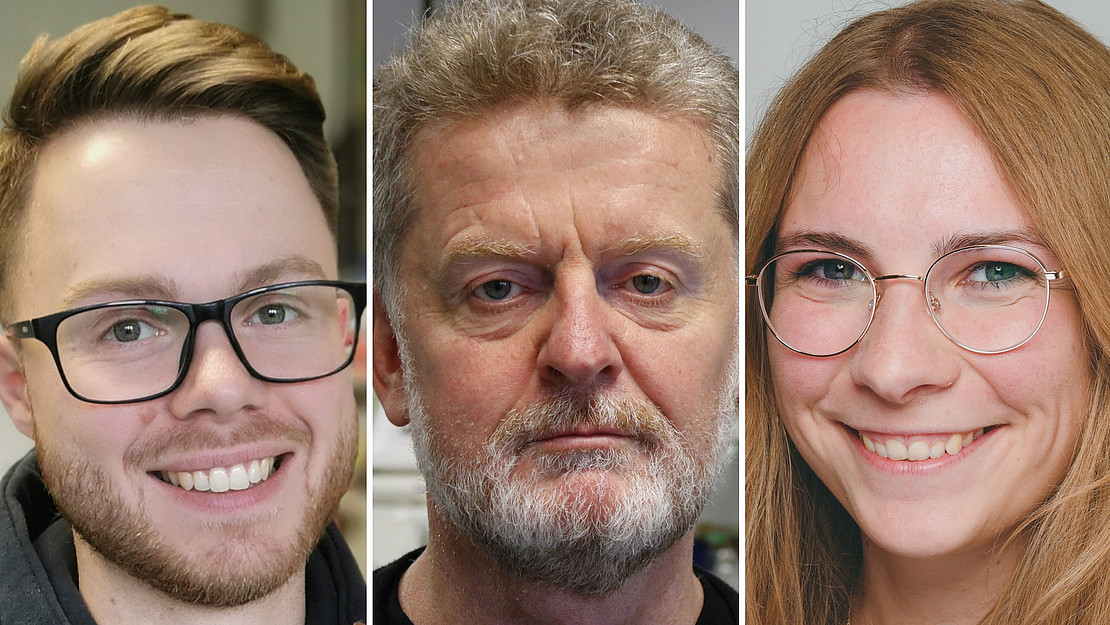
The team led by Prof. Dr. Raffael Schaffrath from the Department of Microbiology has been studying how cells change proteins and RNA (ribonucleic acid) for years. These processes are crucial for cell growth, stress reactions and adaptation to environmental conditions. Her current work focuses on the protein Urm1, which belongs to the so-called ubiquitin-like proteins. These bind specifically to other proteins and thereby alter their stability, activity or function, for example. For Urm1, this process is known as urbimylation. At the same time, Urm1 is also involved in the modification of certain RNA molecules that are important for protein production in the cell. These processes require sulphur and were probably already crucial for survival in the earliest life forms on our planet. The dual function of Urm1 makes it an important model for understanding the evolution of today's protein modification systems.
Kassel PhD students Katharina Zupfer and Lars Kaduhr studied a variant of Urm1 from archaea experimentally in yeast cells. Archaea are microorganisms that exist in extreme habitats and emerged very early in evolutionary terms. It was shown that the archaeal Urm1 protein can be bound to a yeast protein. It therefore supports the basic mechanism of primordial mylation even in the foreign environment of a yeast cell. This is remarkable, as the organisms are separated from each other by billions of years in evolutionary terms, whereas RNA modification with this Urm1 variant does not occur. "Our results suggest that the two functions of this protein have probably developed separately in the course of evolution. The modification of RNA by Urm1 is probably more complex than the modification of proteins," explains Kaduhr. "Other protein modification systems, on the other hand, are highly complex and are associated with many diseases in humans. These could have developed from the original Urm1 system, which could therefore be a kind of intermediate stage in the evolution of this protein family," adds Zupfer. "For us, it was initially astonishing that the archaeal Urm1 protein is formed in the yeast cell at all and that we were able to study it in such detail."
By separating the functions of Urm1, the Kassel research opens up new possibilities for research into individual aspects of this system and its role in the cell. The work also contributes to a better understanding of the origins of today's ubiquitin-like systems. These play a central role in almost all organisms, including humans. In the long term, such findings could also become relevant for medicine, as disorders in protein regulation are involved in numerous diseases, including cancer and neurodegenerative diseases.
The work was carried out at the Institute of Biology at the University of Kassel in collaboration with partners from Johannes Gutenberg University Mainz and was recently published in the journal Communications Biology in the Nature portfolio. It was supported by the German Research Foundation (DFG) as well as internal funding programs of the University of Kassel and B. Braun.
Link to the paper: https://www.nature.com/articles/s42003-025-09212-3
Contact:
Prof. Dr. Raffael Schaffrath
University of Kassel, Faculty of Mathematics and Natural Sciences
Institute of Biology - Department of Microbiology
Tel.: 049 561 804-4175
Email: schaffrath[at]uni-kassel[dot].de